
Metopia argyrocephala
(Meigen, 1824)
satellite fly
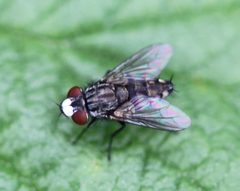
Metopia argyrocephala is a kleptoparasitic satellite fly in the Sarcophagidae. Unlike most kleptoparasitic flies that specialize on either bees or , this has been documented developing in nests of both hymenopteran groups. females follow wasps or bees to their nests and deposit larvae at the entrance, which then crawl inside to parasitize the host's . The species is native to Europe and has been recorded across northern Europe including Belgium, Denmark, Norway, and Sweden.

Pronunciation
How to pronounce Metopia argyrocephala: /mɛˈtoʊ.pi.ə ˌɑːr.dʒɪ.roʊˈsɛf.ə.lə/
These audio files are automatically generated. While they are not always 100% accurate, they are a good starting point.
Identification
First instar larvae can be distinguished from congeneric by specific arrangements of on the maxillary palps and , and by particular thoracic and abdominal spinulation patterns. are difficult to separate from M. argentata, but larval provides reliable diagnostic characters. The species belongs to the kleptoparasitic Miltogramminae, which can be recognized by their of following Hymenoptera to their nests.
Images
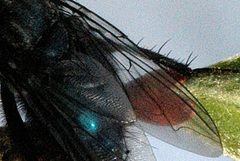
Appearance
not detailed in available sources. First instar larvae possess a strong and well-developed mouth-hooks characteristic of Miltogramminae. Unique larval features include a serrated surface at the tip of the mouth-hook, a base of mouth-hook with lateral arm-like extension, and abdominal segments with transverse furrows ventrally. The body bears longitudinal cuticular ridges on all segments. Larvae of M. argyrocephala can be distinguished from the similar M. argentata by specific arrangements of on maxillary palps and , and by thoracic and abdominal spinulation patterns.
Distribution
Europe: recorded from Belgium (including Walloon Region), Denmark, Norway, and Sweden. The appears to have a northern European distribution based on available records.
Host Associations
- bees - larvae develop in nests
- wasps - larvae develop in nests; unusual among kleptoparasitic flies in using both and wasp
- Clitemnestra bipunctata - confirmed of this sand wasp ; female flies enter burrows and deposit live larvae inside
Life Cycle
First instar larvae described in detail. Females deposit larvae (larviposit) at nest entrances of Hymenoptera. The larvae crawl down the tunnel and become of the host's larval offspring. Larvae feed on paralyzed prey stored by the host , often destroying the host or larva in the process. Complete details not documented.
Behavior
females exhibit kleptoparasitic , following female or bees back to their nests. They deposit live larvae at the lip of the nest entrance, which then enter the burrow to parasitize the host . This behavior has been specifically documented in association with the sand wasp Clitemnestra bipunctata.
Ecological Role
Kleptoparasite ( ) of solitary bees and . Acts as a natural enemy of various Hymenoptera, potentially influencing and nesting success.
Similar Taxa
- Metopia argentata females are otherwise difficult to separate, but first instar larvae show marked morphological and behavioral differences; M. argyrocephala distinguished by specific arrangements and spinulation patterns
- Metopia campestriscongeneric with similar kleptoparasitic ; larval differs in cephaloskeleton details and body surface structures
More Details
Larval morphology
First instar larvae possess several features rare or unique in Miltogramminae: serrated surface of mouth-hook tip, lack of spiracular cavity, base of mouth-hook with lateral arm-like extension, and abdominal segments with transverse furrows ventrally. These structures likely represent adaptations for location and feeding within the nest environment.
Taxonomic note
Formerly placed in Ochleroptera, which was merged with Clitemnestra by Bohart in 2000 for the ; this taxonomic history applies to host associations rather than M. argyrocephala itself.
Sources and further reading
- BugGuide
- Wikipedia
- GBIF taxonomy match
- iNaturalist taxon
- NCBI Taxonomy
- Catalogue of Life
- Bug Eric: Wasp Wednesday: Clitemnestra bipunctata
- Bug Eric: Wasp Wednesday: Ammophila procera
- Bug Eric: Wasp Wednesday: Ant-queen Kidnappers
- Bug Eric: Wasp Wednesday: Beewolves
- Bug Eric: November 2010
- Bug Eric: August 2011
- Comparative morphology of the first instar of three species of Metopia Meigen (Diptera: Sarcophagidae, Miltogramminae)