
Hydrotaea aenescens
(Wiedemann, 1830)
black dump fly, black garbage fly, dump fly
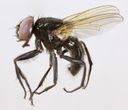
Hydrotaea aenescens, commonly known as the black dump fly or black garbage fly, is a muscid fly native to the New World that has become in Europe. The is notable for its predatory larvae that feed on house fly (Musca domestica) larvae, making it a candidate for programs in livestock facilities. have been documented as of . The species exhibits rapid range expansion in Europe, with records extending to the Far North of European Russia.
Pronunciation
How to pronounce Hydrotaea aenescens: /haɪˈdrɒtiə əˈnɛskɛnz/
These audio files are automatically generated. While they are not always 100% accurate, they are a good starting point.
Identification
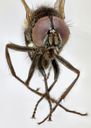
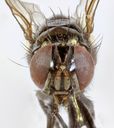
Distinguished from house flies (Musca domestica) by its smaller size, uniformly shiny black coloration, and absence of four dark thoracic stripes. Differs from other Hydrotaea by specific mating and seasonal activity patterns. In the southern Turkey , peak activity occurs in very early spring, which may aid in field identification timing.
Images
Habitat
Breeds in decaying organic matter including manure, wet garbage, and spilled feed in confined animal facilities. Associated with livestock production environments such as dairies, poultry houses, and feedlots where house fly are present.
Distribution
Native to the New World; in Europe with rapid range expansion. Documented in Eastern Europe including the Far North of European Russia, southern Turkey, Azores, and Galápagos Islands. Records from Austria; presence in Belgium considered doubtful.
Seasonality
Peak activity occurs in very early spring in southern Turkey . Activity patterns likely vary with latitude and local climate conditions.
Diet
Larvae are predatory, feeding on larvae of other flies including Musca domestica (house fly) and Scatella (Teichomyza) fusca (urine fly). feeding habits not explicitly documented in available sources.
Host Associations
- Musca domestica - -preyLarvae prey on house fly larvae in manure and decaying organic matter
- Scatella (Teichomyza) fusca - -preyThird instar larvae significantly reduce survival of urine fly larvae in laboratory conditions
- Dermatobia hominis - serve as for
Life Cycle
Complete with four stages: , larva, pupa, and . Development rate temperature-dependent: occurs at approximately 282 hours at 22°C, 174 hours at 27°C, and 126 hours at 32°C under laboratory conditions. Intrapuparial period represents roughly half of total development time.
Behavior
Larvae exhibit active on other dipteran larvae in shared breeding substrates. Courtship and mating differs from other Hydrotaea . disperse and colonize new areas rapidly, facilitating spread.
Ecological Role
Predatory larva that functions as a agent for pest fly , particularly house flies in livestock facilities. As an in Europe, may compete with native dipteran fauna. of parasitic botfly represent a potential veterinary and human health concern.
Human Relevance
Used in programs for of house flies in dairies, poultry houses, and other confined animal facilities. may , creating potential medical concern. status in Europe may impact native biodiversity.
Similar Taxa
- Musca domesticaSimilar size and association; distinguished by gray coloration with four dark thoracic stripes and non-predatory larvae
- Hydrotaea dentipesCongeneric with different mating and seasonal activity patterns
- Ophyra ignavaFormerly congeneric (Ophyra), similar shiny black appearance and ecological role as garbage fly; requires careful morphological examination for separation
More Details
Insecticide Susceptibility
Laboratory studies have examined susceptibility for potential use in programs, though specific resistance profiles not detailed in available sources.
Forensic Relevance
Pupal morphological characters have been identified as potential tools for determining minimum postmortem interval (minPMI) in applications.
Sources and further reading
- BugGuide
- Wikipedia
- GBIF taxonomy match
- iNaturalist taxon
- NCBI Taxonomy
- Catalogue of Life
- Managing External Parasites of Texas Cattle - AgriLife Extension Entomology
- Integrated Pest Management of Flies in Texas Dairies - AgriLife Extension Entomology
- New data on distribution and biology of the invasive species Hydrotaea aenescens (Wiedemann, 1830) (Diptera, Muscidae)
- Development and Intrapuparial Characterization of Hydrotaea aenescens (Diptera: Muscidae) Raised at Different Temperatures Under Laboratory Conditions
- A26 Fundamental studies on house fly control with the larval predator, Hydrotaea aenescens (Diptera : Muscidae) : I. Life cycle and insecticide susceptibility
- Development, survival and fecundity of the urine fly, Scatella (Teichomyza) fusca and predation by the black dumpfly, Hydrotaea aenescens
- Sustained Mass Release of Pupal Parasitoids (Hymenoptera: Pteromalidae) for Control of Hydrotaea aenescens and Musca domestica (Diptera: Muscidae) in Broiler-Breeder Poultry Houses in Arkansas