
Hydrotaea
Robineau-Desvoidy, 1830
Black Dump Flies
Species Guides
6- Hydrotaea aenescens(black dump fly)
- Hydrotaea armipes
- Hydrotaea floccosa
- Hydrotaea houghi
- Hydrotaea ignava(black garbage fly)
- Hydrotaea militaris
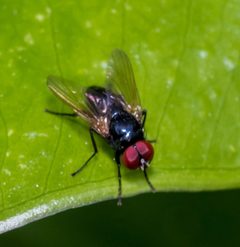
Hydrotaea is a of muscid flies comprising approximately 130 distributed globally, with greatest abundance in warmer climates. are commonly associated with livestock and are frequently found on , decomposing carcasses, and fermenting organic matter. The genus includes significant pest species such as the black dump fly (H. aenescens) and the sheep headfly (H. irritans), which have documented roles in transmission and .
Pronunciation
How to pronounce Hydrotaea: /haɪˈdrɒtiə/
These audio files are automatically generated. While they are not always 100% accurate, they are a good starting point.
Identification
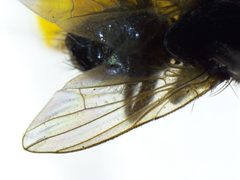
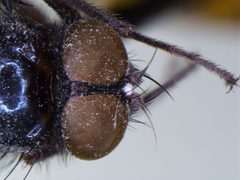
Distinguished from other Muscidae by the metathoracic covered in long, thick setae and the presence of enlarged prestomal teeth in many . The combination of body size (under 9 mm), coloration (light brown to bluish black), and association with decomposing organic matter helps separate Hydrotaea from similar muscid . Species-level identification requires examination of genitalia and other microscopic features.
Images
Habitat
Primarily urban and agricultural environments in warmer regions. are attracted to fermentation and are found in association with vegetation, , and decomposing carcasses, particularly those dead longer than ten days. Larval include manure, decomposing organic matter, and carrion. Some larvae seek shelter underground during cold conditions.
Distribution
distribution occurring in most regions of the world, with greatest abundance in warmer climates. Documented from North and South America, Europe, Asia, and Australia. The H. aenescens, native to the New World, has established across Europe including Eastern Europe and the Far North of European Russia.
Seasonality
Activity varies by and latitude. H. irritans is with activity peaking in mid-July and declining sharply in early August; males are absent after mid-August. H. aenescens shows peak activity during very early spring in southern Turkey. General activity period extends from late spring through summer months in temperate regions.
Host Associations
- Livestock - associated commonly found in proximity to livestock, particularly cattle and sheep
- Mammals - blood-feeding of some feed on mammalian blood and can reopen nearly healed wounds
- Decomposing carcasses - breeding/feedingLarvae develop in carcasses dead longer than ten days; attracted to decay
- Feces - breeding/feedingLarvae commonly develop in manure, particularly in summer months
Life Cycle
Complete with , three larval instars, pupa, and stages. Larvae are often dimorphic obligate : second and third instars are predatory, with first instar also in some . Some species exhibit cannibalistic final instars. Larval size ranges from under 6 mm to 16 mm. bears welts and large with sinuate slits. Developmental time from egg to adult in H. rostrata ranges from 518.4 to 1555.6 hours depending on temperature, with more rapid development at 19–30°C and extended development up to 64.5 days at 12–18°C.
Behavior
exhibit -seeking influenced by carbon dioxide and visual or thermal stimuli. H. irritans females show peak activity between 10:00–18:00 h B.S.T. with maximum activity around 13:00 h; no variation in sex ratio observed. Some larvae can seek shelter underground in cold conditions. H. aenescens exhibits mating behavior that differs from other Hydrotaea .
Ecological Role
Predatory larvae contribute to regulation of other fly , including house flies (Musca domestica) and horn flies (Haematobia irritans). H. aenescens is commercially available for of house flies. serve as indicators of post-mortem interval in forensic investigations, typically colonizing carcasses 4–5 months after decomposition begins. Larvae may feed on other fly larvae including blow-flies.
Human Relevance
Significant veterinary and public health importance. H. irritans is a proven of summer mastitis in cattle, transmitting Staphylococcus aureus, Streptococcus dysgalactiae, Streptococcus uberis, Streptococcus agalactiae, Arcanobacterium pyogenes, Peptostreptococcus indolicus, and Fusobacterium necrophorum. H. aenescens carries Salmonella serovar Infantis. Forensic utility includes post-mortem interval estimation and detection of drug presence in decomposing remains. applications using H. aenescens larvae for house fly management in livestock operations.
Similar Taxa
- Musca domesticaBoth are muscid flies associated with livestock and manure; Hydrotaea distinguished by predatory larvae, metathoracic with long thick setae, and rather than detritivorous larval feeding
- Muscina spp.Similar muscid of other fly larvae; separation requires examination of structure and larval
- Haematobia irritansBoth associated with cattle and blood-feeding; horn flies are obligate blood-feeders with piercing mouthparts and remain on animals, while Hydrotaea has variable mouthparts and different resting
More Details
Forensic significance
Hydrotaea are valuable in . Their presence on a carcass indicates the body was not burned and that the blow-fly phase has ended. H. rostrata may arrive on day two of decay and remain up to 34 days until skeletonization. H. spinigera can comprise 70% of muscid fly on corpses in forested . Absence of larval masses, characteristic of other fly species, is typical of H. rostrata.
Biological control applications
H. aenescens (black dump fly) is commercially reared and sold for control of house flies in livestock facilities. Larvae inhabit fecal material and consume house fly larvae, reducing pest through .
Sources and further reading
- BugGuide
- Wikipedia
- GBIF taxonomy match
- iNaturalist taxon
- NCBI Taxonomy
- Catalogue of Life
- Managing External Parasites of Texas Cattle - AgriLife Extension Entomology
- New data on distribution and biology of the invasive species Hydrotaea aenescens (Wiedemann, 1830) (Diptera, Muscidae)
- The flight activity of the sheep headfly,Hydrotaea irritans(Fallén) (Diptera:Muscidae)