
Hippobosca
Linnaeus, 1758
forest flies, flat flies, iron flies
Species Guides
1- Hippobosca longipennis(dog fly)
Hippobosca is a of louse flies ( Hippoboscidae) comprising seven described . These obligate exhibit dorso-ventrally flattened bodies adapted for clinging to hair or feathers. Unlike many hippoboscids that shed wings after host , Hippobosca species retain fully developed wings throughout life, functioning as temporary that repeatedly leave hosts between blood meals. The genus has broad distribution across Europe, Asia, and Africa, with some species introduced to other regions. Several species are of veterinary and medical significance as of bacterial and protozoan .
Pronunciation
How to pronounce Hippobosca: /hɪpoʊˈbɒskə/
These audio files are automatically generated. While they are not always 100% accurate, they are a good starting point.
Identification
Distinguished from wingless or de-winged hippoboscid (e.g., Melophagus, Lipoptena) by retention of fully developed functional wings in . Distinguished from other winged hippoboscids by combination of: dorso-ventrally flattened body; ; specialized claws; and temporary parasitic habit involving repeated departure. Specific identification to level requires examination of subtle morphological characters including body proportions, coloration patterns, and genitalia structure.
Images
Appearance
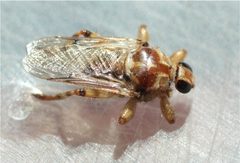
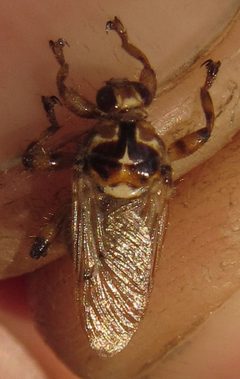
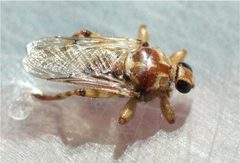
Dorso-ventrally flattened body with hardened , giving a leathery appearance. Fully developed wings retained throughout life. Specialized claws on legs adapted for gripping hair or feathers. positioned ventrally, allowing firm attachment to host skin. for blood feeding. Body shape and texture commonly described as 'flat' or 'iron-like' in appearance.
Habitat
Natural and semi-natural including forests, grasslands, and open rural landscapes. active in sunny, warm to hot conditions with high humidity, preferring windless environments. Optimal activity temperature approximately 25–30°C. Pupae overwinter in protected microhabitats including wall cracks, soil crevices, or ground litter in temperate regions. Increasingly observed in urban and peri-urban areas undergoing anthropogenic .
Distribution
Primary native distribution in Europe, parts of Asia, and Africa. Documented in Transcaucasia (Armenia, Azerbaijan, Georgia, north-western Iran), Egypt, and the Indian subcontinent. Introduced to additional regions including Madagascar, though some have been subsequently reduced through modern animal husbandry practices. Range expansion documented in association with climate change, particularly for H. equina in the Palearctic zone.
Seasonality
In temperate climates, activity occurs primarily May through October, peaking July–August. Mass hatching events observed on hot, humid days. In warmer regions, activity may occur year-round. Typically one per year in temperate zones; pupae overwinter until rising temperatures trigger .
Diet
Obligate ; feed on blood of warm-blooded vertebrates. Feeding frequency varies from several times to over ten times per day depending on and conditions. Blood meals obtained from diverse including equids, cervids, bovids, canids, and birds.
Host Associations
- Equidae (horses, donkeys) - primary well-documented for H. equina; includes and primitive horse
- Cervus elaphus (red deer) - suggested primary proposed as primary European for H. equina
- Bos taurus (cattle) - documented
- Camelus (camels) - H. camelina specific to camels
- Canis lupus familiaris (dogs) - H. longipennis frequently associated with dogs
- Leporidae (rabbits, hares) - documented records
- Alces alces (moose) - documented record
- Capreolus capreolus (roe deer) - documented record
- Ardea cinerea (grey heron) - documented record
- Accipiter gentilis (northern goshawk) - documented record
- Capra hircus (goats) - documented record
- Columbidae (pigeons) - documented record
- Cavia porcellus (guinea pigs) - laboratory used in laboratory rearing studies
Life Cycle
Adenotrophic viviparity with complete . Mating occurs on . Larvae develop through three instars within female , nourished by secretions from uterine glands; larvae lack functional capsules and mouth hooks, with functioning as pump. Female deposits single, weakly motile third-instar larva (pre-pupa) ready to pupate; completed within approximately one hour with pupa enclosed in hardened larval exuvium (). Puparial stage duration variable, up to 30 days at favorable temperatures; may overwinter in temperate climates. Females typically produce 10–15 larvae lifetime (mean approximately 6.2 in laboratory conditions).
Behavior
Temporary : leave after blood ingestion to seek new hosts or deposit larvae. Poor long-distance capability; short-distance flight used for host switching. Rapid movement on host skin surface causing tactile irritation. Host location involves olfactory detection via specialized antennal (coeloconic grooved sensilla, multiporous basiconic sensilla) for medium-to-long range detection, supplemented by visual cues at close range. Movement toward host described as decisive and purposeful rather than exploratory. Adults typically attack singly or in small numbers (rarely more than 3 individuals observed simultaneously on one target).
Ecological Role
impacting welfare through direct irritation, skin damage, and potential secondary . Documented of multiple including Corynebacterium pseudotuberculosis equi, Bartonella spp., Anaplasma spp., Theileria equi, caballi, and Borrelia burgdorferi sensu lato. Bridge vector facilitating pathogen transmission between phylogenetically distant host due to low host specificity. Potential intermediate host for filarial (Acanthocheilonema spp. in H. longipennis).
Human Relevance
Veterinary significance as pest and of domestic animals, particularly equids and dogs. Increasing reports of human attacks with associated anaphylactic reactions. Laboratory research subject for development of artificial feeding techniques. Subject of concern regarding climate change-driven range expansion and emerging disease transmission risks in the Palearctic zone.
Similar Taxa
- Melophagus ovinus (sheep ked)Similar flattened body and ectoparasitic habit; distinguished by complete wing loss in and permanent on sheep
- Lipoptena cervi (deer ked)Similar and general ; distinguished by wing shedding after and more restricted host range
- Stomoxys calcitrans (stable fly)Similar blood-feeding habit and some morphological convergence; distinguished by Muscidae, different wing venation, and non-flattened body form
More Details
Laboratory rearing
H. equina successfully maintained on artificial diets using parafilm feeding with defibrinated bovine blood, achieving survival and reproductive performance comparable to -reared individuals. This technique eliminates logistical constraints of live animal maintenance.
Genomic resources
assembly and annotation completed for H. camelina, including characterization of chemosensory gene involved in location.
Sources and further reading
- BugGuide
- Wikipedia
- GBIF taxonomy match
- iNaturalist taxon
- NCBI Taxonomy
- Catalogue of Life
- Hippobosca equina L. (Hippoboscidae: Hippobosca)—An Old Enemy as an Emerging Threat in the Palearctic Zone
- Biology of hippobosca longipennis (fabricus, 1805) in Egypt (Dipteria: Hippoboscidae)
- The distribution of genus Hippobosca in Transcaucasia
- Studies on Hippobosca maculata Leach and H. equina L. in the Dutch East Indian Archipelago
- Maintenance of Hippobosca equina L. (Dipt., Hippoboscidae) fed through parafilm membrane on defibrinated blood
- Hippobosca longipennis - a potential intermediate host of a species of Acanthocheilonema in dogs in northern India
- Insight into molecular phylogeny and haplotype diversity of the dog louse fly (Hippobosca longipennis) in India.
- Molecular Detection of Theileria equi, Babesia caballi, and Borrelia burgdorferi Sensu Lato in Hippobosca equina from Horses in Spain.
- Data of the study: De Novo genome assembly, annotation, and characterization of chemosensory genes in the camel ked (Hippobosca camelina).