
Melophagus ovinus
(Linnaeus, 1758)
Sheep Ked, Sheep Louse Fly, Sheep Tick
Melophagus ovinus, commonly known as the sheep ked, is a wingless, blood-feeding of domestic sheep. Unlike most flies, females produce one offspring at a time through adenotrophic viviparity—larvae develop internally, feeding on secretions from milk glands, and are deposited as fully-formed that quickly harden into pupae. exhibit strong seasonality, building rapidly in late winter to peak in April–May, then declining through summer. The has a distribution wherever sheep are present and is of veterinary significance, though it is not an effective for Anaplasma ovis.
Pronunciation
How to pronounce Melophagus ovinus: /ˌmɛloʊˈfæɡəs ˈoʊvɪnəs/
These audio files are automatically generated. While they are not always 100% accurate, they are a good starting point.
Identification
Distinguished from ticks (Acari) by having six legs (not eight), visible , and the overall body plan of a fly. Separated from other hippoboscid flies by exclusive association with sheep, permanent winglessness in , and specific body proportions. Lipoptena (deer keds) are winged when young and only secondarily wingless after location; M. ovinus is never winged. Crataerina and Olfersia species parasitize birds, not mammals. The sheep ked's -like appearance combined with confirmed presence on sheep is diagnostic.
Images
Appearance
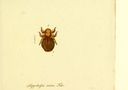
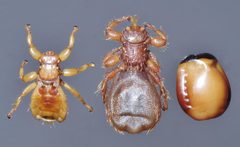
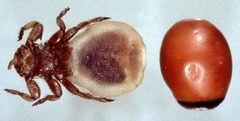
Wingless fly with dorsoventrally flattened, leathery body resembling a . measure 4–6 mm in length. Body covered in short brown hairs. small relative to body. Legs robust with strong claws adapted for gripping wool fibers. No functional wings present in adults (fully ). Tough to crushing.
Habitat
Strictly associated with the fleece of domestic sheep (Ovis aries). Within the fleece, microhabitat use varies seasonally: throat and chest regions favored year-round; chest, lower shoulder, and lower rib wool show greatest concentration during peak (April–May); upper side wool preferred in winter and spring; back and upper sides largely deserted in summer. Pupae are deposited on wool fibers at depths where temperature is suitable for development. Open-fleeced sheep are more susceptible than tight-fleeced individuals.
Distribution
; present wherever domestic sheep are raised. Documented across Europe, North America (including Wyoming, Colorado, and Nuevo León, Mexico), South America (Brazil), and China (Xinjiang). Distribution is -limited rather than climate-limited.
Seasonality
build rapidly during late winter and early spring, reaching maximum in April and early May. Decline begins in May and continues through June; very low numbers persist through summer. On unshorn lambs, decrease continues through summer, possibly due to transference to shorn sheep. Ewes show extended peak if pregnant, continuing increase until parturition (March–April). Rams maintain consistently higher numbers than most sheep classes except pregnant ewes. Second- and third-year animals show smaller peak populations occurring earlier than in first-year sheep, suggesting development of resistance.
Diet
Obligate blood-feeder; both sexes feed exclusively on sheep blood. Feeds by inserting sharp mouthparts into capillaries beneath skin.
Host Associations
- Ovis aries - obligate Domestic sheep; exclusive . Age and breed affect susceptibility: young sheep more susceptible than older animals; open-fleeced breeds more susceptible than tight-fleeced.
Life Cycle
Adenotrophic viviparity: female produces one offspring at a time. hatches in uterus; larva develops internally feeding from milk glands. First pupa deposited ~13 days after female ; subsequent pupae at 7–8 day intervals. Pupal stage lasts 20–26 days (mean 22.5 days). Total completes in 33–36 days. deposited in fleece immediately hardens into true pupa. Newly emerged locate through contact; no free-living larval stage.
Behavior
Spends entire life on ; rarely leaves voluntarily. Vertical in fleece controlled by temperature, not light. Transfers between sheep through direct contact, occurring readily when keds are on fleece surface. Dissemination potential (proportion on surface) varies between individual sheep and increases with bright sunshine due to fleece warming. Males migrate through fleece more than females. Almost completely one-way traffic from ewes to lambs, with transfer rate declining as lambs transition from milk to pasture and contact frequency decreases. Transfer to lambs heaviest during periods of bright sunshine and minimal rain, mediated by increased surface activity on warmed ewes.
Ecological Role
of domestic sheep; causes irritation, wool damage, and reduced productivity. Not a significant for Anaplasma ovis based on experimental evidence. to microbial including Proteobacteria, Bartonella, , Pseudomonas, and Arsenophonus; also associated with (Trypanosoma melophagium, T. theileri). studied extensively for veterinary control purposes.
Human Relevance
Significant veterinary pest of sheep, causing economic losses through reduced wool quality, hide damage, and stress. Summer dipping of lambs proposed as strategy; shearing removes majority of and pupae. Not a human ; will bite humans if given no alternative host but cannot survive or reproduce on human blood. No capacity for human established.
Similar Taxa
- Lipoptena cerviDeer ked; winged when young, secondarily wingless after location, versus permanently wingless M. ovinus. Parasitizes deer, not sheep.
- Lipoptena depressaDeer ked; similar to L. cervi with initial wings lost after location. Host-specific to deer.
- Crataerina pallidaParasitizes common swifts (birds), not mammals. Similar adenotrophic viviparity but association distinguishes it.
- Olfersia spiniferaParasitizes frigatebirds; for (Haemoproteus iwa). Bird , not mammal parasite.
- Pseudolynchia canariensisPigeon louse fly; parasitizes birds, for . Will bite humans experimentally but cannot survive on human blood.
Misconceptions
Frequently mistaken for ticks due to wingless, flattened, hairy appearance and 'sheep tick.' Actually a true fly (Diptera) with six legs, not an arachnid. Despite 'ked' name suggesting deer association, M. ovinus is specific to sheep; deer keds are Lipoptena . Formerly classified in Pupipara, a group name no longer in formal taxonomic use but descriptive of the reproductive strategy.
More Details
Genomic features
assembled at 188.421 Mb with 13,372 protein-coding genes. Shows significant contractions in sensory receptors and vision-associated rhodopsin genes consistent with permanent parasitic lifestyle and narrow . Retains conserved milk protein orthologues supporting adenotrophic viviparity. Diversified from Glossina fuscipes () approximately 72.76 million years ago.
Microbiome
Associated with diverse microbial including Bartonella bovis, Arsenophonus nasoniae, , and . First metagenomic study from Xinjiang, China identified 32 , 372 , and 1037 across and pupae.
Host resistance
Evidence suggests sheep develop resistance to toward end of first year of life, with autumn increases resulting from partial breakdown of this resistance. This explains smaller, earlier peaks in older animals.
Sources and further reading
- BugGuide
- GBIF taxonomy match
- iNaturalist taxon
- NCBI Taxonomy
- Catalogue of Life
- Bug Eric: Louse Flies? Are You "Ked"-ing Me?
- Behold the Hippoboscidae: Bizarre Biting Flies that Give Live Birth!
- The sheep ked, Melophagus ovinus L. I. Dissemination potential
- The distribution and dynamics of ked populations, Melophagus ovinus Linn.
- First record of Melophagus ovinus (Linnaeus, 1758) (Diptera: Hippoboscidae) for Nuevo Leon, Mexico
- The sheep ked, Melophagus ovinus L. II. Keds acquired by a lamb from its mother
- Experimental Elimination of Trypanosoma melophagiumFlu from its Hosts the Sheep and the Ked, Melophagus ovinus (L.)
- Test of the sheep ked Melophagus ovinus (L) as a vector of Anaplasma ovis Lestoquard
- The genome of sheep ked (Melophagus ovinus) reveals potential mechanisms underlying reproduction and narrower ecological niches
- Host-parasite ecology of keds (Melophagus ovinus (L.)) relative to sheep breed and age on Wyoming rangeland
- First metagenomic sequencing for the analysis of microbial community population of Melophagus ovinus and pupae in Xinjiang, China
- Certain Points in the Life History of Melophagus Ovinus Linn, The “Sheep Louse Flyˮ or “Sheep Tick.ˮ
- Studies on the Bionomics of the Sheep Ked, Melophagus ovinus, L., in West Wales
- ANNUAL CYCLES IN NUMBERS OF THE SHEEP KED, MELOPHAGUS OVINUS (L.)