
Lipoptena cervi
(Linnaeus, 1758)
Deer Ked, Deer Fly, European Deer Ked
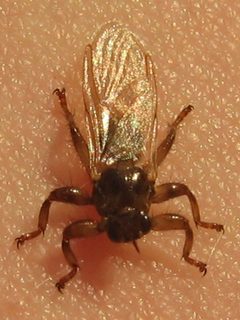
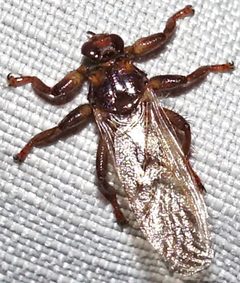
Lipoptena cervi is a blood-feeding ectoparasitic fly in the Hippoboscidae, commonly known as the deer ked or European deer ked. Native to Eurasia, it has been introduced to North America and is now in the northeastern United States. are initially winged but shed their wings after locating a , becoming permanently attached to cervid mammals. The is a significant nuisance to hunters, hikers, and deer processors due to its persistent biting and apparent resistance to common insect repellents.
Pronunciation
How to pronounce Lipoptena cervi: /lɪˈpɒptəna ˈsɛrvi/
These audio files are automatically generated. While they are not always 100% accurate, they are a good starting point.
Identification
are small (5–7 mm), dorsoventrally flattened, and brownish in color. Winged individuals resemble small flies; after attachment, wings are shed leaving characteristic solid semi-cylindrical veinless knobs. The body is adapted for moving through dense host fur with clawed legs. Wingless adults bear a superficial resemblance to ticks, which can cause misidentification. Males measure 2.75–3.75 mm; females are larger at 3.5–4.5 mm.
Images
Habitat
Forested and premountainous areas with cervid . Found in mixed forests on mineral soil, coniferous forests on peat soil, and forest edges. In North America, concentrated in the northeastern United States. Salt licks and moose areas do not appear to increase local ked densities.
Distribution
Native to Europe, Siberia, and northern China; introduced to North America in the 1900s. Established in the northeastern United States. Documented in Bulgaria, Italy, Norway, Finland, United Kingdom, and across Fennoscandia. Undergoing northward range expansion in Finland and Scandinavia.
Seasonality
emerge en masse during a concentrated 4–6 week period in early autumn (August–October in temperate regions) to seek . activity is strongly temperature-dependent. After host attachment, individuals remain on the host for life.
Diet
Obligate blood-feeder on mammalian . Takes multiple small blood meals rather than a single large meal. Documented hosts include elk, deer (red deer, roe deer, deer), moose, reindeer, and occasionally horses, cattle, goats, and humans.
Host Associations
- Cervus elaphus (red deer) - primary
- Capreolus capreolus (roe deer) - primary
- Alces alces (moose) - primary Most abundant in some regions
- Rangifer tarandus (reindeer) - Increasing in southern Finland
- Capra hircus (goat) - accidental Documented in Bulgaria; non-specific with low intensity
- Equus caballus (horse) - accidental
- Bos taurus (cattle) - accidental
- Homo sapiens - accidental Bites cause persistent dermatitis and pruritus
Life Cycle
Females are larviparous, producing one fully developed larva at a time that is deposited on the . Larvae immediately drop to the ground and pupate. emerge from pupae with fully developed wings, fly to find hosts (typically <50 m), then shed wings and remain permanently on the host. Total duration is 270–370 days in Europe, including winter . Pupal development duration and size vary geographically: smaller pupae develop faster, with developmental plasticity allowing to colder northern environments.
Behavior
Mass of winged in autumn creates -like seeking . Flies nearly 50 m to locate hosts. After landing, burrows through haircoat causing progressive wing loss. Causes severe host disturbance including restless , increased , scratching, and shaking in reindeer. Host-seeking activity is temperature-dependent, with high spring and summer temperatures increasing numbers of flying adults.
Ecological Role
of cervids with expanding geographic range. Documented or suspected of multiple including Bartonella schoenbuchensis (with documented), Anaplasma phagocytophilum, and Borrelia burgdorferi. First record of Setaria cervi (filarial ) detected in deer keds suggests potential role in filarial transmission. Harbors endosymbiotic bacterium Candidatus Arsenophonus lipopteni. Range expansion may facilitate of new vector-borne in humans and animals.
Human Relevance
Significant nuisance pest for hunters, hikers, and deer processors in infested regions. Bites often go unnoticed initially but develop into hard, intensely pruritic persisting from weeks to one year. Can cause allergic reactions including dermatitis, rhinoconjunctivitis, and anaphylactic shock. Common insect repellents (DEET, IR3535, picaridin, oil of lemon eucalyptus) are ineffective; permethrin-treated clothing kills keds within 5–15 minutes of contact. Nitrile gloves prevent climbing during deer processing. Light-colored clothing reduces attraction compared to dark colors.
Similar Taxa
- Lipoptena fortisetosa in Italy and elsewhere; co-occurs on same ; L. fortisetosa more abundant at lower altitudes and in southern/eastern areas while L. cervi prefers higher altitudes; asymmetric competition with L. fortisetosa displacing L. cervi at shared body locations
- Lipoptena depressaNative western North American ; similar and
- Neolipoptena ferrisiNative North American deer ked
- Melophagus ovinus (sheep ked)Related hippoboscid with similar but different (sheep); wingless as ; shares related and viral associates
Sources and further reading
- BugGuide
- GBIF taxonomy match
- iNaturalist taxon
- NCBI Taxonomy
- Catalogue of Life
- Meet the Deer Ked: The Fly That Makes Life Tough for Hunters and Hikers
- Bug Eric: Louse Flies? Are You "Ked"-ing Me?
- The Best of 2024 on Entomology Today
- How a Childhood Project Inspired a Life-Long Career
- How One Entomologist Takes a 'One Health' Approach to Engage Across Disciplines
- Pest Management in Deer Farming: First Steps Toward Best Practices
- First record of Lipoptena cervi (Diptera: Hippoboscidae) among goats in Bulgaria
- Bartonella Infections in Deer Keds (Lipoptena cervi) and Moose (Alces alces) in Norway
- Acute impacts of the deer ked (Lipoptena cervi) infestation on reindeer (Rangifer tarandus tarandus) behaviour
- Life Cycle and Distribution Pattern of Lipoptena cervi (L.) (Dipt., Hippobosc.) on Danish Deer
- Efficacy of eprinomectin treatment in a roe deer ( Capreolus capreolus ) infested with Lipoptena cervi and Lipoptena fortisetosa
- Detection of Bartonella schoenbuchensis and a novel sigmavirus within the microbiome of deer keds (Lipoptena cervi) from the United Kingdom
- Phenology of deer ked (Lipoptena cervi) host-seeking flight activity and its relationship with prevailing autumn weather
- Northward invasion of the parasitic deer ked (Lipoptena cervi), is there geographical variation in pupal size and development duration?
- Salt licks do not increase local densities of the deer ked, Lipoptena cervi , an abundant ectoparasite of cervids
- Density of Winged Forms of the Deer Ked Lipoptena cervi (Linnaeus, 1758) in Different Biotopes and Intensity of Infestation of Its Main Host in Leningrad Province
- Fennoscandian distribution of an important parasite of cervids, the deer ked (Lipoptena cervi), revisited
- Genome sequence of Candidatus Arsenophonus lipopteni, the exclusive symbiont of a blood sucking fly Lipoptena cervi (Diptera: Hippoboscidae)
- Interactions between the autochthonous deer ked Lipoptena cervi and the alien L. fortisetosa (Diptera: Hippoboscidae) ectoparasites of Cervus elaphus in Italy: coexistence or competition?
- HAIR-LOSS EPIZOOTIC IN MOOSE (ALCES ALCES) ASSOCIATED WITH MASSIVE DEER KED (LIPOPTENA CERVI) INFESTATION
- Predicting range expansion of an ectoparasite – the effect of spring and summer temperatures on deer ked Lipoptena cervi (Diptera: Hippoboscidae) performance along a latitudinal gradient
- Detection of Bartonella schoenbuchensis and a novel sigmavirus within the microbiome of deer keds (Lipoptena cervi) from the United Kingdom.
- Exploring the vector potential of Lipoptena cervi (Diptera: Hippoboscidae): first record of Setaria cervi (Filarioidea: Onchocercidae) DNA in deer keds.