
Lipoptena
Nitzsch, 1818
deer ked, louse fly, ked fly
Species Guides
3- Lipoptena cervi(Deer Ked)
- Lipoptena depressa(Western American deer ked)
- Lipoptena mazamae(Neotropical deer ked)
Lipoptena is a of louse flies ( Hippoboscidae) comprising approximately 30 described of obligate blood-feeding primarily associated with deer and other cervids. are initially winged but shed their wings upon locating a , becoming permanently attached and resembling ticks in appearance. Several species have expanded their ranges through human-mediated transport of hosts, with L. cervi (European deer ked) now in northeastern North America. Members of this genus are increasingly recognized as nuisance pests for hunters and outdoor recreationists, and as potential of bacterial including Bartonella species.
Pronunciation
How to pronounce Lipoptena: /lɪˈpɒptənə/
These audio files are automatically generated. While they are not always 100% accurate, they are a good starting point.
Identification
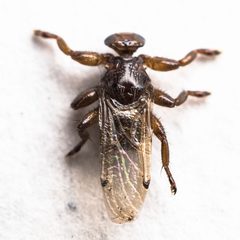
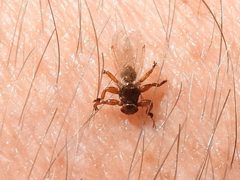
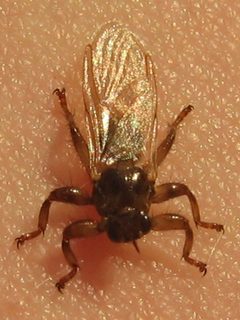
are dorsoventrally flattened with a -like appearance after wing loss. Winged individuals have reduced wings that are shed immediately upon contact; wing bases remain as small stubs. Body size ranges from approximately 3–5 mm. Strongly specialized, talon-like claws on the legs enable clinging to host hair. -level identification requires examination of chaetotaxy (bristle arrangement), genitalia, and subtle differences in body proportions; L. cervi and L. fortisetosa are frequently confused and require microscopic examination of thoracic and abdominal bristle patterns for reliable separation.
Images
Habitat
Primarily associated with forested and woodland supporting cervid . -seeking are found in open areas within or adjacent to deer habitat, particularly along forest edges and trails. On hosts, they occupy areas where fur is thinner or softer, including the surface, legs, and perianal region. Microclimatic conditions influence host-seeking activity, with abundance positively correlated with temperature.
Distribution
Native range spans the Palearctic, with highest diversity in Europe and Asia. L. cervi occurs across Europe and has been introduced to northeastern North America (United States and Canada), where it is established and spreading. L. fortisetosa, native to East Asia, has been introduced to Europe with sika deer and is expanding northward, with records now from Estonia and other Baltic regions. L. mazamae and L. guimaraesi occur in the Neotropics, including Brazil, Uruguay, and the southeastern United States.
Seasonality
-seeking is highly seasonal and varies by . L. cervi exhibits a pronounced autumn emergence in northeastern North America, with adults appearing en masse over a 4–6 week period in early fall (September–October). L. fortisetosa shows spring-to-summer activity in Central Europe, with peak abundance correlated with rising temperatures in May–July. emergence in Neotropical species occurs during the late dry season (September–October in the Pantanal).
Diet
Obligate ; both males and females feed exclusively on blood of mammalian , primarily cervids. Multiple small blood meals are taken from the same host over extended periods, unlike ticks which typically feed once per life stage.
Host Associations
- Cervidae (deer family) - primary groupIncludes roe deer (Capreolus capreolus), red deer (Cervus elaphus), white-tailed deer (Odocoileus virginianus), elk (Cervus canadensis), sika deer (Cervus nippon), pampas deer (Ozotoceros bezoarticus), and brocket deer (Mazama spp.)
- Bovidae - incidental Goats (Capra hircus) documented as for L. cervi in Bulgaria; cattle appear
- Canidae - incidental Dogs reported as for L. fortisetosa in Hungary
- Humans - bite Frequently bite humans during -seeking , particularly in autumn; not considered a permanent host
Life Cycle
Larviparous (pupiparous) ; females gestate a single larva internally, nourished by 'milk' glands. Mature larvae are deposited on the ground, immediately burrow into soil or leaf litter, and pupate without feeding. emerge from as fully formed, winged imagines that must locate a through . Upon host contact, wings are autotomized (self-amputated) and the insect becomes permanently ectoparasitic. Development from larviposition to adult spans several weeks to months depending on temperature.
Behavior
Winged are active, agile fliers that seek through visual and possibly olfactory cues. Attraction to dark-colored clothing has been documented. Upon landing on a suitable host, wings are shed within minutes to hours, after which the insect becomes an obligate , moving rapidly through host pelage to avoid . Individuals cannot climb smooth surfaces such as nitrile gloves. Host-seeking is temperature-dependent, with activity increasing at ambient temperatures above 15°C.
Ecological Role
of wild and domestic ruminants with potential roles as . Documented or suspected transmission of Bartonella spp. (including B. schoenbuchensis), Anaplasma phagocytophilum, and possibly Borrelia burgdorferi between . Heavy may cause localized hair loss, skin irritation, and secondary in cervids. Serve as prey for birds and possibly other .
Human Relevance
Emerging nuisance pest for outdoor recreationists, hunters, and deer processors in invaded ranges. Bites are initially painless but develop into intensely pruritic, hardened persisting from weeks to over a year. Standard insect repellents (DEET, picaridin, IR3535, oil of lemon eucalyptus) are ineffective at preventing bites. Permethrin-treated clothing kills keds within 5–15 minutes of contact but does not prevent landing. Nitrile gloves prevent attachment during deer processing. Potential, unconfirmed role in zoonotic transmission.
Similar Taxa
- Melophagus ovinus (sheep ked)Also a wingless , but permanently associated with sheep and other Bovidae; never winged as , unlike Lipoptena which is initially winged
- Neolipoptena ferrariFormerly included in Lipoptena; distinguished by morphological features of the and , and different associations
- Ixodidae (hard ticks)Superficially similar to wingless keds in size, shape, and on ; distinguished by eight legs (vs. six in insects), lack of , and capitulum (mouthpart structure visible dorsally)
- Hippobosca spp.Related louse flies of similar but typically associated with birds or ungulates in Africa and Asia; differ in wing retention and specificity
Sources and further reading
- BugGuide
- Wikipedia
- GBIF taxonomy match
- iNaturalist taxon
- NCBI Taxonomy
- Catalogue of Life
- wingless deer ked, Lipoptena cervi - Entomology Today
- Lipoptena cervi Archives - Entomology Today
- Meet the Deer Ked: The Fly That Makes Life Tough for Hunters and Hikers
- Bug Eric: Louse Flies? Are You "Ked"-ing Me?
- Parasitism rates of Lipoptena guimaraesi and a new record of Lipoptena mazamae on Ozotoceros bezoarticus from the Central Pantanal wetlands in Brazil
- Efficacy of eprinomectin treatment in a roe deer ( Capreolus capreolus ) infested with Lipoptena cervi and Lipoptena fortisetosa
- Neotropical Deer Ked or Neotropical Deer Louse Fly, Lipoptena mazamae Rondani (Insecta: Diptera: Hippoboscidae)
- Occurrence of Lipoptena mazama and Lipoptena guimaraesi (Diptera: Hippoboscidae) on gray brocket deer (Mazama gouazoubira) in southern Brazil
- Neotropical Deer Ked or Neotropical Deer Louse Fly, Lipoptena mazamae Rondani
- Life Cycle and Distribution Pattern of Lipoptena cervi (L.) (Dipt., Hippobosc.) on Danish Deer
- Two New Haplotypes of Bartonella sp. Isolated from Lipoptena fortisetosa (Diptera: Hippoboscidae) in SE Poland
- A New Bacterium, Corynebacterium lipoptenae, Associated with the Louse Fly, Lipoptena depressa Say
- Temporal-Microclimatic Factors Affect the Phenology of Lipoptena fortisetosa in Central European Forests
- Detection of Bartonella schoenbuchensis and a novel sigmavirus within the microbiome of deer keds (Lipoptena cervi) from the United Kingdom
- The northernmost record of a blood-sucking ectoparasite, Lipoptena fortisetosa Maa (Diptera: Hippoboscidae), in Estonia
- First record of Lipoptena cervi (Diptera: Hippoboscidae) among goats in Bulgaria
- Detection of Bartonella schoenbuchensis and a novel sigmavirus within the microbiome of deer keds (Lipoptena cervi) from the United Kingdom.
- The enigmatic case of Lipoptena sp. in the Bosco della Mesola Nature Reserve (Italy).
- The role of deer keds (Diptera: Hippoboscidae: Lipoptena and Neolipoptena) in occupational and public health.
- Reports of Lipoptena fortisetosa on dogs and in the environment, and evidence of its widespread establishment in Hungary.