
Lipoptena depressa
(Say, 1823)
Western American deer ked
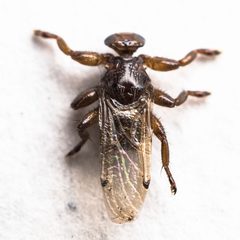
Lipoptena depressa, the Western American deer ked, is a blood-feeding louse fly ( Hippoboscidae) and specialized on deer. are initially winged but shed wings upon locating a , after which they remain permanently on the host animal. The is native to western North America and is one of three Lipoptena species found on the continent.

Pronunciation
How to pronounce Lipoptena depressa: /lɪˈpɒptəˌnə dɪˈprɛsə/
These audio files are automatically generated. While they are not always 100% accurate, they are a good starting point.
Identification
Distinguished from ticks (Ixodidae) by having six legs rather than eight. Differentiated from other deer ked by geographic range: L. depressa occurs in western North America, while L. cervi is found in the northeastern US and eastern Canada, and L. mazamae in the southeastern US and Central/South America. After wing shedding, may be confused with L. cervi; geographic location is the primary distinguishing feature. The winged form could potentially be confused with other Hippoboscidae, but association and range help confirm identity.
Images
Habitat
Associated with deer in western North America, including regions containing the Rocky Mountains. are found on animals; pre-pupal larvae and pupae occur in ground substrate where they fall from hosts.
Distribution
Western United States (Washington, Oregon, California, Idaho, Montana, South Dakota, Colorado, Utah) and Alberta, Canada. Native to this region.
Seasonality
and -seeking activity has been observed in fall (November-December in some regions), though specific timing may vary by location and climate. Mass emergence events can occur over concentrated periods.
Diet
Blood-feeding specialized on deer. take multiple small blood meals from the rather than single large meals.
Host Associations
- Odocoileus hemionus - primary mule deer
- Odocoileus virginianus - primary white-tailed deer
- Odocoileus hemionus columbianus - primary Columbian black-tailed deer
Life Cycle
Females are , producing one larva at a time and retaining it internally through all three instars. The fully developed third-instar larva is born alive (as a pre-pupa), immediately drops from the , buries itself in the ground, and pupates. emerge from pupae with wings, fly to locate a host (limited to approximately 50 meters), shed wings upon host contact, and remain on the host for and feeding. Lifespan on host estimated at 8-13 months, with females producing 4-7 larvae during this period.
Behavior
exhibit limited capability (approximately 50 meters), making location dependent on deer and distribution. Upon finding a host, adults immediately shed wings and become permanently associated with that host. They are highly mobile on the host, dodging attempts and using flattened body shape and clawed legs to slip between hairs and grip hide. Wingless adults remain capable of rapid movement. Do not voluntarily leave hosts except when females give birth to larvae.
Ecological Role
of deer with potential role in transmission dynamics among deer . Heavy (documented at over 2000 flies per ) can cause host discomfort and calcaneus hemorrhages in white-tailed deer, potentially leading to secondary disease or death. Associated with bacterial including Corynebacterium lipoptenae.
Human Relevance
Occasionally misidentified as deer ticks, causing concern among hunters and hikers. Rarely bites humans; documented human bites are few and typically associated with handling infested deer carcasses. Not known to human . Can be a nuisance to hunters and deer processors during fall hunting season. Standard insect repellents (DEET, picaridin, etc.) have been shown ineffective against deer keds in studies of related ; permethrin-treated clothing may increase mortality upon contact.
Similar Taxa
- Lipoptena cerviSimilar winged-then-wingless and -like appearance after ; distinguished by geographic range (northeastern US and eastern Canada vs. western range of L. depressa) and by L. cervi being introduced from Europe
- Lipoptena mazamaeSimilar and ; distinguished by geographic range (southeastern US, Central and South America)
- Ixodes scapularis (deer tick)Frequently misidentified due to similar size, flattened shape, and blood-feeding on deer; distinguished by having 6 legs (insect) vs. 8 legs (arachnid), and by L. depressa being more -specific and mobile
Misconceptions
Commonly misidentified as ticks due to wingless, flattened appearance on . Despite being blood-feeding , they are not known to transmit to humans, contrary to assumptions based on their similarity to ticks. Reports of increasing bites on humans in some regions may refer to the introduced L. cervi rather than the native L. depressa.
More Details
Population density
on individual deer can exceed 2000 flies, causing measurable distress.
Disease associations
Has been found carrying bacterial including Anaplasma phagocytophilum, Bartonella spp., and Borrelia burgdorferi in related deer ked , but competence for transmission to humans has not been established. Associated with the described bacterium Corynebacterium lipoptenae.
Climate change implications
Recent literature suggests deer ked ranges may be expanding with climate change, potentially increasing encounters with humans and altering transmission dynamics in deer .
Sources and further reading
- BugGuide
- Wikipedia
- GBIF taxonomy match
- iNaturalist taxon
- NCBI Taxonomy
- Bug Eric: Louse Flies? Are You "Ked"-ing Me?
- Meet the Deer Ked: The Fly That Makes Life Tough for Hunters and Hikers
- Remarkable Bat Discoveries from the ZooKeys Archives | Blog
- A New Bacterium, Corynebacterium lipoptenae, Associated with the Louse Fly, Lipoptena depressa Say
- NOTES ON THE LIFE HISTORY AND MORPHOLOGY OF CEPHENEMYIA JELLISONI TOWNSEND AND LIPOPTENA DEPRESSA SAY, TWO DIPTEROUS PARASITES OF THE COLUMBIAN BLACK-TAILED DEER (ODOCOILEUS HEMIONUS COLUMBIANUS (RICHARDSON))