
Lipoptena mazamae
Rondani, 1878
Neotropical deer ked, Neotropical deer louse fly
Lipoptena mazamae is an obligate blood-feeding ectoparasitic fly in the Hippoboscidae. emerge winged from , then shed their wings permanently upon locating a suitable . The is primarily associated with white-tailed deer (Odocoileus virginianus) in the southeastern United States and red brocket deer (Mazama americana) from Mexico to northern Argentina. Both sexes feed on host blood. Females are larviparous, retaining and nourishing a single larva internally until it is ready to pupate.
Pronunciation
How to pronounce Lipoptena mazamae: //lɪˈpɒptɪnə məˈzɑːmiː//
These audio files are automatically generated. While they are not always 100% accurate, they are a good starting point.
Identification
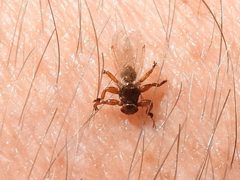
are frequently misidentified as ticks due to their wingless, flattened appearance on . Unlike ticks, deer keds are insects with six legs and will move rapidly through host fur when disturbed. Winged individuals may be found near hosts during periods. The combination of small size, brown coloration, dorsoventral flattening, and rapid movement distinguishes them from other .
Images
Appearance
Small, dorsoventrally flattened brown fly. Females measure 3.5–4.5 mm in body length; males are smaller at approximately 3 mm. possess a tough, protective . Wings are present at but are shed after acquisition, leaving wingless adults permanently attached to hosts. Strongly specialized claws are present for clinging to host pelage.
Habitat
Associated with forested and woodland supporting of cervid . Found directly on host animals; winged dispersing may be encountered in near host habitat. One record from the Central Pantanal wetlands of Brazil suggests adaptability to open wetland habitats where suitable hosts occur.
Distribution
Southeastern United States; Mexico through Central America to northern Argentina. Records from Brazil (Paraná, Mato Grosso do Sul, Pantanal region), Venezuela, and Campeche, Mexico. GBIF distribution records include Colombia (Rionegro) and multiple Brazilian states (Amazonas, Mato Grosso do Sul, Mato Grosso, Pará, Paraná, Rio Grande do Sul, Santa Catarina, São Paulo).
Seasonality
Winged emerge from and seek ; in related this occurs during specific seasonal windows. One study from Brazil recorded winged individual in September–October (late dry season).
Diet
Obligate blood-feeding . Both males and females feed on blood.
Host Associations
- Odocoileus virginianus (white-tailed deer) - primary Southeastern United States and Central America
- Mazama americana (red brocket deer) - primary Mexico to northern Argentina
- Mazama gouazoubira (gray brocket deer) - primary Southern Brazil
- Ozotoceros bezoarticus (pampas deer) - incidental Single record from Central Pantanal, Brazil; considered incidental
- Bos taurus (domestic cattle) - incidental Wikipedia source; considered incidental
- Puma concolor (cougar) - incidental Wikipedia source; considered incidental
- Homo sapiens (humans) - incidental Wikipedia source; considered incidental
Life Cycle
Females are larviparous, producing one larva at a time and retaining it internally. The larva feeds on secretions from a milk gland in the female uterus. After three larval instars, a white pre-pupa is deposited; it immediately forms a hard, dark . The pupa is typically deposited where the has rested. emerge winged, fly to locate a host, then permanently shed their wings and remain attached to that host.
Behavior
are highly mobile on pelage, rapidly dodging attempts to capture them. Winged individuals actively fly to locate hosts. Upon host acquisition, wings are broken off and the individual becomes permanently associated with that host. Non-aggregate distribution pattern observed on hosts; tends to occupy body areas and legs, especially near genitals and where fur is softer.
Ecological Role
of cervid mammals. Potential of blood-borne including Bartonella and . Molecular evidence suggests possible role in transmission of Trypanosoma (Megatrypanum) perronei between white-tailed deer. of 73% for Candidatus Bartonella odocoilei n. sp. documented in one Mexican .
Human Relevance
Incidental bites to humans have been reported, though the is primarily a wildlife . Considered a nuisance to hunters handling infected deer. Potential zoonotic concern due to association with Bartonella and other , though competence for human transmission remains unproven. Standard insect repellents (DEET, picaridin, IR3535, oil of lemon eucalyptus) have been shown ineffective against related deer ked species; permethrin-treated clothing causes mortality.
Similar Taxa
- Lipoptena cervi (European deer ked)Similar wingless appearance and ; in northeastern North America. Distinguished by geographic distribution and associations (primarily cervids in Eurasia and northeastern USA).
- Lipoptena guimaraesiCo-occurs on some deer in South America; distinguished by morphological features and primary association with pampas deer (Ozotoceros bezoarticus).
- Lipoptena depressaRelated western North American ; distinguished by geographic range and associations.
- Ticks (Ixodida)Frequently misidentified due to wingless, flattened appearance on . Distinguished by having six legs (eight in ticks), rapid movement, and insect body plan.
Misconceptions
Commonly misidentified as ticks due to wingless, flattened appearance on . This confusion is exacerbated by the habit of shedding wings immediately upon host acquisition.
More Details
Pathogen associations
Known to carry several Bartonella including Candidatus Bartonella odocoilei n. sp. with 73% in one Mexican study. Associated with Trypanosoma (Megatrypanum) perronei in Venezuelan white-tailed deer, with 38% of ked guts testing positive. competence for these has not been definitively established.
Taxonomic note
Catalogue of Life lists this as a synonym under Lipoptenella mazamae, though most sources including GBIF, NCBI, and primary literature maintain Lipoptena mazamae as the accepted name.
Sources and further reading
- BugGuide
- Wikipedia
- GBIF taxonomy match
- iNaturalist taxon
- NCBI Taxonomy
- Catalogue of Life
- wingless deer ked, Lipoptena cervi - Entomology Today
- Lipoptena cervi Archives - Entomology Today
- Meet the Deer Ked: The Fly That Makes Life Tough for Hunters and Hikers
- Bug Eric: Louse Flies? Are You "Ked"-ing Me?
- Neotropical Deer Ked or Neotropical Deer Louse Fly, Lipoptena mazamae Rondani
- Parasitism rates of Lipoptena guimaraesi and a new record of Lipoptena mazamae on Ozotoceros bezoarticus from the Central Pantanal wetlands in Brazil
- Neotropical Deer Ked or Neotropical Deer Louse Fly, Lipoptena mazamae Rondani (Insecta: Diptera: Hippoboscidae)
- NEW RECORD OF LIPOPTENA MAZAMAE (RONDANI, 1878) AS A MAZAMA GOUAZOUBIRA (FISCHER, 1814) PARASITE IN SOUTHERN BRAZIL
- Pan-American Trypanosoma (Megatrypanum) perronei sp. n. in white-tailed deer (Odocoileus virginianus) and its deer ked Lipoptena mazamae: morphological, developmental and phylogeographical characterisation
- Pan-American Trypanosoma (Megatrypanum) perronei sp. n. in white-tailed deer (Odocoileus virginianus) and its deer ked Lipoptena mazamae: morphological, developmental and phylogeographical characterisation
- Detection of Candidatu s Bartonella odocoilei n. sp. in Lipoptena mazamae associated with white‐tailed deer in Campeche, Mexico
- Pan-American Trypanosoma (Megatrypanum) trinaperronei n. sp. in the white-tailed deer Odocoileus virginianus Zimmermann and its deer ked Lipoptena mazamae Rondani, 1878: morphological, developmental and phylogeographical characterisation
- Occurrence of Lipoptena mazama and Lipoptena guimaraesi (Diptera: Hippoboscidae) on gray brocket deer (Mazama gouazoubira) in southern Brazil