
Melophagus
Latreille, 1802
sheep ked, sheep louse fly, sheep tick
Species Guides
1- Melophagus ovinus(Sheep Ked)
Melophagus is a of wingless, blood-feeding flies in the Hippoboscidae. All are obligate of cloven-hoofed mammals in the family Bovidae, particularly sheep, cattle, goats, and related wild species. The genus is native to Europe, Asia, and North Africa, but M. ovinus has been introduced worldwide with domestic sheep. These insects spend their entire on the , with females giving birth to pupae that attach to wool fibers.
Pronunciation
How to pronounce Melophagus: //məˈlɒfəɡəs//
These audio files are automatically generated. While they are not always 100% accurate, they are a good starting point.
Identification
Distinguished from other Hippoboscidae by winglessness combined with association with Bovidae . Differs from Lipoptena (deer keds) by host specificity and morphological characters including scutellar setae number and scutellum shape. M. ovinus specifically identified by association with domestic sheep; other Melophagus distinguished by subtle morphological differences in setation and body proportions. Identification to species level requires examination of scutellar setae count, scutellum , and abdominal setae characteristics.
Images
Appearance
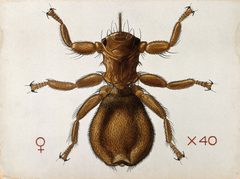
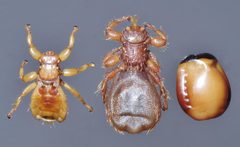
Wingless, dorsoventrally flattened flies with a -like appearance. Body compact and leathery, adapted for clinging to hair and wool. All lack functional wings. Specific morphological characters distinguishing species include number of scutellar setae, scutellum , abdominal setae length and thickness, and body coloration.
Habitat
Strictly -associated; found exclusively on the body surface of live bovid mammals. Within host fleece, distribution varies seasonally: greatest concentration on chest, lower shoulder, and lower rib wool during peak (late winter–spring); throat and chest favored year-round; back practically deserted in summer. Pupae attach to wool fibers at depth where temperature is suitable for development. Open-fleeced sheep more susceptible than tight-fleeced sheep; young sheep more susceptible than older animals.
Distribution
Native to Europe, Asia, and North Africa. M. ovinus introduced worldwide wherever domestic sheep are kept, with confirmed records including Mexico (Nuevo León), and distribution in sheep-raising regions. GBIF records from Denmark, Norway, and Sweden. -specific distributions: M. himalayae (Himalayan region), M. kamtshaticus (Kamchatka), M. kaukasikus (Caucasus), M. pantholopsus (associated with Tibetan antelope), M. rupicaprinus (chamois range), M. storozhenkoi (Eastern Pamir, Tajikistan).
Seasonality
strongly seasonal: rapid buildup during late winter and early spring, peak in April–May, decline beginning May and continuing through June. Summer decrease on unshorn lambs, possibly due to transfer to shorn sheep. Peak infestation of ewes and hoggs occurs before lambing; maximum lamb infestation before shearing. Shearing removes majority of and pupae; dipping kills surviving adults.
Diet
Blood-feeding ; females and males both feed on blood. Specific feeding mechanics not detailed in sources.
Host Associations
- Ovis aries (domestic sheep) - primary Preferred of M. ovinus; worldwide distribution follows sheep husbandry
- Bos taurus (domestic cattle) - Confirmed for
- Capra hircus (domestic goat) - Confirmed for
- Procapra gutturosa (Mongolian gazelle) - Wild
- Rupicapra rupicapra (chamois) - of M. rupicaprinus
- Capra ibex (alpine ibex) - Confirmed
- Bos grunniens (yak) - of M. grunini
- Ovis ammon (argali) - Doubtful records; of M. storozhenkoi (O. ammon polii)
- Ovis canadensis (bighorn sheep) - Doubtful records
- Ovis dalli (Dall sheep) - Doubtful records
- Pantholops hodgsonii (Tibetan antelope/chiru) - of M. pantholopsus
Life Cycle
Pupiparous: females give birth to fully developed larvae that immediately pupate. Female matures in 6–7 days, male in 10–11 days. Copulation occurs ~16 hours after . First pupa deposited ~13 days after female emergence; subsequent pupae at 7–8 day intervals. Pupal stage lasts 20–26 days (mean 22.5 days). Complete : 33–36 days. attach to wool fibers at depth where temperature suitable for development; throat region indicated as possible breeding area. Late spring puparia laid more in lower fleece relative to distribution.
Behavior
Vertical in fleece controlled by temperature, not light. Bright sunshine increases movement to fleece surface (dissemination potential) by raising fleece temperature. Readily transfer between sheep through contact, especially when on fleece surface. Transfer from ewe to lamb predominantly one-way, with rate declining as lamb transitions from milk to pasture. Higher proportion of males in body regions of ewes; males migrate through fleece more than females. Sheep with high dissemination potential act as 'disinfecting agents'—approximately half of departing keds fail to reach new , causing decline in multi-sheep systems.
Ecological Role
Obligate of bovids; no significant role as —experimental evidence indicates M. ovinus is not a mechanical or biological vector of Anaplasma ovis. Microbial includes Proteobacteria ( ), with Bartonella, , Pseudomonas, and Arsenophonus; associated with including Bartonella bovis, Trypanosoma theileri, and potentially others, though vector competence not established for most.
Human Relevance
Veterinary significance as pest of domestic sheep and other livestock. Causes irritation, wool damage, and reduced productivity. Control through shearing (removes and pupae), dipping (kills surviving adults), and summer dipping of lambs to eradicate from flocks. Re- occurs from pupae hatching in fleece or transfer from infested contact sheep. Not a significant of human or major livestock based on available evidence.
Similar Taxa
- LipoptenaOther wingless hippoboscid ; distinguished by association (Cervidae vs. Bovidae) and morphological differences in scutellar setae and scutellum shape
- NeolipoptenaWingless hippoboscid; distinguished by range and morphological characters
Misconceptions
'sheep ' and 'sheep louse fly' are misleading—Melophagus is a true fly (Diptera), not a tick (Arachnida) or (Psocodea). Despite morphological convergence with ticks, these are insects with complete (though pupiparous). Formerly suspected as of Anaplasma ovis; experimental evidence refutes this role.
More Details
Genomic characteristics
M. ovinus assembled at 188.421 Mb, 330 scaffolds, N50 10.666 Mb, GC content 27.74%. Contains 13,372 protein-coding genes. Significant contractions in sensory receptors and vision-associated Rhodopsin genes consistent with narrow and permanent association. Phylogenetic divergence from Glossina fuscipes estimated at 72.76 Mya (Late Cretaceous).
Microbiome
and pupae harbor diverse microbial : 32 , 372 , 1037 . phylum Proteobacteria; dominant genera include Bartonella, , Pseudomonas, Arsenophonus. First reports of Bartonella bovis, Arsenophonus nasoniae, Saitoella complicata (fungus), Orf virus, Wolbachia phage WO, Trypanosoma theileri, and Trichomonas vaginalis from M. ovinus.
Reproductive biology
Females mate only within 24 hours of from , storing sufficient sperm for lifetime production. This severely limited mating window constrains and .
Sources and further reading
- BugGuide
- Wikipedia
- GBIF taxonomy match
- iNaturalist taxon
- NCBI Taxonomy
- Catalogue of Life
- The sheep ked, Melophagus ovinus L. I. Dissemination potential
- The distribution and dynamics of ked populations, Melophagus ovinus Linn.
- First record of Melophagus ovinus (Linnaeus, 1758) (Diptera: Hippoboscidae) for Nuevo Leon, Mexico
- The sheep ked, Melophagus ovinus L. II. Keds acquired by a lamb from its mother
- Test of the sheep ked Melophagus ovinus (L) as a vector of Anaplasma ovis Lestoquard
- Experimental Elimination of Trypanosoma melophagiumFlu from its Hosts the Sheep and the Ked, Melophagus ovinus (L.)
- The genome of sheep ked (Melophagus ovinus) reveals potential mechanisms underlying reproduction and narrower ecological niches
- Host-parasite ecology of keds (Melophagus ovinus (L.)) relative to sheep breed and age on Wyoming rangeland
- First metagenomic sequencing for the analysis of microbial community population of Melophagus ovinus and pupae in Xinjiang, China
- A new species of the genus Melophagus Latreille, 1802 (Diptera, Hippoboscidae) from the Eastern Pamir
- Certain Points in the Life History of Melophagus Ovinus Linn, The “Sheep Louse Flyˮ or “Sheep Tick.ˮ
- Studies on the Bionomics of the Sheep Ked, Melophagus ovinus, L., in West Wales