
Hippobosca longipennis
Fabricius, 1805
dog fly, louse fly, blind fly
Hippobosca longipennis is an obligate blood-feeding ectoparasitic fly in the Hippoboscidae. It primarily infests wild and domestic , particularly canids and hyaenids, but has been recorded on felids and occasionally humans. The is larviparous, with females producing 10–15 larvae during a lifetime of four to five months. It serves as an intermediate for the filarial Dipetalonema dracunculoides (now Acanthocheilonema dracunculoides) and has been implicated as a potential for other . Native to Africa, it has spread to the Middle East, Asia, and parts of Europe through transport on zoo animals and domestic dogs.
Pronunciation
How to pronounce Hippobosca longipennis: //ˌhɪp.oʊˈbɒs.kə ˌlɒn.dʒɪˈpɛn.ɪs//
These audio files are automatically generated. While they are not always 100% accurate, they are a good starting point.
Identification
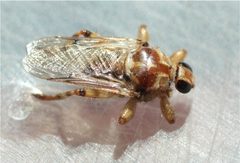
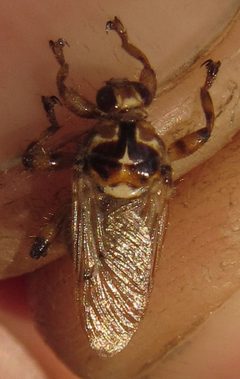
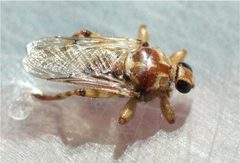
The fly has a dorsoventrally flattened and body adapted for moving through fur. Wings are well-developed with venation concentrated in the half; the specific epithet "longipennis" refers to these relatively long wings. Mouthparts are piercing-sucking, adapted for blood-feeding. Legs possess tarsal claws for gripping host hair. The is morphologically similar to sheep keds (Melophagus ovinus) but can be distinguished by host association and wing characteristics.
Images
Habitat
spend their entire lives within the fur of mammalian . Females temporarily leave hosts to deposit larvae on soil, in cracks or crevices, beneath vegetation, or on debris. The occurs in arid and semi-arid regions across its native range.
Distribution
Native to Africa; established in the Middle East, Asia (including China, India, and Japan), and the Palearctic region south of approximately 45° north latitude. Recorded in Europe from Ireland, Germany, Poland, and Romania. Introduced to North America on multiple occasions via zoo animals (notably cheetahs to the San Diego Zoo in 1970), but eradicated and not established. Occasional records from Sri Lanka, Taiwan, and other fringe areas.
Diet
Blood; feed multiple times daily, completing a blood meal in approximately 8 minutes. Females require feeding at least every 6 hours. Blood meal size ranges from 1.5–4.5 mg per feeding.
Host Associations
- Canis lupus familiaris - primary domestic dogs, preferred
- Crocuta crocuta - primary spotted hyena, wild
- Acinonyx jubatus - cheetah
- Panthera leo - lion
- Felis silvestris - wildcat; domestic cat status debated
- Viverridae - civets and relatives
- Homo sapiens - occasional rare bites reported, painless to -sting sensation
Life Cycle
Larviparous (pupiparous). Larvae develop internally for 3–8 days before deposition. Females produce 10–15 larvae in a lifetime, depositing them on soil, in cracks, under plants, or on debris. Larvae pupate immediately in , which may confer environmental . emerge from puparia 19–142 days after larviposition, typically in morning hours. Females leave approximately 8 times for larviposition, returning to feed and initiate new larval cycles. Adults begin feeding on hosts within a week of ; mating occurs on the host after approximately one week of feeding. Female lifespan is 4–5 months.
Behavior
Strong fliers that actively move between within a group. Moves swiftly through host fur, making capture difficult. emerge from in morning to seek hosts. Feeds multiple times daily. Does not normally travel long distances independently; primarily through host movement. Some hosts (e.g., cheetahs) show minimal response to .
Ecological Role
Confirmed intermediate for Acanthocheilonema dracunculoides (formerly Dipetalonema dracunculoides), a filarial of canids and hyaenids. Confirmed transport host for Cheyletiella yasguri mites, potentially facilitating mite among dogs. Hypothesized mechanical or biological for Leishmania spp. and other , though vector competence remains experimentally unproven for most agents.
Human Relevance
Bites can be painful and cause skin irritation in humans and animals. Serves as intermediate for canine filarial of veterinary importance. Potential for zoonotic . Transport on zoo animals has led to temporary introductions outside native range, requiring efforts. Historical specimens documented from ancient dog corpses in Greece and Egypt, indicating long association with domestic dogs.
Similar Taxa
- Melophagus ovinusSheep ked; similar flattened body and pupiparous , but restricted to sheep and goats, with reduced wings in some
- Hippobosca equinaRelated hippoboscid with similar , but primarily associated with equids rather than
- Lipoptena fortisetosaPotentially hippoboscid with overlapping geographic range in Europe; distinguished by preferences and morphological details
Sources and further reading
- BugGuide
- Wikipedia
- GBIF taxonomy match
- iNaturalist taxon
- NCBI Taxonomy
- Catalogue of Life
- Grasshoppers of Colorado
- Grasshoppers of Colorado
- Grasshoppers of Colorado
- Grasshoppers of Colorado
- List of Species Fact Sheets| Grasshoppers of Wyoming and the West
- High Plains Grasshopper
- Biology of hippobosca longipennis (fabricus, 1805) in Egypt (Dipteria: Hippoboscidae)
- First report of the dog louse fly Hippobosca longipennis in Romania
- Hippobosca longipennis - a potential intermediate host of a species of Acanthocheilonema in dogs in northern India
- Dipetalonema dracunculoides (Cobbold, 1870), from the Dog in Kenya: with a Note on its Development in the Louse-fly, Hippobosca longipennis
- First molecular confirmation of the presence of Hippobosca longipennis (Diptera: Hippoboscidae) and infestation of sheltered dogs in Morocco
- Insight into molecular phylogeny and haplotype diversity of the dog louse fly (Hippobosca longipennis) in India.