
Ochlerotatus triseriatus
(Say, 1823)
eastern treehole mosquito, treehole mosquito
Ochlerotatus triseriatus, the eastern treehole mosquito, is a container-breeding mosquito native to North America. It is the primary enzootic of La Crosse virus, the leading cause of arboviral in children in the United States. Larvae develop in natural tree holes and artificial water-holding containers, feeding on microbial associated with decaying organic matter. The exhibits strong -dependent survival, with larval crowding significantly reducing per-capita survival rates—a trait that has important implications for mosquito control strategies.
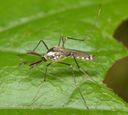
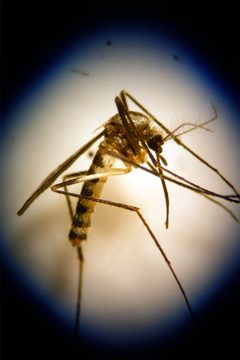
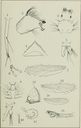
Pronunciation
How to pronounce Ochlerotatus triseriatus: /ˌɒklɛroʊˈteɪtəs ˌtraɪˌsɛriˈeɪtəs/
These audio files are automatically generated. While they are not always 100% accurate, they are a good starting point.
Identification
Ochlerotatus triseriatus is distinguished from similar container-breeding Aedes by its association with tree holes and its role as a for La Crosse virus. It can be differentiated from the Aedes albopictus (Asian tiger mosquito) and Aedes aegypti by morphological keys; genetic analysis confirms its placement in the Ochlerotatus group. are similar in size to related , with female wing length serving as a measurable trait in laboratory studies.
Images
Habitat
Natural tree holes and artificial water-holding containers including discarded tires, cemetery vases, and plastic containers. are characterized by the presence of detritus such as plant matter and dead insects that support microbial growth for larval food.
Distribution
Native to North America; present across the eastern and central United States and southern Canada. GBIF records indicate presence in Caribbean, Middle America, and North America. Absent from Sweden.
Diet
Larvae feed on microbial (bacteria, fungi, and associated biofilms) that develop on decaying organic matter in container . feed on nectar; females require blood meals for production.
Life Cycle
undergo embryonic to survive winter conditions. Larvae develop through four instars in aquatic container . Development time and survival are strongly influenced by larval and nutrient availability. emerge from pupae; time can be shortened when larval density is reduced late in development.
Behavior
Females exhibit specific oviposition , laying in tree holes and containers. Larval feeding activity influences bacterial structure in . Movement and oviposition behavior are linked to spatial distribution patterns.
Ecological Role
Primary enzootic of La Crosse virus, maintaining the virus in wild (particularly in chipmunks and squirrels) and serving as the bridge vector to humans. Influences microbial dynamics in container through larval feeding activity.
Human Relevance
Major public health concern as the primary of , which predominantly affects children under 16 and can cause seizures, paralysis, and coma. Control efforts are complicated by -dependent survival dynamics—partial larval mortality can sometimes increase rather than decrease .
Similar Taxa
- Aedes albopictusAlso a container-breeder and La Crosse virus , but , more associated with artificial containers, and exhibits different -dependent responses to larval mortality.
- Aedes aegyptiContainer-breeding relative with different geographic distribution and associations; does not transmit La Crosse virus.
- Ochlerotatus hendersoniClosely related that can hybridize with O. triseriatus; transmits La Crosse virus at very low rates compared to O. triseriatus.
Sources and further reading
- BugGuide
- GBIF taxonomy match
- NCBI Taxonomy
- Mosquito redux - Culicidae — Bug of the Week
- Researchers Find La Crosse Virus in Aedes japonicus Mosquitoes
- Snow-Covered Tires Help Invasive Mosquitoes Survive Cold Winters
- Another Invasive Mosquito Species Arrives in Florida
- Sometimes, Mosquito Control Efforts Give Larvae More Room to Grow
- Setting a Baseline: A Clearer View of Mosquito Resistance to Insecticides
- Quantitative Genetics of Vector Competence for La Crosse Virus and Body Size in Ochlerotatus hendersoni and Ochlerotatus triseriatus Interspecific Hybrids
- Soluble nutrient effects on microbial communities and mosquito production in Ochlerotatus triseriatus habitats
- Bacterial Community Structure in Tree Hole Habitats of Ochlerotatus triseriatus: Influences of Larval Feeding
- Indirect Effects of Soluble Nitrogen on Growth ofOchlerotatus triseriatusLarvae in Container Habitats
- Linking movement and oviposition behaviour to spatial population distribution in the tree hole mosquito Ochlerotatus triseriatus
- Indirect Effects of Soluble Nitrogen on Growth of<I>Ochlerotatus triseriatus</I> Larvae in Container Habitats
- Horizontal transfer of the insect growth regulator pyriproxyfen to larval microcosms by gravid Aedes albopictus and Ochlerotatus triseriatus mosquitoes in the laboratory
- Habitat Preferences and Phenology ofOchlerotatus triseriatusandAedes albopictus(Diptera: Culicidae) in Southwestern Virginia