
Rabdophaga
Westwood, 1847
Willow Gall Midges
Species Guides
5- Rabdophaga rigidae(willow beaked-gall midge)
- Rabdophaga rosacea(rose rosette gall midge)
- Rabdophaga salicisbatatus(Potato Gall Midge)
- Rabdophaga salicisbrassicoides(willow rosette gall midge)
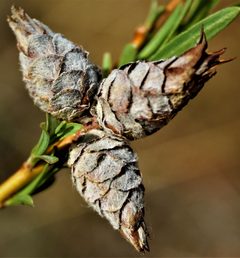
- Rabdophaga strobiloides(Willow Pinecone Gall Midge)
Rabdophaga is a of gall midges in the Cecidomyiidae comprising approximately 105 distributed across Africa, Asia, Europe, and North America. The genus is predominantly associated with willows (Salix spp.), where larvae induce characteristic galls; most species are -specific to particular willow species or sections. A notable exception is R. giraudiana, which forms stem galls on poplars (Populus spp.), and a 2016 record documents the first Rabdophaga species on a non-Salicaceae host, Symplocos cochinchinensis (Symplocaceae). Species within the genus exhibit varying degrees of host fidelity, with some showing strong preference-performance relationships and others demonstrating broader host ranges across willow sections.
Pronunciation
How to pronounce Rabdophaga: /ræbˈdɒfəɡə/
These audio files are automatically generated. While they are not always 100% accurate, they are a good starting point.
Identification
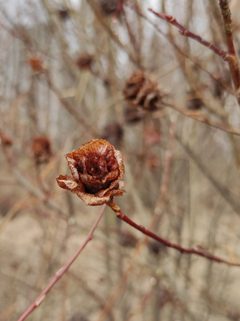
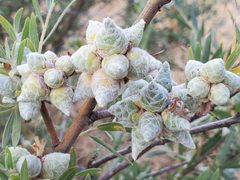
Rabdophaga are distinguished from other gall midge by their association with willow and characteristic gall morphologies, which vary by species: rosette galls (R. rosaria), terminal bud galls (R. terminalis), and pinecone-shaped stem galls (R. strobiloides). Specific identification typically requires examination of gall structure, host plant species, and microscopic features of or larvae. Genetic analysis of mitochondrial COI sequences has been employed to resolve cryptic species boundaries, particularly within the R. rosaria and R. strobiloides .
Images
Habitat
Found in where willows occur, including riparian zones, wetlands, floodplains, and disturbed areas with Salix spp. establishment. Field studies indicate higher levels in denser willow stands.
Distribution
Holarctic distribution with records from Europe (Denmark, Norway, Sweden, Netherlands, UK, Poland, Georgia), Asia (Japan, Russian Far East), and North America (Canada, United States including Alaska and Vermont).
Host Associations
- Salix alba - preferred for R. terminalis; larger buds preferred for oviposition
- Salix fragilis - secondary for R. terminalis
- Salix myrsinifolia - for R. rosaria
- Salix myrsinifolia × phylicifolia - naturally hybrid support R. rosaria
- Salix viminalis - rarely oviposited by R. terminalis
- Salix triandra - not accepted for oviposition by R. terminalis
- Salix daphnoides - not accepted for oviposition by R. terminalis
- Salix smithiana - not accepted for oviposition by R. terminalis
- Populus - for R. giraudiana (stem galls); exception to willow association
- Symplocos cochinchinensis - first recorded non-Salicaceae for (Japan)
Life Cycle
Complete with gall-inducing larval stage. Larvae develop within plant tissue galls, with development time and success influenced by gall size and larval . Competition among larvae within galls negatively affects individual weight, with steeper density-dependent effects observed on preferred . occurs within galls in cocoons.
Behavior
Females exhibit selective oviposition , with preference varying among . R. terminalis shows strong preference hierarchy among willow species, ovipositing almost exclusively on S. alba and S. fragilis. R. rosaria demonstrates -level preference variation within host species, though preferences are not consistently linked to plant growth traits or gall size. Host selection behavior has been observed to correlate with offspring survival in some species.
Ecological Role
As gall inducers, modify willow growth patterns and create structure for associated . Gall size determines susceptibility to natural enemies: small galls are vulnerable to bird , medium galls to by Torymus cecidomyiae, and large galls to attack by Gastrancistrus sp., creating size-mediated phenotypic that influence -parasitoid dynamics.
Similar Taxa
- Dasineuraboth are Cecidomyiidae gall midges on willows; Dasineura typically forms leaf margin or shoot-tip galls rather than the bud and stem galls characteristic of Rabdophaga
- ContariniaCecidomyiidae gall midges with broader ranges; distinguished from Rabdophaga by gall and lack of specialization on Salicaceae
Sources and further reading
- BugGuide
- GBIF taxonomy match
- iNaturalist taxon
- NCBI Taxonomy
- Catalogue of Life
- Gall size determines the structure of the Rabdophaga strobiloides host–parasitoid community
- Resurrection of Rabdophaga salicivora Shinji (Diptera: Cecidomyiidae), a Japanese gall midge formerly misidentified as a North American species, Rabdophaga rigidae (Osten Sacken), with observations on the phylogenetic relationships of its populations in Japan and the Russian Far East
- Preference–performance relationship in the gall midge Rabdophaga rosaria : insights from a common‐garden experiment with nine willow clones
- Oviposition and larval performance of Rabdophaga terminalis on Salix spp. with special consideration to bud size of host plants
- Genetic variation in intraspecific populations of Rabdophaga rosaria (Diptera: Cecidomyiidae) indicating possible diversification scenarios into sibling species along with host range expansion on willows (Salicaceae: Salix)
- Taxonomic status of a gall midge (Diptera: Cecidomyiidae) associated with Symplocos cochinchinensis (Symplocaceae) in Japan: The first example of Rabdophaga on a host plant other than Salicaceae