
Chrysanthrax crocinus
(Coquillett, 1892)
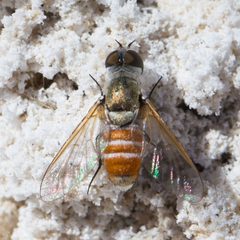
Chrysanthrax crocinus is a of bee fly in the Bombyliidae, found in the southwestern United States and Baja California Norte. Like other bee flies, are that visit flowers to feed on nectar using an elongated . The species belongs to a whose larvae are of ground-nesting bees and other insects.
Pronunciation
How to pronounce Chrysanthrax crocinus: //krɪˈsænθræks ˈkroʊsɪnəs//
These audio files are automatically generated. While they are not always 100% accurate, they are a good starting point.
Images
Distribution
Southwestern United States and Baja California Norte, Mexico.
Diet
feed on nectar from flowers. The is elongated to reach deep into floral structures.
Life Cycle
Complete with , larva, pupa, and stages. Larvae are that develop within the nests of insects.
Behavior
are active flower visitors and . Females have been observed following solitary ground-nesting bees back to their nests to deposit near or within burrow entrances.
Ecological Role
function as through incidental pollen transport on their hairy bodies. Larvae act as , regulating of ground-nesting bees and potentially other insects.
Human Relevance
Contributes to pollination of wildflowers. May be encountered by observers due to its -like appearance, leading to frequent misidentification as a true bee.
Similar Taxa
- Chrysanthrax cyprisCongeneric with distinct black patches on wings used for identification; C. crocinus lacks this specific wing pattern.
- Bombylius majorLarger bee fly with more robust body and different wing venation; widespread across North America rather than restricted to southwestern regions.
- Anthrax speciesRelated bee flies in the same Anthracinae; some have more extensively patterned wings or different body proportions.
Misconceptions
Frequently mistaken for bees due to hairy body and flower-visiting ; distinguished by having only one pair of wings ( Diptera ) versus two pairs in Hymenoptera , and by the absence of deliberate pollen collection behavior.
More Details
Parasitoid biology
Larvae of Chrysanthrax develop as within the nests of solitary bees. The larva attaches to the larva and feeds on its tissues, eventually killing the host.