
Chrysanthrax cypris
(Meigen, 1820)
Chrysanthrax cypris is a of bee fly in the Bombyliidae. It occurs in the eastern United States from Massachusetts and Iowa south to Mexico. The species is a of tiphiid wasps. are active that visit flowers for nectar.
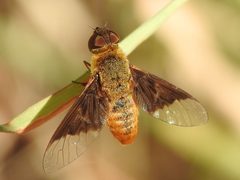
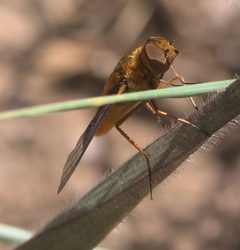
Pronunciation
How to pronounce Chrysanthrax cypris: //ˌkrɪsænˈθræks ˈsaɪprɪs//
These audio files are automatically generated. While they are not always 100% accurate, they are a good starting point.
Identification
The distinct black patches on the wings are the primary diagnostic feature separating Chrysanthrax cypris from similar bee flies. The single pair of wings distinguishes it from true bees, which have two pairs. The long and frenetic are additional characteristics typical of the .
Images
Appearance
Habitat
Meadows and open areas with abundant flowering plants. Often found in supporting ground-nesting insects.
Distribution
Eastern United States from Massachusetts and Iowa southward to Mexico.
Seasonality
Active in spring, with observed during periods when flowers are in bloom and ground-nesting insects are active.
Diet
feed on nectar from flowers. Larvae are that develop by feeding on insects.
Host Associations
- Tiphiidae - Larvae develop as of tiphiid wasps.
Life Cycle
Females deposit in or near burrows. Larvae enter host galleries, attach to host larvae, and feed on their tissues and blood until the host is consumed.
Behavior
exhibit rapid, darting patterns while foraging for nectar. They perform pre-flight warm-up by rapidly fluttering their wings on cool mornings.
Ecological Role
function as , transporting pollen on their hairy bodies while feeding on nectar. Larvae act as agents by parasitizing .
Human Relevance
Provides pollination services in meadows and natural areas. Often mistaken for bees due to appearance, which may cause unnecessary concern.
Similar Taxa
- Bombylius majorAnother common bee fly with long , but lacks the distinct black wing patches of C. cypris.
- Anthrax georgicusSimilar bee fly , but parasitizes tiger larvae rather than .
- Xenox tigrinusTiger bee fly that parasitizes carpenter bees; differs in association and wing pattern.
More Details
Taxonomic history
Originally described by Meigen in 1820. Placed in Chrysanthrax within tribe Villini of Anthracinae.