
Chrysanthrax
Osten Sacken, 1886
Species Guides
9Chrysanthrax is a of bee flies ( Bombyliidae) comprising at least 50 described distributed across North and South America. are frequent flower visitors that serve as , though they do not deliberately collect pollen. The genus exhibits the characteristic bee fly : hairy bodies, long for nectar feeding, and a single pair of wings. Larvae are that develop within the nests of solitary bees and other ground-dwelling insects.
Pronunciation
How to pronounce Chrysanthrax: //krɪˈsænθræks//
These audio files are automatically generated. While they are not always 100% accurate, they are a good starting point.
Identification
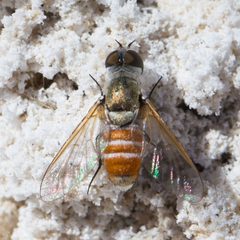
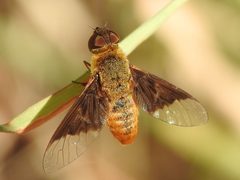
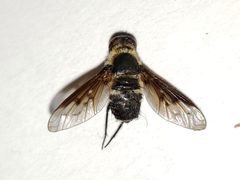
Chrysanthrax can be distinguished from similar bee fly by wing venation patterns and specific markings, such as the dark patches present in C. cypris. The combination of a single wing pair, long , and -like hairiness separates it from true bees (Hymenoptera), which have two pairs of wings and often exhibit more deliberate pollen-collecting . Within Bombyliidae, precise identification to level requires examination of wing pattern details and genitalic structures.
Images
Appearance
possess densely hairy bodies resembling bees, with a single pair of wings (diagnostic for Diptera). The is remarkably elongated, often as long as or longer than the body, adapted for reaching deep into flowers. Wing patterns vary by ; for example, Chrysanthrax cypris displays distinct black patches on the wings that aid identification. The overall coloration tends toward muted browns, blacks, and sometimes metallic tones. Body size varies among species but generally falls within the medium range for bee flies.
Habitat
frequent meadows, riverbanks, and other open areas with abundant flowering vegetation. They are particularly associated with supporting of solitary ground-nesting bees, which serve as for their larvae. Alluvial banks and earthen substrates suitable for nesting galleries appear to be important landscape features.
Distribution
North and South America. The has been documented from the United States (including Maryland and South Carolina) through Central America to South America.
Seasonality
are active during spring and early summer, coinciding with peak flowering periods and the activity seasons of solitary . Activity appears to peak on warm days when both flowers and host bees are active.
Diet
feed exclusively on nectar, which provides the necessary to power their energetically demanding . They do not consume pollen as food. Larvae are that feed on the blood and body tissues of larvae, and may also consume pollen provisions stored in host nests.
Host Associations
- Solitary ground-nesting bees (Halictidae, Colletidae, Andrenidae) - Females deposit in or near burrows; larvae parasitize developing larvae
Life Cycle
Females follow solitary bees back to their nests and deposit in or near the burrow entrance. Upon hatching, larvae enter the nest gallery. Some first consume the pollen and nectar provisions left by the before attaching to the host larva. The larva affixes itself to the host's body with a sucker-like structure and feeds on and tissues, eventually killing the host. Development from egg to occurs within the host nest.
Behavior
exhibit rapid, hovering and are often observed darting among flowers. They perform pre-flight warm-up by rapidly fluttering wings on cool mornings. Females display tracking , following bees to locate nests for oviposition. Adults are hyperactive fliers requiring frequent nectar feeding to sustain energy demands.
Ecological Role
function as through incidental pollen transfer on their hairy bodies while feeding on nectar. Larvae act as regulators of solitary bees and potentially other ground-nesting insects. The contributes to both pollination services and pressure within meadow and riparian .
Human Relevance
provide pollination services in natural and semi-natural . They are frequently mistaken for bees by observers, which can cause confusion but poses no direct harm. No significant economic impact has been documented; they are neither pests nor managed beneficials.
Similar Taxa
- BombyliusShares general bee fly and flower-visiting , but lacks the distinct wing markings characteristic of some Chrysanthrax and has different associations
- AnthraxSimilar lifestyle and appearance, but Anthrax such as A. georgicus attack tiger larvae rather than bees, and wing patterns differ
- XenoxAnother bee fly with superficially similar appearance, but Xenox tigrinus specifically targets carpenter bees and exhibits different (loitering on wooden structures)
Misconceptions
are commonly mistaken for true bees due to their hairy bodies and flower-visiting habits. This resemblance is purely convergent; they are flies with only one pair of wings and do not sting or deliberately collect pollen.
More Details
Taxonomic history
The was established by Osten Sacken in 1886 and currently contains at least 50 described , though many likely remain undescribed. It belongs to the tribe Villini within Anthracinae.
Observation frequency
The is relatively well-documented on citizen science platforms, with over 3,400 observations recorded, suggesting it is conspicuous and readily identifiable by informed observers.