
Anisolabis maritima
(Bonelli, 1832)
maritime earwig, seaside earwig
A , wingless found on coastal beaches worldwide. Males possess asymmetrical forceps used for mating, prey capture, and defense. Exhibits notable maternal care , with females guarding and nymphs for up to 28 days and progressively provisioning offspring. Displays complex social dynamics including sex-specific aggression patterns and size-based dominance in shelter competition.
Pronunciation
How to pronounce Anisolabis maritima: /ˌænɪˈsɒləbɪs məˈrɪtɪmə/
These audio files are automatically generated. While they are not always 100% accurate, they are a good starting point.
Identification
Distinguished from other earwigs by the combination of wingless condition, coastal preference, and male asymmetrical forceps. The (Labidura riparia) occurs in similar habitats but males have symmetrical forceps. Other Anisolabis may require examination of genitalia for definitive identification.
Images
Appearance
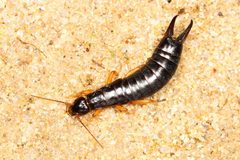
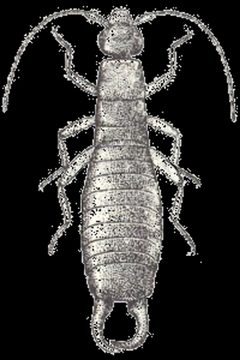
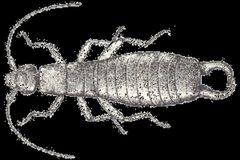
measure 25–30 mm in length. Body grayish to blackish in coloration with pale yellow legs. (lacks wings). Males possess characteristically asymmetrical forceps (); females have straight, symmetrical forceps. in body size, with females typically larger than males.
Habitat
Coastal beaches in temperate and tropical regions, typically occupying areas at or above the high tide line. Aggregates under driftwood, seaweed, and debris during daytime . Prefers dark, warm, humid microhabitats. In some , found up to 3 meters above high-tide line to avoid water-logging and competition.
Distribution
worldwide distribution across temperate and tropical coastal . Present in nearly all biogeographic realms. Native to Asia; introduced to North America and other regions through international commerce. Documented from Europe, Asia, North America, Oceania, and the Middle East.
Diet
Life Cycle
Females lay in soil burrows and engage in extended maternal care, guarding eggs and nymphs for up to 28 days. Mothers progressively provision nymphs, carrying food to burrows and adjusting provisioning levels based on offspring hunger signals. Nymphs develop through multiple instars before reaching adulthood.
Behavior
forager, returning to shelter during daytime. Females exhibit high aggression toward conspecifics, using forceps to jab and cut rivals; males resolve disputes through non-lethal ritualistic abdominal pinching. Social dynamics vary with group size and composition: females more aggressive than males in pairs, but intrasexual competition alters outcomes in larger groups. Males court by moving backward toward females with genitalia emerging between forceps; females control copulation and can terminate mating at any time. Cohabitation patterns influenced by shelter availability, time of day, and body size.
Ecological Role
of small in coastal . may provide protection from and desiccation. Maternal care represents a rare example of subsocial behavior among Dermaptera.
Human Relevance
Forceps strong enough to break human skin, though not considered medically significant. Occasionally encountered by beachgoers under debris. Subject of extensive behavioral research due to unusual social and reproductive traits.
Similar Taxa
- Labidura ripariaAlso occurs in coastal ; distinguished by males having symmetrical rather than asymmetrical forceps
- Euborellia plebejaAnother ; has wings and different male genitalia structure
More Details
Maternal Care Trade-offs
Research indicates that maternal care in this involves limited physiological cost: females removed from clutches produce subsequent clutches more rapidly, though clutch sizes are smaller. Total lifetime does not differ between caring and non-caring females, suggesting care costs are relatively minor.
Sexual Selection and Forceps
Male asymmetrical forceps function in mating, prey capture, and defense. In competitive contexts, larger males achieve more copulatory opportunities when size advantage over rivals increases. However, females preferentially mate with smaller males when given opportunity, creating tension between female choice and intrasexual competition.
Aggregation Ecology
Field observations document densities up to 2.75 individuals per 100 cm². Spatial distribution patterns differ by sex: males tend toward clumped distributions, while females are more uniformly distributed, suggesting territoriality. Mixed-sex groups show uniform distribution during activity but become clumped after settling into daytime positions.
Sources and further reading
- BugGuide
- Wikipedia
- GBIF taxonomy match
- iNaturalist taxon
- NCBI Taxonomy
- Catalogue of Life
- One Bad Beetle | Beetles In The Bush
- More Than Wheat to Eat: New Zealand's Wheat Bug Has a Taste for Brassicas, Too
- St. Anthony Dune Tiger Beetle | Beetles In The Bush
- Bruneau Sand Dune tiger beetles caught in the act! | Beetles In The Bush
- Two’s company, three’s a crowd: Social situations alter group dynamics in the maritime earwig (Anisolabis maritima)
- Distribution and ultrastructure of sensillae on legs and anal cerci in earwig Anisolabis maritima (Dermaptera: Carcinophoridae)
- Big wigs and small wigs: Time, sex, size and shelter affect cohabitation in the maritime earwig (Anisolabis maritima)
- The origin and distribution of periodic acid‐Schiff‐positive substances in the oocyte of the earwig, Anisolabis maritima (Géné)
- Physiological cost of maternal care? Effect of pre- and post-hatching care on the clutch size in the earwig Anisolabis maritima
- Provisioning control during maternal care by the earwigAnisolabis maritima(Dermaptera: Anisolabididae): Do mothers adjust provisioning according to offspring need?
- Weaponry, size, and sex ratio affect spatial distribution within small and large groups of the maritime earwig (Anisolabis maritima)