
Asbolus verrucosus
LeConte, 1851
Blue Death-Feigning Beetle, Desert Ironclad Beetle
A darkling beetle native to southwestern North American deserts, distinguished by its powdery blue wax coating and dramatic death-feigning when threatened. measure 18–21 mm and are highly adapted to arid environments. The has become popular in the pet trade due to its hardiness and ease of care.
Pronunciation
How to pronounce Asbolus verrucosus: //ˈæsbələs vɛruˈkoʊsəs//
These audio files are automatically generated. While they are not always 100% accurate, they are a good starting point.
Identification
The combination of powdery blue coloration, bumpy , and moderate size (18–21 mm) distinguishes this from other desert darkling beetles. The antennal hairs in males provide a secondary sex characteristic. When handled, the immediately responds with death-feigning —tensing legs and falling motionless—providing a behavioral diagnostic. Similar darkling beetles in the same region lack both the blue wax coating and the pronounced elytral .
Images
Appearance
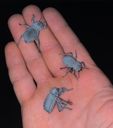
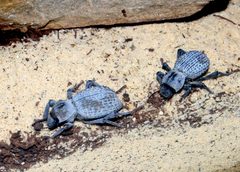
are 18–21 mm in length with a distinctive powdery blue to steely blue coloration. The blue hue results from a dense wax coating secreted by specialized glands beneath the , which prevents desiccation. The bear characteristic wart-like bumps (verrucae), referenced in the name 'verrucosus.' Males are slightly smaller than females and possess bristly red hairs on their . The body is robust and somewhat flattened, typical of desert-adapted tenebrionids.
Habitat
Dry, sandy desert environments including the Sonoran and Mojave Deserts. Found in open sandy areas, often associated with vegetation such as creosote bush and other desert shrubs that provide food and microhabitat.
Distribution
Southwestern United States (southern California eastward through southern Nevada, Utah, Arizona, to New Mexico) and northwestern Mexico (Baja California, Sonora).
Seasonality
are , most active at dawn and dusk. Active year-round in suitable conditions, though surface activity likely reduced during extreme summer heat or winter cold.
Diet
. Consumes dead insects, fruits, lichen, and other plant matter. In captivity, accepts vegetables, fruits, lichen, shrimp, dead insects, and commercial pet foods.
Life Cycle
Complete with , larva, pupa, and stages. Larvae develop in sandy substrates. Breeding in captivity is notoriously difficult; larvae require specific humidity and temperature conditions to successfully pupate. One documented captive rearing required four years from breeding initiation to adult .
Behavior
Exhibits (death-feigning) when threatened: the falls from substrate, tenses legs, and remains motionless for seconds to hours. May reflex bleed during death-feigning, releasing that acts as an adhesive, causing sand and debris to adhere to the body and further camouflage the insect. Unable to climb smooth surfaces such as plastic or glass. Generally docile and slow-moving when not disturbed.
Ecological Role
Functions as a and scavenger in desert , consuming dead plant and animal matter. Serves as prey for lizards, birds, and other desert ; its defensive represent an to high pressure in exposed desert environments.
Human Relevance
Increasingly popular in the pet trade due to hardiness, longevity, minimal care requirements, and striking appearance. Commonly kept in communal arrangements. Wild subject to collection pressure; most captive specimens are wild-caught. Has been successfully maintained in mixed exhibits with desert hairy scorpions and velvet ants. The complete mitochondrial was sequenced in 2015, representing the first fully assembled mitogenome for a pimeliine darkling beetle.
Similar Taxa
- Eleodes spp.Other desert darkling beetles share and general body form, but lack the blue wax coating and death-feigning ; Eleodes typically exhibit defensive -stand posture and release defensive secretions instead.
- Cryptoglossa spp.Other blue-colored desert tenebrionids that possess wax coatings, but differ in body shape, elytral sculpturing, and .
More Details
Wax Coating Function
The powdery blue appearance is produced by a heavy layer of wax secreted from specialized subcuticular glands. This coating dramatically reduces cuticular water loss, a critical for survival in environments receiving as little as 5 inches of rainfall.
Captive Breeding Challenges
Despite popularity in captivity, successful breeding is rare. Researchers at the Cincinnati Zoo required four years (2014–2018) to rear their first captive . Hobbyist successes suggest precise humidity and temperature control during larval development is critical.
Sources and further reading
- BugGuide
- Wikipedia
- GBIF taxonomy match
- iNaturalist taxon
- NCBI Taxonomy
- The Beetle Boys Meet at the Bohart | Bug Squad
- Archive — Bug of the Week
- Destination Mojave Desert: Defying death by playing dead, Blue Death-Feigning Beetle, 'Asbolus verrucosus' — Bug of the Week
- Bug Eric: That's Not an Ant?!
- Flower ants? Check again! | Beetles In The Bush
- The “silky-bellied humpbacked” ant | Beetles In The Bush