
Asbolus
LeConte, 1851
blue death-feigning beetles
Species Guides
4- Asbolus laevis
- Asbolus mexicanus
- Asbolus papillosus
- Asbolus verrucosus(Blue Death-Feigning Beetle)
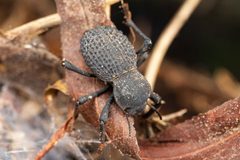
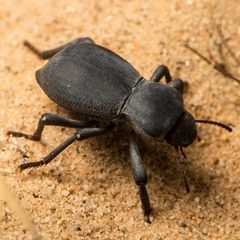
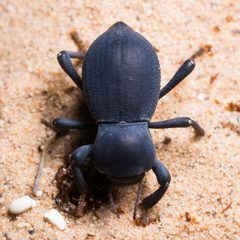
Asbolus is a small of darkling beetles ( Tenebrionidae) native to the southwestern United States and Mexico. The genus contains four , including the well-known Asbolus verrucosus, commonly called the blue death-feigning . These beetles are adapted to arid desert environments and exhibit a distinctive blue coloration derived from a waxy coating that prevents desiccation. The genus is notable for its —playing dead when threatened.
Pronunciation
How to pronounce Asbolus: /ˈæs.bə.ləs/
These audio files are automatically generated. While they are not always 100% accurate, they are a good starting point.
Identification
The blue coloration from the waxy coating is the primary diagnostic feature. When disturbed, these beetles exhibit —falling onto their backs, drawing in their legs, and remaining motionless for minutes to hours. This , combined with the desert and blue coloration, distinguishes Asbolus from similar darkling beetles. The waxy coating can be rubbed off, revealing a black beneath.
Images
Appearance
Beetles in this exhibit a striking steely blue to black coloration caused by a heavy coating of wax secreted by specialized glands beneath the . This wax layer gives the beetles a dusty or matte appearance. The body is compact and somewhat rounded, typical of darkling beetles. The blue death-feigning (A. verrucosus) is the most visually distinctive member.
Habitat
Arid and semi-arid desert environments, particularly the Mojave Desert and other regions of the southwestern United States and Mexico. Found in sandy or rocky substrates with sparse vegetation. Often encountered on the ground surface or under debris during cooler periods.
Distribution
Southwestern United States (California, Nevada, Arizona, Utah) and adjacent regions of Mexico. Primarily restricted to the Nearctic region.
Seasonality
Active during cooler periods in desert environments; may be or to avoid extreme daytime heat. Activity patterns tied to moisture availability and temperature.
Diet
; feeds on decaying plant matter, fungi, and possibly carrion. Specific dietary preferences vary by and availability in arid environments.
Life Cycle
Complete with , larval, pupal, and stages. Larvae are typically -like and develop in soil or decaying substrates. Detailed information for most is limited.
Behavior
Exhibits (death-feigning) when threatened: the falls onto its back, draws in its legs, and remains motionless. This may last from minutes to hours and is thought to confuse motion-detecting . The waxy coating also serves as an anti-desiccation , critical for survival in arid environments.
Ecological Role
Contributes to decomposition and nutrient cycling in desert . Serves as prey for reptiles, birds, and other desert . The waxy coating and represent important anti-predator adaptations in .
Human Relevance
Popular in the pet trade, particularly Asbolus verrucosus, due to its striking appearance and docile nature. Used in educational settings and insect zoos to demonstrate desert adaptations and . Not considered an agricultural or medical pest.
Similar Taxa
- EleodesOther darkling beetles in the same ; some exhibit similar defensive but lack the blue waxy coating and response of Asbolus.
- CryptoglossaDesert darkling beetles with waxy coatings for water conservation, but typically with different coloration and lacking the pronounced of Asbolus.
More Details
Wax secretion
The blue color is not structural pigmentation but rather a layer of wax secreted from specialized subcuticular glands. This wax can be experimentally removed to reveal the black beneath, demonstrating its protective rather than color-signaling function.
Etymology
The name Asbolus derives from Greek mythology, where Asbolus was a centaur known as a seer and augur. The name means 'sooty' or 'carbon dust,' possibly alluding to the dark coloration of these beetles.