
Eleodes fuchsii
Blaisdell, 1909
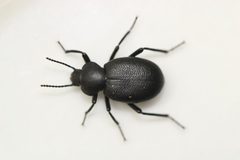
Eleodes fuchsii is a darkling beetle in the Tenebrionidae, first described by Blaisdell in 1909. As a member of the Eleodes, it belongs to a group commonly known as "clown beetles" or "stink beetles," recognized for their defensive posture of raising the when disturbed. The is part of a large North American genus with over 200 described species, many of which inhabit arid and semi-arid regions.
Pronunciation
How to pronounce Eleodes fuchsii: //ˌɛliˈoʊdiːz ˈfʊksi.aɪ//
These audio files are automatically generated. While they are not always 100% accurate, they are a good starting point.
Identification
Distinguished from other Eleodes by subtle morphological characters including proportions of antennal segments, details of pronotal shape and punctation, and elytral striation patterns. Accurate identification requires examination of or detailed original description (Blaisdell 1909). Similar to E. suturalis and E. hispilabris, from which it differs in specific ratios of body segments and surface sculpturing. Genitalic examination may be necessary for definitive identification.
Images
Habitat
Inferred from : inhabits arid and semi-arid environments including grasslands, shrublands, and open woodlands. Often found in sandy or loose soil substrates where it can burrow. Specific microhabitat preferences for E. fuchsii remain undocumented.
Distribution
Distribution poorly documented. Known from type locality and limited collection records. GBIF and iNaturalist data suggest scattered North American records, but precise range boundaries require verification. Not associated with the Siberian orchid mentioned in provided context (that reference pertains to Dactylorhiza fuchsii, an unrelated orchid ).
Behavior
Expected to exhibit typical Eleodes defensive : when disturbed, raises and stands on forelegs, presenting defensive glands to potential . This posture is the source of the "clown beetle" or "acrobat ." activity pattern inferred from . Specific behavioral observations for E. fuchsii not documented.
Ecological Role
Functions as a in arid , contributing to nutrient cycling through consumption of decaying plant material. Serves as prey item for various vertebrate and . Specific ecological studies for this not available.
Human Relevance
No documented economic or medical significance. Like other Eleodes , may be kept as low-maintenance pets in captivity due to hardiness and simple care requirements. Not a pest species.
Similar Taxa
- Eleodes suturalisSimilar somber coloration and general body form; distinguished by subtle differences in elytral and pronotal characteristics
- Eleodes hispilabrisOverlapping distribution and preferences; requires examination of antennal proportions and surface punctation for separation
- Eleodes opacusShared dark coloration and defensive posture; differentiated by body proportions and male genitalic structures
More Details
Nomenclatural note
The specific epithet "fuchsii" honors a person (standard Latin genitive form), not related to the orchid Dactylorhiza fuchsii mentioned in provided context. The orchid and share only an epithet, not a taxonomic relationship.
Data deficiency
This is data-deficient in public repositories. iNaturalist records (24 observations as of source date) suggest it is rarely encountered or underreported relative to more common like E. obscura or E. tricostata.