
Eleodes tricostata
(Say, 1824)
Three-ribbed Darkling Beetle, desert stink beetle
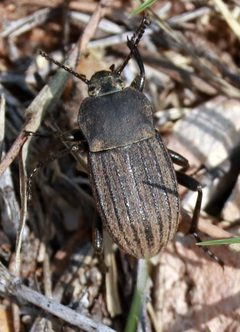
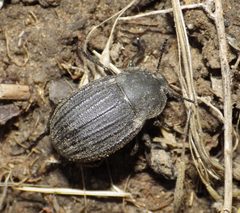
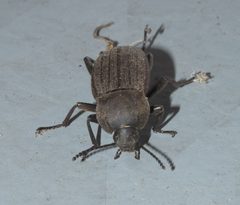
Eleodes tricostata is a darkling beetle ( Tenebrionidae) native to the Great Plains of North America. It is distinguished from by its dull coloration, depressed body shape, and three distinct tuberculate (ridges) on the . The is known for its active crawling and has been observed in mass movements across highways in early evening hours. It was first described by Say in 1824 and represents a significant eastern range extension for the Eleodes, which occurs exclusively in western North America.
Pronunciation
How to pronounce Eleodes tricostata: /ɛˈleɪ.əˌdiːz traɪkɒˈsteɪtə/
These audio files are automatically generated. While they are not always 100% accurate, they are a good starting point.
Identification
The combination of three distinct, bumpy (tuberculate) longitudinal ridges on the , dull non-shiny , and depressed body shape separates E. tricostata from the dozens of co-occurring Eleodes . Most have smooth, shiny elytra without prominent and a more convex body profile. The species lacks the "black olive with legs" appearance characteristic of larger, shinier Eleodes species.
Images
Appearance
Medium to large darkling beetle with dull (non-shiny) coloration and a distinctly depressed, (spindle-shaped) body. The bear three prominent, tuberculate —raised, wart-like longitudinal ridges that distinguish this from the typically smooth, shiny "black olive" appearance of most other Eleodes species. The overall form is more flattened and less convex than .
Habitat
Open with exposed soil surfaces and sandy soil in close proximity to shrub and tree cover. Found in red-cedar woodlands, grasslands, and desert-edge environments. The Wisconsin was encountered exclusively in this specific habitat configuration, suggesting habitat specificity may limit eastern range expansion.
Distribution
Great Plains of North America, from Canada (Alberta, Saskatchewan, Manitoba) to Mexico. Eastern limit historically uncertain; recently documented east of the Mississippi River in Wisconsin (1998). Historical records from western and central Iowa. Absent from Missouri due to lack of suitable (exposed sandy soil with shrub/tree cover).
Seasonality
Active observed in September; mass movements across highways documented in early evening hours. Specific otherwise not described.
Behavior
are persistently active , making them difficult to photograph in the field. When disturbed, individuals may attempt the characteristic Eleodes -stand defensive posture, though this appears less pronounced than in some . Mass movements involving large numbers of individuals crossing highways have been observed in early evening hours in south-central Kansas, though such appear rare.
Human Relevance
Occasionally kept as pets due to low maintenance requirements and longevity in captivity, though less commonly kept than some . Subject of entomological interest due to its distinctive and range extension patterns.
Similar Taxa
- Eleodes suturalisCo-occurs across much of range and has been observed in mass movements together; distinguished by shinier coloration, lack of three prominent tuberculate elytral , and more convex body shape
- Eleodes hispilabrisSimilar size and general form; distinguished by elytral and body profile differences
More Details
Etymology
The name Eleodes is derived from Greek and means "olive-like," referring to the typical appearance of most . The specific epithet tricostata refers to the three (ridges) on the .
Range extension significance
The 1998 Wisconsin record represented the first confirmed occurrence east of the Mississippi River, prompting investigation into requirements that may limit further eastern expansion.