
Pseudozonitis schaefferi
(Blatchley, 1922)
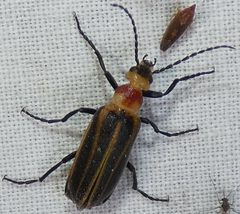
Pseudozonitis schaefferi is a blister beetle in the Meloidae, first described by Blatchley in 1922. It belongs to the Nemognathinae, a group characterized by elongated maxillary mouthparts adapted for nectar feeding on flowers. The Pseudozonitis comprises approximately 14 described in North America, with P. schaefferi being one of the less commonly encountered members. Like other nemognathine blister beetles, are likely associated with flowers for feeding, while larvae are probably or of and provisions in nest .
Pronunciation
How to pronounce Pseudozonitis schaefferi: //ˌsjuː.doʊˈzɒ.nɪ.tɪs ˈʃɛ.fɛr.aɪ//
These audio files are automatically generated. While they are not always 100% accurate, they are a good starting point.
Identification
Pseudozonitis schaefferi can be distinguished from other Pseudozonitis by the combination of its specific elytral coloration and pattern, body proportions, and details of antennal structure. The Pseudozonitis is separated from the closely related Zonitis by characters of the male genitalia and antennal structure. Within Nemognathinae, Pseudozonitis is further distinguished from Nemognatha and Gnathium by the relatively shorter and different body form. Specimens should be compared directly with identified material or original descriptions for reliable determination.
Images
Distribution
North America. Specific records indicate presence in the United States, though precise documented localities are sparse in available sources. The Pseudozonitis as a whole has its center of diversity in western and southwestern North America.
Diet
feed on nectar and pollen from flowers. The elongated characteristic of Nemognathinae are adapted for accessing nectar in flowers with deep corollas, with nectar uptake occurring via capillary action along bristles on the outer surface of the mouthparts rather than through a sucking mechanism. Larval diet is presumed to involve or on and provisions, as is typical for Nemognathinae, though this has not been directly documented for P. schaefferi specifically.
Ecological Role
function as while feeding on flowers. The larvae likely act as natural regulators of native bees through their parasitic or predatory habits in nest , though this role has not been quantified for this specifically.
Human Relevance
Blister beetles in the Meloidae, including Pseudozonitis , contain the defensive compound , which can cause blistering of skin upon contact. While P. schaefferi itself is not documented as a significant agricultural pest or medical concern, the family is of general interest to entomologists studying -flower associations and - relationships.
Similar Taxa
- Pseudozonitis vittipennisSimilar in general appearance and body form; distinguished by differences in elytral vittae (stripes) and color pattern, as well as male genitalic characters.
- Zonitis speciesClosely related with similar flower-visiting habits; separated by antennal structure and male genitalic .
- Nemognatha speciesSame with similar elongated mouthparts; Nemognatha typically has longer relative to body length and different body proportions.