
Tegrodera
LeConte, 1851
iron cross blister beetles, iron cross soldier beetles, soldier blister beetles
Species Guides
3- Tegrodera aloga(iron cross blister beetle)
- Tegrodera erosa
- Tegrodera latecincta(Soldier Blister Beetle)
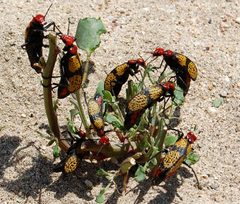
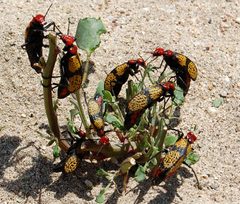
Tegrodera is a North American of large, colorful blister beetles in the Meloidae, comprising three . The genus is confined to arid and semi-arid regions of southwestern North America, with each species occupying distinct geographic ranges separated by major desert barriers. are conspicuous and often form immense feeding and mating . All species contain , a defensive compound toxic to mammals. The genus is notable for unique male courtship involving antennal grasping and stimulation.
Pronunciation
How to pronounce Tegrodera: //tɛɡroʊˈdɛrə//
These audio files are automatically generated. While they are not always 100% accurate, they are a good starting point.
Identification
Tegrodera are large, robust blister beetles with bright coloration. Males possess a pair of grooved depressions on the used during courtship to grasp and stimulate female . The three species are separable by minor but consistent differences in anatomy: T. aloga occurs in the Sonoran Desert, T. erosa (with T. e. erosa and T. e. inornata) in southern California and Baja California, and T. latecincta in the Owens and Antelope valleys of California. Geographic range is the primary diagnostic feature.
Images
Habitat
Arid and semi-arid regions including the Sonoran Desert, Colorado Desert, and Mojave Desert. are associated with different plant . frequently occur in agricultural settings, particularly alfalfa fields, where natural have been encroached upon.
Distribution
Southwestern North America. T. aloga: western Arizona, extreme southeastern California, and northwestern Sonora, Mexico. T. erosa: cismontane southern California and Baja California (nominate in California, T. e. inornata in Baja California). T. latecincta: Antelope and Owens valleys of eastern California.
Seasonality
active primarily in late spring and early summer. T. latecincta emerges earlier than other .
Diet
feed on flowers and foliage of Eriastrum (Polemoniaceae), a group of low herbaceous annuals that serves as the primary plant for all . Adults also feed readily on alfalfa where agriculture encroaches on natural lands.
Host Associations
- Eriastrum - primary plant ( feeding) of low herbaceous annuals in Polemoniaceae; important food source for all Tegrodera .
- alfalfa - secondary ( feeding)Fed upon when agriculture encroaches on natural ; contaminated hay poses livestock risk.
Life Cycle
Behavior
often occur in immense feeding and mating . When threatened, adults exhibit a 'frightening attitude': sudden elevation of exposing brilliant red abdominal intersegmental combined with rapid movement away from the stimulus. This display may intimidate through abrupt warning coloration and apparent body size increase. Adults occasionally follow one another in single file formation, contributing to the 'soldier beetle' . Male courtship is unique: male and female each other, male grasps female with his own and repeatedly pulls them in and out of his grooves, presumably exuding a stimulatory compound.
Ecological Role
are herbivores that feed on flowering plants and may contribute to pollination. The serves as a model for studying mating system evolution and constraints on . of alfalfa hay poses documented risks to livestock, particularly horses, due to .
Human Relevance
Large- feeding on alfalfa create significant agricultural concern. Tegrodera-contaminated alfalfa hay is toxic to livestock, especially horses, due to content. The beetles are large and conspicuous but do not bite or sting humans directly; handling should be avoided due to defensive cantharidin secretion.
Similar Taxa
- EpicautaBoth are large, colorful Meloidae in the tribe Epicautini (now Eupomphini), but Epicauta contains many more with broader geographic distribution and generally lacks the distinctive grooves and antennal courtship of male Tegrodera.
- PyrotaSimilar in size and coloration as meloid beetles, but Pyrota differ in body shape, elytral , and lack the specialized male structures and courtship characteristic of Tegrodera.
Sources and further reading
- BugGuide
- Wikipedia
- GBIF taxonomy match
- iNaturalist taxon
- NCBI Taxonomy
- Catalogue of Life
- Bug Spotlight | Entomology Research Museum
- Meloidae Holdings | Entomology Research Museum
- A TAXONOMIC STUDY OF THE GENUS TEGRODERA (COLEOPTERA: MELOIDAE)
- Notes on adult feeding and behavior of Tegrodera aloga Skinner, 1903 (Coleoptera: Meloidae)
- Constraints on Size‐assortative Mating in the Blister Beetle Tegrodera aloga (Coleoptera: Meloidae)
- Intra- and Interspecific Courtship Behavior in Blister Beetles of the Genus Tegrodera (Meloidae)1