
Tegrodera latecincta
Horn, 1891
Soldier Blister Beetle, Iron Cross Blister Beetle
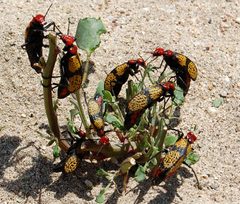
Tegrodera latecincta is a large, colorful blister beetle to the Owens and Antelope valleys of eastern California. As the northernmost in the Tegrodera, it is geographically isolated from its closest relative T. erosa by the San Gabriel and San Bernardino mountains, and from T. aloga by the Mojave Desert. are active in late spring and early summer, often forming conspicuous feeding and mating . Like other meloid beetles, it possesses in its for chemical defense.
Pronunciation
How to pronounce Tegrodera latecincta: /tɛɡroʊˈdɛrə ˌleɪtəˈsɪŋktə/
These audio files are automatically generated. While they are not always 100% accurate, they are a good starting point.
Identification
Distinguished from by geographic range: occurs only in the Owens and Antelope valleys of California, north of the ranges of T. erosa and T. aloga. are large beetles with bright coloration. Males possess a pair of grooved depressions on the used during courtship to grasp and stimulate female . Specific pattern differences from T. erosa and T. aloga are minor but consistent, involving details of adult anatomy.
Images
Habitat
Owens and Antelope valleys of eastern California; associated with specific plant in these arid valley systems. Occurs in areas where agriculture encroaches on natural lands, particularly where alfalfa is grown.
Distribution
to the Owens and Antelope valleys of eastern California, USA. Northernmost member of the , separated from T. erosa by the San Gabriel and San Bernardino mountains and from T. aloga by the Mojave Desert.
Seasonality
Active in late spring and early summer; primarily observed during this period.
Diet
feed on Eriastrum (Polemoniaceae), a group of low herbaceous annuals. Also feeds readily on alfalfa where agriculture encroaches on natural .
Life Cycle
Behavior
form large feeding and mating . When threatened, exhibits a "frightening attitude": sudden elevation of exposing brilliant red abdominal intersegmental combined with rapid movement away from the stimulus. Males follow one another in single file formation. Male courtship is distinctive: male and female each other, male grasps female with his own and repeatedly pulls them in and out of his grooves where a stimulatory compound is presumably exuded.
Ecological Role
are herbivores that feed on native Eriastrum and cultivated alfalfa. Chemical defense via deters . Potential threat to livestock when contaminated alfalfa hay is consumed.
Human Relevance
Poses potential threat to livestock, especially horses, when beetles contaminate alfalfa hay; in is toxic to mammals. Large conspicuous make it noticeable to agricultural .
Similar Taxa
- Tegrodera erosaClosest relative, separated geographically by the San Gabriel and San Bernardino mountains; occurs in southern California and Baja California. Two recognized: T. e. erosa and T. e. inornata.
- Tegrodera alogaMore southerly ranging throughout much of the Sonoran Desert in western Arizona, extreme southeastern California, and northwestern Sonora; separated from T. latecincta by the vast Mojave Desert.