
Tegrodera aloga
Skinner, 1903
iron cross blister beetle
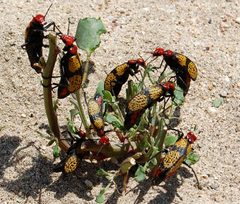
Tegrodera aloga is a large, conspicuous blister beetle to the Sonoran Desert. are easily recognized by their black bodies with contrasting yellow and red spots and a distinctive black cross pattern on the . The is notable for its aposematic coloration, which advertises the presence of toxins used for defense. Adults feed on spring blossoms and occur in large during mating and feeding. The species poses a documented risk to livestock, particularly horses, when contaminated alfalfa hay is ingested.
Pronunciation
How to pronounce Tegrodera aloga: //ˌtɛɡrəˈdɛrə əˈloʊɡə//
These audio files are automatically generated. While they are not always 100% accurate, they are a good starting point.
Identification
Distinguished from by the bold black cross marking on the (source of the "iron cross"). Body approximately 2 cm long, cylindrical with a wide . Coloration consists of black ground color with yellow and red spots. Males possess paired grooved depressions on the head used during courtship. Similar Tegrodera erosa and T. latecincta lack the distinct cross pattern and occur in different geographic regions (southern California/Baja California and Owens/Antelope valleys respectively).
Images
Habitat
Sonoran Desert in western Arizona, extreme southeastern California, and northwestern Sonora. Associated with desert plant , particularly areas supporting Eriastrum . Also found in agricultural settings where alfalfa encroaches on natural lands.
Distribution
Western Arizona, extreme southeastern California, and northwestern Sonora, Mexico. Geographic range separated from T. erosa by the arid Colorado Desert.
Seasonality
active primarily in late spring and early summer. Peak activity coincides with spring blooming of plants.
Diet
feed on pollen and floral parts of Eriastrum (Polemoniaceae), desert willow (Chilopsis linearis), and Bahia species. Also consumes alfalfa blossoms and nectar.
Life Cycle
First instar larva described but poorly known. Larvae assumed to be of ground-nesting provisions based on related , though specific remain undocumented.
Behavior
occur in large feeding and mating . Males exhibit competitive , fighting for access to females. Courtship involves males grasping female with their own and pulling them into grooves where stimulatory compounds are presumably exuded. Males have been observed mounting females for extended periods without copulation, interpreted as mate-guarding behavior. When threatened, adults display a "frightening attitude": are suddenly elevated to expose brilliant red abdominal intersegmental while rapidly moving away. is excreted through leg joints and antennal pores as chemical defense.
Ecological Role
pollen feeding suggests potential role as of desert willow and Eriastrum, though this function has not been experimentally verified.
Human Relevance
toxin poses serious risk to livestock, particularly horses (lethal dose approximately 1 mg/kg). Beetles are incorporated into baled alfalfa hay during harvest or transfer onto forage, causing potentially fatal cantharidin poisoning when ingested. Human lethal dose when ingested is approximately 10 mg (0.5 mg/kg). Skin contact causes severe blistering dermatitis within hours. Conversely, cantharidin is used medicinally as a topical treatment for wart removal and tattoo removal, and has been investigated for cancer treatment applications.
Similar Taxa
- Tegrodera erosaLacks the distinct black cross pattern on ; occurs in southern California and Baja California, separated by Colorado Desert
- Tegrodera latecinctaLacks the distinct black cross pattern; occurs in Owens and Antelope valleys of California, separated by Mojave Desert from T. aloga range
Sources and further reading
- BugGuide
- Wikipedia
- GBIF taxonomy match
- iNaturalist taxon
- NCBI Taxonomy
- Bug Spotlight | Entomology Research Museum
- Meloidae Holdings | Entomology Research Museum
- Notes on adult feeding and behavior of Tegrodera aloga Skinner, 1903 (Coleoptera: Meloidae)
- Constraints on Size‐assortative Mating in the Blister Beetle Tegrodera aloga (Coleoptera: Meloidae)
- A TAXONOMIC STUDY OF THE GENUS TEGRODERA (COLEOPTERA: MELOIDAE)