
Polyphylla variolosa
(Hentz, 1830)
Variegated June Beetle
Polyphylla variolosa, commonly known as the Variegated , is a scarab beetle in the Scarabaeidae. It is a medium-sized , approximately 2 cm in length, with reddish-brown coloration. Males possess enlarged, fan-like with seven antennomeres that are longer than those of females, which they use to detect female . The species is associated with sandy soil , particularly in coastal and Great Lakes regions of eastern North America.


Pronunciation
How to pronounce Polyphylla variolosa: /ˌpɒlɪˈfɪlə ˌvɛəriəˈloʊsə/
These audio files are automatically generated. While they are not always 100% accurate, they are a good starting point.
Identification
Distinguished from other Polyphylla by its smaller size (~2 cm) and eastern North American distribution. The seven antennomeres in the antennal club separate it from some . Males can be identified by their elongated, fan-like . The species is smaller than Polyphylla hammondi and P. decemlineata, which exceed 2.5 cm. It can be separated from Phyllophaga (May beetles) by the antennae and from other eastern Polyphylla by geographic range and specificity.
Images
Appearance
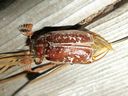
Reddish-brown body, slightly over 2 cm in length. Males have enlarged, with seven antennomeres that are longer than those of females. The antennae form a distinct club. Body form is robust and typical of the Polyphylla.
Habitat
Sandy soils, primarily in coastal regions and near the Great Lakes. Associated with dune and sandy soil where larvae can develop in the soil matrix.
Distribution
Eastern North America: Quebec and Ontario in Canada; south through the northeastern and mid-Atlantic United States to Virginia. Specific records from Delaware, Maine, Maryland, Massachusetts, New Hampshire, New Jersey, New York, Pennsylvania, Rhode Island, Vermont, and Virginia.
Seasonality
are active in June, as indicated by the . Males are attracted to lights after dusk. Activity ceases shortly to several hours after sunset.
Life Cycle
Larvae develop in sandy soils, feeding on roots. do not feed, or feed minimally, as is typical for the . Females are likely flightless or weakly flying, remaining in or near the soil surface while emitting to attract males.
Behavior
Males fly actively at dusk, making loud buzzing sounds. They use their enlarged, splayed to detect female . Males are strongly attracted to artificial lights. Males cease activity and become inactive several hours after sunset, presumably when females stop emitting and burrow back into sand.
Ecological Role
Larvae function as root-feeders in sandy soil . serve as prey for and as potential if they visit flowers, though adult feeding is minimal or absent.
Human Relevance
Attracted to artificial lights, where males are commonly collected. Occasionally mistaken for other June beetles. Not considered an agricultural pest. Collected by entomologists for study of sand dune .
Similar Taxa
- Polyphylla decemlineataLarger size (exceeds 2.5 cm), ten distinct longitudinal stripes on , western North American distribution
- Polyphylla hammondiLarger and more robust body, different geographic distribution (central North America), more pronounced longitudinal lines
- Phyllophaga spp.Smaller that are not strongly , more uniform brown coloration, different and timing
More Details
Sexual dimorphism in antennae
The pronounced in antennal structure is a key feature of the . Males use the enlarged surface area of their to detect low concentrations of female-emitted , enabling them to locate flightless or weakly flying females in sandy .
Female rarity in collections
Females of many Polyphylla , including likely P. variolosa, are rarely collected due to their flightless or weakly flying nature. They remain in or near the soil surface, making them difficult to detect without specialized searching techniques.
Sources and further reading
- BugGuide
- Wikipedia
- GBIF taxonomy match
- iNaturalist taxon
- NCBI Taxonomy
- What a Night for Moths and Spectators! | Bug Squad
- Like a Moth to a Flame: Moth Night at Bohart Museum of Entomology | Bug Squad
- Super duper June bugs | Beetles In The Bush
- 2018 New Mexico/Texas Insect Collecting Trip “iReport” | Beetles In The Bush
- Bug Eric: Results of the Red Rock Canyon Open Space Bioblitz
- Bug Eric: National Moth Week Recap, 2015