
Polyphylla barbata
Cazier, 1938
Mount Hermon June Beetle
Polyphylla barbata is a federally endangered scarab beetle to a single restricted locality in the Zayante sandhills of Santa Cruz County, California. The occupies less than 1,500 acres of , making it one of the most geographically limited beetles in North America. are active in mid-summer, with males flying at dusk to locate flightless females using -detecting . The species severe habitat loss from sand mining and development, with over 40% of its sandhills habitat already destroyed.
Pronunciation
How to pronounce Polyphylla barbata: //ˌpɒlɪˈfɪlə bɑːrˈbɑːtə//
These audio files are automatically generated. While they are not always 100% accurate, they are a good starting point.
Identification
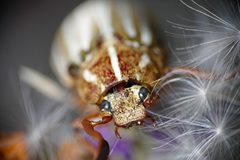
Approximately 2 cm in length; black and brown coloration with broken white longitudinal stripes on the surface; covered with a thin coat of hairs; females slightly larger than males; males possess the enlarged, fan-like characteristic of the Polyphylla, which they hold splayed to detect female . Distinguished from other Polyphylla by its restricted range and association with the Zayante sandhills; most similar to other western sand-dune inhabiting Polyphylla but separated by geography and subtle morphological features.
Images
Habitat
Ponderosa pine forest and chaparral with open, sandy pockets in volcanic hills; specifically restricted to the Zayante sandhills characterized by deep, well-drained sandy soils derived from marine deposits.
Distribution
to California, United States; known only from Santa Cruz County in the Santa Cruz Mountains; single occurrence spanning under 1,500 acres (6.1 km²) centered on Mount Hermon, Scotts Valley, and Ben Lomond.
Seasonality
males fly between mid-June and late July, with peak activity between 8:45 and 9:30 pm; females remain underground except to mate.
Diet
may not feed at all; larvae feed underground on plant roots and mycorrhizal fungi.
Life Cycle
Underground-dwelling larva for most of ; life cycle duration estimated at 2–3 years; male adulthood lasts approximately one week; female dies shortly after laying .
Behavior
Males fly actively at dusk with wings producing a crackling sound; males use greatly enlarged, splayed to detect female ; females are flightless and spend nearly all their time underground, emerging only to mate; males attracted to lights after dusk but cease activity shortly to several hours after sunset.
Ecological Role
Larval root-feeding may influence plant structure in the sandhills ; serves as a component of the unique and threatened Zayante sandhills fauna.
Human Relevance
Federally listed in the United States; threatened by sand mining, urban development, and fire suppression altering native plant ; conservation attention has focused on the Zayante sandhills , which also supports other rare and endangered species including the Zayante band-winged grasshopper (Trimerotropis infantilis) and several rare plants.
Similar Taxa
- Polyphylla hammondiSimilar large size, sand dune preference, and male of splayed for detection; distinguished by geographic separation (Great Plains and western interior) and morphological details.
- Polyphylla decemlineataShared characteristics including enlarged male and activity; distinguished by ten distinct longitudinal white stripes and much broader distribution across western North America.
- Trimerotropis infantilisCo-occurs in the Zayante sandhills and shares endangered status; not a but another sandhills with overlapping conservation concerns.
Sources and further reading
- BugGuide
- Wikipedia
- GBIF taxonomy match
- iNaturalist taxon
- NCBI Taxonomy
- What a Night for Moths and Spectators! | Bug Squad
- Like a Moth to a Flame: Moth Night at Bohart Museum of Entomology | Bug Squad
- Super duper June bugs | Beetles In The Bush
- 2018 New Mexico/Texas Insect Collecting Trip “iReport” | Beetles In The Bush
- Bug Eric: Results of the Red Rock Canyon Open Space Bioblitz
- Bug Eric: National Moth Week Recap, 2015