
Xyloryctes thestalus
Bates, 1888
Western Rhinoceros Beetle
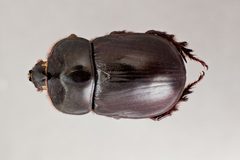
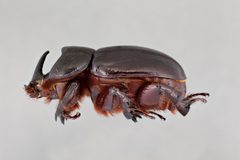
Xyloryctes thestalus is a of rhinoceros beetle in the Scarabaeidae, commonly known as the Western Rhinoceros Beetle. Males possess prominent horns on the and pronotum, a characteristic feature of the Dynastinae . The species is and strongly attracted to lights, often appearing in large numbers at ultraviolet and mercury vapor light setups. It occurs across the southwestern United States and Mexico, with two recognized : X. t. thestalus and X. t. borealis.
Pronunciation
How to pronounce Xyloryctes thestalus: //zaɪloʊˈrɪktiːz θɛsˈtɑːləs//
These audio files are automatically generated. While they are not always 100% accurate, they are a good starting point.
Identification
Distinguished from other Xyloryctes by geographic range and subtle morphological features. Xyloryctes jamaicaensis occurs in eastern North America. Males are immediately recognizable by the combination of horn and pronotal horn; the similar Strategus aloeus (ox beetle) is larger with different horn configuration. Females may be confused with other large scarabs but lack the horns of males and have the characteristic rhinoceros beetle body form.
Images
Appearance
Large, robust scarab beetle with in horn development. Males possess a single, curved horn projecting forward from the and a smaller pronotal horn; females lack horns entirely. Body coloration is typically dark brown to black. are smooth and cover the completely. are (clubbed with plate-like segments), typical of Scarabaeidae. Overall body form is heavy-bodied and somewhat clumsy in .
Habitat
Dry mixed conifer forest with oaks, juniper/oak/pinyon woodland, and riparian corridors in arid and semi-arid regions. Often found in association with juniper, oak, and pinyon pine vegetation. In urban settings, attracted to well-lit areas including service stations and building lights.
Distribution
Southwestern United States (Arizona, California, Colorado, Nevada, New Mexico, Texas, Utah) and throughout Mexico (Aguascalientes, Chiapas, Chihuahua, Coahuila, Distrito Federal, Durango, Guerrero, Hidalgo, Jalisco, México, Michoacán, Morelos, Nayarit, Nuevo León, Oaxaca, Puebla, Querétaro, San Luis Potosí, Sinaloa, Sonora, Tamaulipas, Veracruz, Zacatecas). Also recorded from Guatemala.
Seasonality
active in late summer, with records from June through August. Peak activity appears to coincide with monsoon season in the southwestern United States. , with greatest activity after dusk.
Behavior
Strongly and phototactic, readily attracted to blacklights, ultraviolet lights, and mercury vapor lamps. Often flies with apparent clumsiness. Males have been observed flying around lights in large numbers in urban areas. are active after sunset and throughout the night.
Human Relevance
Frequently encountered by entomologists and naturalists due to its attraction to lights. Considered a spectacular and memorable find by observers. No significant agricultural or economic impacts reported. Occasionally mistaken for other large scarabs.
Similar Taxa
- Xyloryctes jamaicaensisSimilar appearance and horn structure, but occurs in eastern North America rather than the western range of X. thestalus
- Strategus aloeusLarger size with different horn configuration (three pronotal horns in males versus one in Xyloryctes)
- Dynastes tityusEastern Hercules beetle is larger with distinctive yellow coloration and different horn
More Details
Subspecies
Two recognized: Xyloryctes thestalus thestalus Bates, 1888 (nominate subspecies) and Xyloryctes thestalus borealis Endrödi, 1975
Field observations
Described as 'clumsy' in by observers; large numbers can accumulate at light setups, to the point where protective headgear has been humorously suggested