
Strategus aloeus
(Linnaeus, 1758)
ox beetle, Aloeus ox beetle
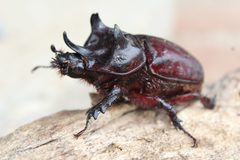
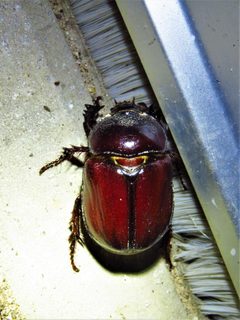
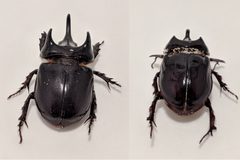
Strategus aloeus is a large rhinoceros beetle in the Scarabaeidae, native to the Americas. The exhibits pronounced and male , with "major" males possessing three prominent thoracic horns resembling Triceratops, while "minor" males have reduced horns and females bear only a small horn used for digging. are and attracted to lights. The species has been documented as a significant pest of young oil palm crops in Latin America, where are strongly influenced by plantation management practices.
Pronunciation
How to pronounce Strategus aloeus: //ˈstrætɛɡəs əˈloʊəs//
These audio files are automatically generated. While they are not always 100% accurate, they are a good starting point.
Identification
Major males unmistakable due to three large thoracic horns; minor males distinguished by reduced horn development compared to majors. Females recognized by small, non-combative horn and larger body size relative to horn length. Distinguished from other Strategus by specific horn configuration and geographic range.
Images
Habitat
Occurs in diverse including sand prairies, oak woodlands, and riparian areas. In the United States, found in sandstone glades, prairies, and areas near water. In Latin America, strongly associated with oil palm plantations where decomposing organic matter from replanting operations provides breeding substrate.
Distribution
Nearctic: southern United States (Alabama, Arizona, Arkansas, Colorado, Florida, Georgia, Louisiana, Mississippi, New Mexico, Texas). Neotropical: Mexico (widespread), Belize, Guatemala, Honduras, El Salvador, Nicaragua, Rica, Panama, Colombia, Venezuela, Trinidad & Tobago, Grenada, Guyana, Suriname, French Guiana, Ecuador, Peru, Bolivia, Brazil (Amapá, Amazonas, Mato Grosso do Sul, Pará, Rondônia, Roraima).
Seasonality
active from May to November in the southern United States. Peak activity during summer months. , frequently collected at lights.
Diet
Larvae feed on roots in soil, including roots of grasses and cultivated plants. feed on flowers and fruits.
Host Associations
- Elaeis oleifera × Elaeis guineensis - pestOil palm OxG interspecific hybrid; significant pest of young palms in Latin America
- Elaeis guineensis - pestAfrican oil palm; affected by bud rot in regions where S. aloeus occurs
Life Cycle
Complete . Larval development takes four to six months to reach pupal stage. period can be shortened in warm conditions. facilitated by decomposing organic matter; in oil palm plantations, highest associated with stem felling and stacking methods, absent where felling and burying is practiced.
Behavior
; frequently attracted to ultraviolet and other light sources. Males use horns in combat for access to females. Females use small horn for digging in soil to lay . Both sexes respond to cues: attracted to male-specific compounds (2,4,7,9-tetramethyl-5-decyne-4,7-diol, sec-butyl acetate, ethyl 4-methyloctanoate) and plant (2-butanone, 3-pentanone).
Ecological Role
Decomposer and herbivore. Larvae contribute to soil nutrient cycling through root feeding and organic matter decomposition. In natural , likely plays role in nutrient turnover. In agricultural contexts, acts as pest affecting young oil palm establishment.
Human Relevance
Agricultural pest in oil palm plantations, particularly in Colombia and broader Latin America. Larvae sometimes considered minor pests of lawns and gardens in the United States due to root feeding. Subject of research for ; -based trapping systems show female-biased capture rates (80:20). Collected by entomologists and enthusiasts due to striking of major males.
Similar Taxa
- Strategus cessusSimilar size and general appearance; distinguished by horn and geographic distribution overlap in Arizona
- Triceratops (dinosaur)Major males superficially resemble this dinosaur due to three-horned configuration; convergent frequently noted in popular accounts
More Details
Semiochemical research
Research has identified a male-specific and plant effective for monitoring and management. Field trials demonstrate high capture rates with optimized blends.
Male polymorphism
Presence of distinct major and minor male morphs represents an example of alternative reproductive tactics, with horn size likely correlating with fighting ability and mating strategy.
Sources and further reading
- BugGuide
- Wikipedia
- GBIF taxonomy match
- iNaturalist taxon
- NCBI Taxonomy
- Catalogue of Life
- Sphecidae | Beetles In The Bush
- Erebidae | Beetles In The Bush | Page 2
- Mate and host semiochemicals as management tools for Strategus aloeus (Coleoptera: Scarabaeidae) in oil palm crops
- Effect of replanting systems on populations of Strategus aloeus (L.) and Rhynchophorus palmarum (L.) associated with the oil palm OxG interspecific hybrid (Elaeis oleifera × Elaeis guineensis) in Southwestern Colombia