
Xyleborus pubescens
Zimmermann, 1868
Xyleborus pubescens is a of bark beetle in the weevil Curculionidae. First described by Zimmermann in 1868, this small wood-boring belongs to a known for fungus-farming , where beetles cultivate symbiotic fungi in tunnels they excavate within wood. The species occurs in North America, with records extending from the Caribbean through Middle America to Canada, including Ontario.
Pronunciation
How to pronounce Xyleborus pubescens: /zaɪˈlɛbərəs pjuˈbɛskɛnz/
These audio files are automatically generated. While they are not always 100% accurate, they are a good starting point.
Identification
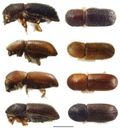
As a member of the Xyleborus, this is a small , typically only a few millimeters in length. Species-level identification within Xyleborus generally requires examination of fine morphological details including pronotal and elytral , declivital characters, and genitalia. The specific epithet "pubescens" suggests the presence of fine, short hairs () on some portion of the body, though this trait alone is insufficient for definitive identification without comparison to closely related species.
Images
Habitat
Found in wooded environments where suitable trees are available. As an ambrosia beetle, it excavates tunnels in wood and cultivates fungal gardens for food.
Distribution
Recorded from North America, Middle America, and the Caribbean. Specific records include Ontario, Canada. The full extent of its native versus introduced range is not well documented.
Diet
Feeds on symbiotic fungi cultivated within wood tunnels; does not consume wood directly. The specific fungal associates of X. pubescens have not been documented.
Life Cycle
Typical of Xyleborus, this likely has a haplodiploid with inbreeding sib-mating, where females are and males are haploid. Females initiate galleries in wood and introduce fungal spores carried in specialized mycangia. Larvae feed on the cultivated fungus. Specific details for X. pubescens have not been published.
Behavior
Exhibits ambrosia beetle : females bore into wood, establish fungal gardens in tunnels, and rear . Males are typically flightless and remain within the natal gallery.
Ecological Role
Contributes to wood decomposition and nutrient cycling through fungal in dead or dying wood. May fungal , though its specific ecological impact has not been studied.
Similar Taxa
- Xyleborus glabratusAnother North American Xyleborus , but distinguished by being a significant pest spreading laurel wilt ; X. pubescens has not been documented as a
- Other Xyleborus speciesMany in this are morphologically similar and require detailed examination of declivital slopes, punctation patterns, and genitalia for separation
More Details
Taxonomic note
Xyleborus is a large within the tribe Xyleborini, historically placed in the but now treated as a (Scolytinae) within Curculionidae. The genus is characterized by social and fungus-farming that have evolved independently multiple times within weevils.
Data limitations
Despite being described in 1868, X. pubescens remains poorly studied. Only 16 observations are recorded in iNaturalist, and no peer-reviewed studies specifically addressing its , associations, or fungal were found in the provided sources.
Sources and further reading
- BugGuide
- Wikipedia
- GBIF taxonomy match
- iNaturalist taxon
- Catalogue of Life
- Forest Pest Invasions Can—And Should—Be Studied Before They Happen
- August | 2021 | Beetles In The Bush
- The Ambrosia Beetle Megaplatypus mutatus: Tiny but Destructive
- The Best Look Yet at the Tiny Fungus Storage Units Inside Ambrosia Beetles
- Botanizing at Hawn State Park | Beetles In The Bush
- Missouri | Beetles In The Bush | Page 6