
Cyclorhipidion bodoanum
(Reitter, 1913)
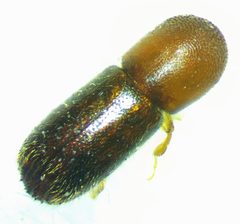
An ambrosia beetle native to East Asia, now established in North America and Europe. First detected in Europe in 1960 in Alsace, France, with subsequent slow expansion across the continent. Confirmed in the Bohemian Massif of the Czech Republic in 2020, demonstrating continued eastward spread. Frequently introduced to new regions through international trade in wood and wood products.


Pronunciation
How to pronounce Cyclorhipidion bodoanum: /ˌsaɪkloʊˈrɪpɪdiən boʊˈdoʊənəm/
These audio files are automatically generated. While they are not always 100% accurate, they are a good starting point.
Images
Habitat
Forests with well-spaced oak trees of various ages.
Distribution
Native to eastern Siberia, Korean Peninsula, Northeast China, Southeast Asia, and Japan. Introduced to North America and Europe. In Europe, first recorded in Alsace, France in 1960; subsequently spread north, southeast, and east; confirmed in western Czech Republic (Bohemian Massif) in 2020. GBIF records indicate presence in the Netherlands and doubtful records for Belgium, France, and Great Britain.
Behavior
Spreads slowly through natural ; the ~60 year expansion from France/Switzerland borders to Bohemia suggests gradual movement. Has been introduced repeatedly to new areas via international trade of wood and wood products. May remain undetected for periods after establishment in new regions.
Human Relevance
Pest of forestry concern due to status and association with international wood trade. Monitoring of spread is important for forest management.
More Details
Taxonomic Note
Listed as a synonym of Xyleborus bodoanus in GBIF, though widely referenced under Cyclorhipidion bodoanum in recent invasion literature.
Spread Dynamics
The 2020 Czech Republic record is geographically isolated from other Central European , suggesting independent introduction or long-distance event rather than continuous range expansion.