
Cyclorhipidion
Hagedorn, 1912
Species Guides
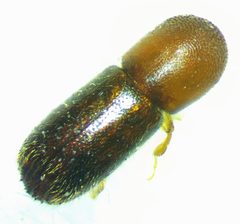
2Cyclorhipidion is a of ambrosia beetles in the Curculionidae, established by Hagedorn in 1912. The genus has nearly distribution and includes multiple , some of which are . Cyclorhipidion bodoanum, a well-documented species, is native to eastern Asia and has spread to Europe and North America through international wood trade. Members of this genus are associated with forest and are attracted to ethanol-baited traps.


Pronunciation
How to pronounce Cyclorhipidion: /ˌsɪkloʊˈrɪpɪdiˌɒn/
These audio files are automatically generated. While they are not always 100% accurate, they are a good starting point.
Images
Habitat
Forests, including stands of well-spaced oak trees of various ages. have been captured in ethanol-baited insect traps in forested environments.
Distribution
Native range includes eastern Siberia, the Korean Peninsula, Northeast China, Southeast Asia, and Japan. Introduced to North America and Europe. In Europe, first recorded in 1960 in Alsace, France, with subsequent spread to the north, southeast, and east; confirmed present in Belgium, France, and the Netherlands; recorded in the Czech Republic by 2020. GBIF records indicate presence in Denmark.
Host Associations
- oak trees - associationBased on capture location in oak forest; specific feeding relationship not confirmed
Behavior
Frequently introduced to new regions through international trade of wood and wood products. Attracted to ethanol-baited insect traps. Spread rate appears slow; Cyclorhipidion bodoanum took approximately 60 years to spread from France/Switzerland borders to the Bohemian Massif, though detection gaps may affect this estimate.
Human Relevance
of concern in Europe and North America due to spread via international wood trade. Monitoring relies on ethanol-baited traps in forest management and biosecurity contexts.
More Details
Taxonomic note
The Cyclorhipidion belongs to the weevil Curculionidae, specifically within the ambrosia beetle lineage. -level has been revised, with multiple species described by Smith, Beaver & Cognato in 2020.
Invasion biology context
Cyclorhipidion bodoanum exemplifies the slow-burn invasion pattern sometimes seen in wood-boring beetles: long lag periods between introduction and detection, followed by gradual range expansion. This pattern complicates management and risk assessment.