
Scolytus schevyrewi
Semenov, 1902
Banded Elm Bark Beetle
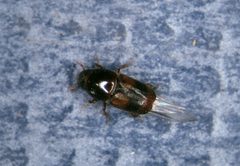
Scolytus schevyrewi is a small bark beetle native to Asia that has become in North America. It is a documented of (Ophiostoma ulmi and O. novo-ulmi). The exhibits strong attraction to stressed or weakened trees, particularly Ulmus pumila, and has been observed displacing both native elm bark beetles and the earlier-introduced smaller European elm bark beetle (S. multistriatus) in North America. In its native range, it also causes significant damage to fruit trees including apricot.
Pronunciation
How to pronounce Scolytus schevyrewi: /ˈskoʊlɪtəs ʃɛvɪˈrɛwi/
These audio files are automatically generated. While they are not always 100% accurate, they are a good starting point.
Identification
are morphologically similar to Scolytus multistriatus (smaller European elm bark beetle) and cannot be reliably distinguished by external characters alone. provides definitive identification. analysis with specific oligonucleotide primers yields distinct banding patterns and can identify both adults and larvae. External morphology is highly variable within species, making identification based on adult appearance problematic.
Images
Habitat
Urban and forested areas with elm trees; primarily colonizes weakened, water-stressed, or wilting trees rather than healthy . In China, found in fruit tree causing damage to apricot orchards. Laboratory rearing successful at 26.5°C with 14:10 light:dark cycle and 65% relative humidity.
Distribution
Native to Asia: China (Hebei, Heilongjiang, Henan, Ningxia, Qinghai, Shaanxi, Xinjiang), Kazakhstan, Korea, Kyrgyzstan, Mongolia, Tajikistan, Turkmenistan, Uzbekistan, and eastern Siberia/Russian Far East. Introduced to North America: Canada (Alberta, Manitoba, Ontario, Saskatchewan) and USA (Arizona, California, Colorado, Connecticut, Idaho, Illinois, Indiana, Kansas, Maryland, Michigan, Minnesota, Missouri, Montana, Nebraska, Nevada, New Jersey, New Mexico, North Dakota, Ohio, Oklahoma, Oregon, Pennsylvania, South Dakota, Texas, Utah, Virginia, Washington, Wyoming). First detected in Canada in 2007.
Seasonality
activity observed from May to October in Saskatchewan and Manitoba, Canada.
Diet
Xylem-feeding; larvae develop in phloem and outer xylem of tree branches and stems. feed on xylem of host trees.
Host Associations
- Ulmus pumila - primary strongly attracted to water-stressed trees; successfully colonized for breeding
- Ulmus americana - spore source acquire fungal spores but not colonized for breeding in Saskatchewan/Manitoba study
- Ulmus - poor attraction to healthy trees
- Armeniaca vulgaris - laboratory used for rearing in Chinese studies
- Armeniaca spp. - causes serious damage to apricot trees in Xinjiang Province, China
- Caragana korshinskii - Korshinsk pea shrub
- Elaeagnus spp. - oleaster
- Prunus spp. - plum
- Pyrus bretschneideri - yali pear
- Salix babylonica - weeping willow
Life Cycle
deposited in galleries constructed in phloem of trees. Larvae feed and develop in phloem and outer xylem, creating characteristic gallery patterns. occurs within host material. emerge from galleries; emerging adults from diseased trees frequently carry fungal spores. Adults can be collected daily upon in laboratory settings.
Behavior
Exhibits mediated by male-produced . Strongly attracted to volatiles from stressed or freshly cut material, particularly Ulmus pumila and apricot logs. Antennal response to host volatiles includes detection of (1S)-(−)-α-pinene, (±)-limonene, (1S)-(+)-3-carene, and 1-hexanol. Repelled by octanal, nonanal, decanal, linalool, and N,N-diethylformamide at tested concentrations. acquire fungal spores when developing in infected trees and transmit when contacting xylem of healthy trees during feeding.
Ecological Role
of Ophiostoma ulmi and Ophiostoma novo-ulmi. competitor displacing native Scolytus and earlier-introduced S. multistriatus in North America. Significant pest of fruit industry in China, particularly apricot production in Xinjiang Province. Primary association with Ulmus pumila in North America, which rarely exhibits Dutch elm disease in Saskatchewan and Manitoba, potentially limiting impact in that region.
Human Relevance
Economic pest of fruit orchards in China. Threat to urban and forest elm in North America as of . Subject of monitoring and management efforts using -based traps. Displacement of earlier bark beetle invaders alters forest pest composition.
Similar Taxa
- Scolytus multistriatusSmaller European elm bark beetle; morphologically similar with overlapping size range and external character variability; distinguished reliably by or markers; displaced by S. schevyrewi in North America
- Native Scolytus elm bark beetlesNative North American ; being displaced by S. schevyrewi throughout its expanding range
More Details
Olfactory Biology
Antennal transcriptome analysis identified 47 odorant receptors (ORs), 22 ionotropic receptors (IRs), 22 odorant-binding proteins (OBPs), and 11 chemosensory proteins (CSPs). ScosOBP2 and ScosOBP18 are highly expressed in female ; ScosCSP2, ScosCSP3, and ScosCSP5 are specifically expressed in antennae of both sexes, providing potential molecular targets for management.
Competitive Displacement
In North America, S. schevyrewi is actively displacing both native elm bark beetles and the previously introduced S. multistriatus, which are becoming less common throughout their ranges as S. schevyrewi expands.
Disease Vector Capacity
While confirmed as a of , field studies in Saskatchewan and Manitoba found S. schevyrewi primarily colonizes Ulmus pumila rather than U. americana (the main local pathogen source), suggesting regional variation in risk.
Sources and further reading
- BugGuide
- Wikipedia
- GBIF taxonomy match
- iNaturalist taxon
- NCBI Taxonomy
- Catalogue of Life
- Scolytus schevyrewi . [Distribution map].
- Identification of Candidate Olfactory Genes in Scolytus schevyrewi Based on Transcriptomic Analysis
- Bionomics ofScolytus schevyrewi(Coleoptera: Curculionidae) in Saskatchewan and Manitoba, Canada
- Characterization of two non-native invasive bark beetles, Scolytus schevyrewi and Scolytus multistriatus (Coleoptera: Curculionidae: Scolytinae)
- Behavioral Responses of Scolytus schevyrewi (Coleoptera: Curculionidae: Scolytinae) to Volatiles From Apricot Tree (Rosales: Rosaceae)
- Breeding behaviour of the bark beetle Scolytus schevyrewi Semenov (Col., Scolytidae) in Ulmus pumila
- Host Acceptance and Larval Competition in the Banded and European Elm Bark Beetles, Scolytus schevyrewi and S. multistriatus (Coleoptera: Scolytidae): Potential Mechanisms for Competitive Displacement between Invasive Species