
Scolytus multistriatus
(Marsham, 1802)
European elm bark beetle, smaller European elm bark beetle
Scolytus multistriatus is a small bark beetle in the Scolytinae that infests elm trees (Ulmus spp.). It is a known of caused by the fungus Ophiostoma ulmi, though it is less effective than the related Scolytus scolytus. The uses chemical cues including vanillin and syringaldehyde to locate trees during oviposition. It has been introduced to North America and other regions beyond its native European range, where it contributes to elm decline through transmission and direct tree damage.
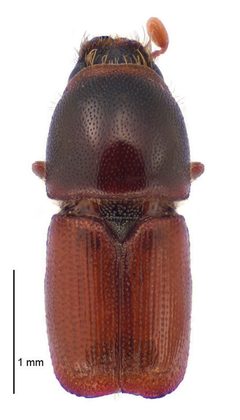
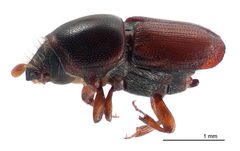
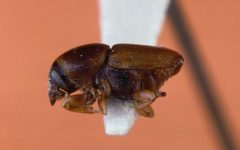
Pronunciation
How to pronounce Scolytus multistriatus: /ˈskɒlɪtəs ˌmʌltɪˈstraɪətəs/
These audio files are automatically generated. While they are not always 100% accurate, they are a good starting point.
Identification
can be distinguished from the similar Scolytus schevyrewi (banded elm bark beetle) by ; external morphological characters alone are unreliable due to wide within- variability. markers () produce distinct banding patterns that can identify both adults and larvae. The gallery pattern in elm wood is characteristic: the female creates a mother gallery with laid in notches along the sides, and larval galleries radiate from this central tunnel. The antennal club has basiconica (long type) as the predominant type across all three fields, unlike S. scolytus where sensilla trichodea type II predominate in field three.
Images
Appearance
are small, cylindrical bark beetles typical of the Scolytus. The antennal club contains basiconica (long type) as the predominant sensilla, comprising 63–68% of sensilla on the antennal club, with sensilla trichodea type II and III also present. The is diagnostic and can be used to distinguish this from the morphologically similar Scolytus schevyrewi. Larvae are whitish, wrinkled, legless with brown scaly , closely resembling other Scolytus larvae.
Habitat
Associated with elm trees (Ulmus spp.), specifically colonizing the inner bark and sapwood of living, dying, or recently dead elms. In Europe, has been documented on Ulmus glabra (wych elm).
Distribution
Native to Europe, with documented occurrence in Austria, Belgium, Britain, Bulgaria, Corsica, Czechoslovakia, France, Germany, Greece, Hungary, Italy, Netherlands, Poland, Portugal, Romania, Spain, Switzerland, and Yugoslavia. Also recorded in Iran, Algeria, and Egypt. Introduced to North America (Canada and USA) and Australia, where it is established as a non-native .
Diet
Larvae feed on phloem and sapwood tissue of elm trees. may feed on bark tissue, though specific adult feeding habits are not well documented in available sources.
Host Associations
- Ulmus - Primary ; includes Ulmus glabra and other elm
- Ophiostoma ulmi - Transmits the fungus causing ; less effective than Scolytus scolytus
Life Cycle
Females enter trees to construct galleries (mother galleries) in the inner bark, laying eggs in notches along the gallery sides. Larvae develop within the phloem and sapwood, creating characteristic larval galleries that radiate from the mother gallery. Larvae are legless, whitish with brown scaly . occurs within the gallery system. The overwinters as larvae or , though specific stage varies. Developmental stages (egg, larva, pupa, adult) all occur within the host tree.
Behavior
Uses olfactory cues for location: vanillin and syringaldehyde serve as signals to find host trees during oviposition. Females bore into host tree bark to construct galleries for -laying. and larvae are confined to the inner bark and sapwood of host trees. Phoretic mites and are carried on or within adults, including under the and inside the .
Ecological Role
Primary of fungus Ophiostoma ulmi, contributing to elm tree mortality and forest change. Galleries and feeding activity damage wood structure, altering hydrogen bond patterns in cellulose and affecting wood strength. Serves as for (e.g., Dendrosoter protuberans) and associated mites and . May facilitate fungal of wood through gallery construction and introduction of symbiotic fungi.
Human Relevance
Significant forest pest and in North America and other introduced ranges. Causes economic damage through tree mortality and reduced timber quality. of , which has devastated urban and forest elm across multiple continents. Subject to and early detection programs; identification tools including genitalia and markers are used for monitoring. efforts include introductions.
Similar Taxa
- Scolytus scolytusLarger European elm bark beetle; more effective of ; differs in antennal distribution (sensilla trichodea type II predominate in field three of antennal club versus sensilla basiconica in S. multistriatus)
- Scolytus schevyrewiBanded elm bark beetle; morphologically similar external appearance; distinguished by and markers ()
- Scolytus pygmaeusSmaller elm bark beetle with which it shares mite associates and ; differs in size and gallery characteristics
More Details
Chemical ecology
Uses vanillin and syringaldehyde as -finding signals during oviposition, indicating specialized chemical detection adaptations for locating suitable elm hosts.
Associated organisms
Carries phoretic mites including Pyemotes scolyti (most frequent), Pseudotarsonemoides eccoptogasteri, Trichouropoda bipilis, and others. associates include Cryptaphelenchus sp. under and Neoparasitylenchus sp. inside (the latter not found in S. pygmaeus). Parasitaphelenchus oldhami is a known .
Wood chemistry effects
Feeding damage alters wood ultrastructure: breakdown of strong intermolecular hydrogen bonds in cellulose occurs, with increased intramolecular bonding, potentially affecting water metabolism in wood and reducing trunk strength.
Sources and further reading
- BugGuide
- Wikipedia
- GBIF taxonomy match
- iNaturalist taxon
- NCBI Taxonomy
- Catalogue of Life
- Scolytus multistriatus . [Distribution map].
- The change in the structure of hydrogen bonds in elm wood due to damage by European elm bark beetle Scolytus multistriatus (Marsham) (Coleoptera: Curculionidae, Scolytinae)
- A Redescription of Parasitaphelenchus Oldhamirühm, 1956 (Nematoda: Aphelenchoididae) to a Parasite of Two Elm Bark Beetles: Scolytus scolytus and S. multistriatus, Together With Some Notes on Its Biology
- Relative effectiveness of Scolytus scolytus, S. multistriatus and S. kirschi as vectors of Dutch elm disease
- Morphology of the antennal club of Scolytus scolytus (F.) and S. multistriatus (Marsham) (Coleoptera, Scolytidae)
- Survival of Dendrosoter protuberans,1 a Parasitoid of Scolytus multistriatus,2 in Colorado
- The Biology and Forest Importance of Scolytus (Eccoptogaster) multistriatus (Marsh)
- Characterization of two non-native invasive bark beetles, Scolytus schevyrewi and Scolytus multistriatus (Coleoptera: Curculionidae: Scolytinae)
- Phoretic mites and nematode associates of Scolytus multistriatus and Scolytus pygmaeus (Coleoptera: Scolytidae) in Austria