
Scolytus mali
(Bechstein, 1805)
larger shothole borer, apple bark beetle, large fruit bark beetle
Scolytus mali is a bark beetle native to Europe that has become in North America. It is commonly known as the larger shothole borer or apple bark beetle, reflecting its association with fruit trees. The exhibits brief maturation feeding on living but weakened apple trees before aggregating for breeding in response to female-produced . Both sexes possess a well-developed gular-prosternal stridulatory apparatus and produce characteristic double chirps through movement, with distinct acoustic differences between stress and attraction signals.
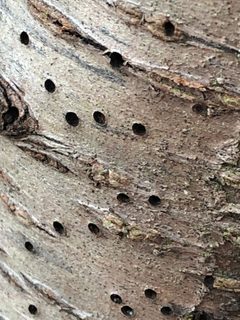
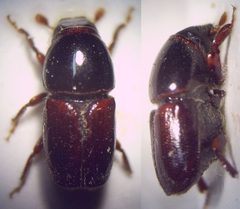
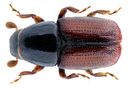
Pronunciation
How to pronounce Scolytus mali: /ˈskɒlɪtəs ˈmeɪlaɪ/
These audio files are automatically generated. While they are not always 100% accurate, they are a good starting point.
Identification
As a Scolytus , this belongs to a of typical bark beetles characterized by cylindrical bodies and clubbed . Specific diagnostic features for S. mali relative to are not documented in available sources. The species is distinguished from the related shothole borer Scolytus rugulosus by taxonomic separation, though both may occur on similar .
Images
Habitat
Breeding occur on trees with branches killed the previous year; whole trees are progressively killed over several years. Maturation feeding takes place on living but weakened apple trees.
Distribution
Native to Europe; in North America. Present in Belgium and other European countries, with established in North America.
Diet
Larvae feed under bark in galleries; engage in brief maturation feeding on living but weakened apple trees before .
Host Associations
- Malus - maturation feeding and breeding apple trees
- Prunus padus - associated bird cherry
- Prunus domestica - associated common European plum
Life Cycle
After approximately five days of maturation feeding, mature and beetles leave feeding sites to aggregate for breeding. Mating has been observed at maturation feeding sites, though males also occur in breeding galleries. The can complete its on pear fruit alone under artificial conditions.
Behavior
aggregate for breeding in response to a female-produced . Both sexes stridulate, producing a double chirp through upward and downward motion. Males respond to females by entering galleries and producing attraction chirps acoustically distinct from stress chirps. Released volatiles include limonene, alpha-pinene, and car-3-ene.
Ecological Role
As a bark beetle, contributes to tree mortality and nutrient cycling through dead wood creation. Progressive tree killing over multiple years suggests a role in forest decline dynamics.
Human Relevance
Considered a pest of apple and other fruit trees. The Pacific flatheaded borer Chrysobothris mali (a different with similar ) has been documented damaging pear fruit in California, but this appears to be a distinct . Serves as a for the Bursaphelenchus eucarpus.
Similar Taxa
- Scolytus rugulosusAlso known as shothole borer; both occur on Prunus and may be confused due to similar and
- Chrysobothris maliShares the 'apple bark beetle' and similar associations, but belongs to Buprestidae (jewel beetles) rather than Curculionidae; distinguished by larval damage to pear fruit and metallic coloration
Misconceptions
The 'apple bark beetle' is shared with Chrysobothris mali, a flatheaded borer in Buprestidae, leading to potential confusion between these unrelated .
More Details
Acoustic communication
The stridulatory apparatus is gular-prosternal and well developed in both sexes. Stridulation produces a characteristic double chirp (phonatom) through fore-and-aft movement. Male attraction chirps differ significantly from stress chirps and from female chirps.
Semiochemicals
Female-produced mediates breeding aggregation. volatiles identified include limonene, alpha-pinene, and car-3-ene.
Sources and further reading
- BugGuide
- Wikipedia
- GBIF taxonomy match
- iNaturalist taxon
- NCBI Taxonomy
- Catalogue of Life
- Cindy Kron: Adventures of the North Coast Area Extension Entomologist | Bug Squad
- Coleoptera | Blog - Part 2
- A non-black background is better… often! | Beetles In The Bush
- Advances in Sterile Insect Technique Driven by Sugarcane Pest Management in South Africa
- Taxon Expeditions | Blog
- Bug Eric: Polyester Bees
- Sound production in Scolytidae: Attraction and stridulation of Scolytus mali (Col., Scolytidae)
- Redescription of Bursaphelenchus eucarpus Rühm, 1956 (Nematoda: Aphelenchoididae) associated with the apple bark beetle, Scolytus mali Bechstein, and the shothole borer, S. rugulosus Müller