
Scolytus rugulosus
Ratzeburg, 1837
shothole borer, fruit tree bark beetle, apple tree beetle
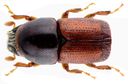
Scolytus rugulosus is a bark beetle in the Curculionidae, commonly known as the shothole borer or apple tree . The is native to Europe and has been introduced to the Americas and North Asia. It is a pest of stone and pome fruit trees in the family Rosaceae, where it tunnels beneath the bark to complete its .
Pronunciation
How to pronounce Scolytus rugulosus: /ˈskɔl.ɪ.təs ruːˈɡuː.loʊ.səs/
These audio files are automatically generated. While they are not always 100% accurate, they are a good starting point.
Identification
The specific epithet "rugulosus" refers to the finely wrinkled surface texture of the . As a member of the Scolytus, it can be distinguished from other bark beetles by its cylindrical body form and the characteristic gallery patterns it creates in bark. Positive identification to level requires examination of detailed morphological features not described in available sources.
Images
Habitat
Associated with the bark and cambium of living or damaged Rosaceae trees, particularly fruit trees. Larval galleries and pupal chambers occur in tunnels just beneath the bark surface.
Distribution
Native to Europe; introduced to North America, South America, and North Asia. Documented from: Europe (Albania, Austria, Belgium, Britain, Bulgaria, Czechoslovakia, Denmark, Finland, France, Germany, Greece, Hungary, Italy, Malta, Netherlands, Norway, Poland, Portugal, Sicily, Spain, Sweden, Switzerland, Yugoslavia), Asia (Afghanistan, Cyprus, Iran, Iraq, Israel, Lebanon, Pakistan, Saudi Arabia, Syria, Turkey), Africa (Algeria, Egypt, Libya, Morocco, Tunisia), North America (Canada, USA), and South America (Argentina, Brazil, Chile, Peru, Uruguay).
Seasonality
emerge in late spring (May in the northern hemisphere). Second- adults emerge in summer (mid-August in the northern hemisphere). Two or three generations may occur per year. Overwinters as mature larvae or pupae in tunnels under bark.
Diet
Feeds on various of Rosaceae, with documented association with Prunus padus (bird cherry) and Prunus domestica (common European plum). Utilizes damaged branches and trunks of stone-fruit and pome-fruit trees.
Host Associations
- Prunus padus - bird cherry
- Prunus domestica - common European plum
Life Cycle
Females bore into the cambium of susceptible trees and lay in pockets along tunnel walls. Larvae develop in galleries beneath the bark. Overwinters as mature larvae or pupae in tunnels just under the bark. emerge in late spring, with potential for two or three per year depending on conditions.
Behavior
Females initiate gallery construction by boring into the cambium of trees. The is known to the Bursaphelenchus eucarpus, which has been isolated from larval galleries and .
Ecological Role
Primary cambium feeder that creates galleries in the bark of Rosaceae trees. Acts as a for the Bursaphelenchus eucarpus. increases may occur on damaged or stressed trees.
Human Relevance
Recognized as a pest of stone-fruit and pome-fruit trees in orchards and cultivated settings. (apple tree , fruit tree bark beetle, shothole borer) reflect its economic association with cultivated fruit trees.
Similar Taxa
- Scolytus maliSimilar bark beetle also associated with apple and other Rosaceae; both species Bursaphelenchus eucarpus and occur in similar under bark of Prunus species.
More Details
Taxonomic authorship
Originally described as Bostrichus rugulosus by Otto Friedrich Müller in 1818, then transferred to Scolytus rugulosus by the same author. The combination S. rugulosus (Ratz.) is erroneous; the valid authority is Ratzeburg, 1837 per modern sources.
Nematode association
Documented of the Bursaphelenchus eucarpus (Aphelenchoididae), which occurs in larval galleries and on of this .
Sources and further reading
- BugGuide
- Wikipedia
- GBIF taxonomy match
- iNaturalist taxon
- NCBI Taxonomy
- Catalogue of Life
- Bembicid Holdings | Entomology Research Museum
- EU responsible for extinction domino effect on frog populations |
- Scolytus rugulosus . [Distribution map].
- Redescription of Bursaphelenchus eucarpus Rühm, 1956 (Nematoda: Aphelenchoididae) associated with the apple bark beetle, Scolytus mali Bechstein, and the shothole borer, S. rugulosus Müller