
Polygraphus
Erichson, 1836
four-eyed fir bark beetles, polygraphus bark beetles
Species Guides
1- Polygraphus rufipennis(Four-eyed Spruce Bark Beetle)
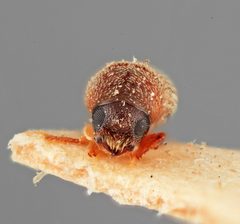
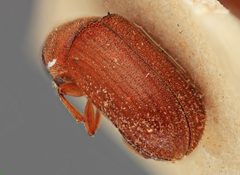
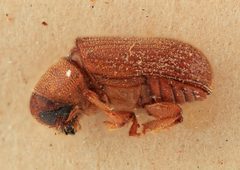
Polygraphus is a of bark beetles (Coleoptera: Curculionidae: Scolytinae) in the tribe Polygraphini. in this genus are phloephagous, feeding on the inner bark of coniferous trees, particularly fir (Abies) and spruce (Picea). The genus includes both native and , with Polygraphus proximus being the most economically significant due to its spread across Russia and mass mortality impacts on fir forests. Members exhibit monogynous mating systems and produce species-specific stridulatory signals.
Pronunciation
How to pronounce Polygraphus: //pɒlɪˈɡræfəs//
These audio files are automatically generated. While they are not always 100% accurate, they are a good starting point.
Identification
within Polygraphus can be distinguished by morphological features of the and pronotum, as well as by their species-specific stridulatory signals. Acoustic analysis reveals diagnostic differences in chirp duration, interchirp interval, number of tooth-strikes per chirp, and intertooth-strike interval among sympatric species such as P. proximus, P. subopacus, and P. nigrielytris. Entry hole distribution patterns and gallery architecture (number and orientation of gallery arms) may also aid in species identification where biological data are available.
Images
Habitat
Forests dominated by coniferous , particularly fir (Abies) and spruce (Picea) . In native ranges, species inhabit mountain forests at elevations of 1500–2500 m. In ranges, species colonize middle taiga forests and mixed stands of varying age and health condition. Some species occur in sympatry on the same host plants, while others occupy distinctly different host species within the same .
Distribution
Holarctic distribution with centers of diversity in East Asia and North America. Native range of P. proximus includes northeastern China, Korea, Japan, and the southern Russian Far East. established in European Russia and Western Siberia. Other such as P. rufipennis occur in North America (Canada, New Brunswick, Vermont). Records from Scandinavia (Denmark, Norway, Sweden) and the United States.
Diet
Phloephagous; feeds on phloem tissue of woody plants. Primary are fir (Abies spp.) and spruce (Picea spp.), with -specific host preferences documented.
Host Associations
- Abies sibirica - primary Siberian fir; main for P. proximus in Western Siberia
- Abies veitchii - Veitch's fir; mass mortality documented in Japan
- Abies firma - Momi fir
- Abies holophylla - Manchurian fir
- Abies homolepis - Nikko fir
- Abies mariesii - Maries' fir
- Abies nephrolepis - Khingan fir
- Abies sachalinensis - Sakhalin fir
- Picea glauca - white spruce; primary for P. rufipennis
- Picea mariana - black spruce; less favorable for P. rufipennis
- Picea rubens - red spruce; most favorable for P. rufipennis due to thicker, more scaly bark
Life Cycle
bore into bark to initiate gallery systems. Males typically excavate entry holes and initial tunnels, with females entering to mate. Females construct double-armed horizontal mother-galleries beneath the bark for oviposition. Larvae feed and develop within the phloem, constructing individual galleries. Each offspring creates its own exit hole upon . Gallery systems typically contain 2–3 galleries of 3–7 cm oriented horizontally, with maximum horizontal length approximately 14 cm.
Behavior
Males produce that attract both sexes, with male-only sources showing maximum attractiveness in field experiments. exhibit monogynous mating systems despite constructing multiple gallery arms. attack trees at uniform spatial intervals to avoid in the phloem, though aggregated distributions emerge at higher attack densities and in association with rough bark texture. Both sexes may re-emerge from galleries after initial . Stridulatory signals function in interactions, with airborne signals produced during male-male contact.
Ecological Role
Primary consumers of phloem tissue in coniferous forests. cause rapid forest degradation and loss of natural biological diversity. Act as for associated fungi and mites. In phases, may colonize fresh-cut logs and trees weakened by fire, , storms, or defoliation. In phases, species can kill healthy trees and cause mass mortality of undergrowth and mature forest stands. Associated organisms include phoretic mites (Tarsonemus spp.) and fungal .
Human Relevance
Major forest pest in ranges, particularly P. proximus in Russia. Causes economic losses through timber degradation and forest mortality. Impacts natural potential of fir forests and alters structure. Subject to monitoring and efforts. -based trapping systems developed for monitoring and management.
Similar Taxa
- DendroctonusBoth contain tree-killing bark beetles with similar gallery systems, but Polygraphus typically have multiple gallery arms and monogynous mating systems, whereas Dendroctonus species often exhibit harem- and different systems.
- IpsBoth are scolytine bark beetles with similar ecological roles, but Ips typically construct H- or I-shaped galleries with multiple females per male (), while Polygraphus species have double-armed horizontal galleries and monogynous systems.
- ScolytusBoth contain phloephagous bark beetles, but Scolytus generally have simpler gallery architectures and different associations, often with hardwoods in addition to conifers.
More Details
Mating system clarification
Despite earlier assumptions of based on multiple gallery arms and tribal characteristics, detailed field studies have confirmed that P. proximus is strictly monogynous, with only one male per gallery and rare occurrence of multiple females (2.8% of galleries). The multiple gallery arms represent an architectural feature rather than evidence of harem-polygyny.
Aggregation pheromone source
Field experiments confirmed that males are the primary source of in P. proximus, contradicting some earlier laboratory studies. This discrepancy appears due to behavioral responses to pheromone concentration differences between natural and confined laboratory conditions.
Acoustic communication
-specific stridulatory signals in sympatric Polygraphus species function in species recognition and interactions, with chirp duration, tooth-strike number, and interval patterns serving as diagnostic acoustic characters.
Sources and further reading
- BugGuide
- GBIF taxonomy match
- iNaturalist taxon
- NCBI Taxonomy
- Catalogue of Life
- Fungi associated with Dendroctonus rufipennis and Polygraphus rufipennis, and white spruce inoculation tests
- Distribution pattern of entry holes of the tree-killing bark beetle Polygraphus proximus
- THE NATURAL POTENTIAL OF REGENERATION IN FIR FORESTS, DAMAGED DURING THE INVASION OF POLYGRAPHUS PROXIMUS
- Distribution and population characteristics of the four-eyed fir bark beetle Polygraphus proximus in the north of the Tomsk Oblast
- Males of the invasive bark beetle Polygraphus proximus Blandford (Coleoptera, Curculionidae, Scolytinae) as a source of aggregation pheromone: results of a field experiment
- Mass reproduction of Polygraphus proximus Blandford in fir forests of Siberia infected with root and stem pathogens: monitoring, patterns, biological control
- Interspecific differences of stridulatory signals in three species of bark beetles from the genus Polygraphus Er. (Coleoptera: Curculionidae, Scolytinae) inhabiting the island of Sakhalin
- Some Relationships Between Polygraphus rufipennis (Kirby) (Coleoptera: Scolytidae) and Spruces in New Brunswick
- Mating Systems of the Tree-Killing Bark Beetle Polygraphus proximus (Coleoptera: Curculionidae: Scolytinae)
- THE EFFECTS OF BARK MOISTURE ON POLYGRAPHUS RUFIPENNIS (COLEOPTERA: SCOLYTIDAE) ADULTS AND THEIR DEVELOPING BROODS
- Host Preferences of the Bark Beetle Polygraphus proximus Blandford (Coleoptera: Curculionidae: Scolytinae) in Japan during an Endemic Population Phase
- Interspecific differences of stridulatory signals in three species of bark beetles from the genus Polygraphus Er. (Coleoptera: Curculionidae, Scolytinae) inhabiting the island of Sakhalin
- Natural regeneration in Siberian fir (Abies sibirica Ledeb.) forests subjected to invasion of the four-eyed fir bark beetle (Polygraphus proximus Blandf.)
- On monogyny of the four-eyed fir bark beetle Polygraphus proximus Blandf. (Coleoptera, Curculionidae: Scolytinae) and its reproductive behavior
- A new species of Tarsonemus (Acari: Tarsonemidae) associated with the bark beetle, Polygraphus proximus (Coleoptera: Curculionidae: Scolytinae) from the Far East of Russia