
Pityogenes
Bedel, 1888
bark beetles
Species Guides
7Pityogenes is a of bark beetles in the Curculionidae, comprising over 30 described distributed across the Northern Hemisphere. Species in this genus are primarily associated with coniferous trees, with P. chalcographus being the most extensively studied due to its economic significance as a pest of Norway spruce. The genus exhibits typical scolytine characteristics including communication and specialized -finding . Some species demonstrate notable geographic variation in and genetics, suggesting differentiation across their ranges.
Pronunciation
How to pronounce Pityogenes: /ˌpɪtiˈɒdʒɪniːz/
These audio files are automatically generated. While they are not always 100% accurate, they are a good starting point.
Identification
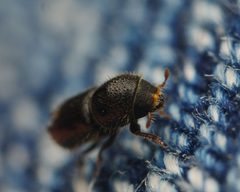
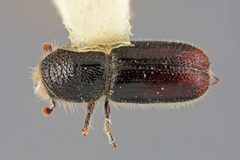
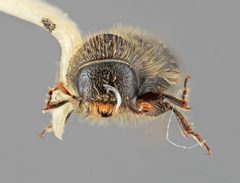
of Pityogenes are small bark beetles, typically 2-4 mm in length, with cylindrical bodies adapted for burrowing under bark. Males of some species exhibit distinctive tooth-like projections on the elytral declivity that aid in species identification; for example, P. chalcographus has six teeth on each side of the declivity. The antennal club is oval to oblong with that may be visible. Close examination of the elytral declivity, pronotal shape, and antennal proportions is required to distinguish Pityogenes from related such as Ips and Orthotomicus.
Images
Habitat
in this inhabit coniferous forests, particularly those dominated by spruce, pine, and fir. They colonize the phloem layer beneath the bark of living, weakened, or recently dead trees. P. chalcographus has been observed infesting the upper, thin-barked sections of older trees and young spruce stands. Suitable conditions often arise following abiotic disturbances such as windthrow, drought, or snow damage that create stressed material.
Distribution
The occurs across the Northern Hemisphere, with records from Europe, North America, and northern Asia. P. chalcographus is widely distributed throughout Europe, overlapping with the range of Norway spruce. P. hopkinsi occurs in North America, where it colonizes Pinus strobus. Distribution records include Denmark, Norway, Sweden, the United States (Vermont), and Greece at the southern margin of spruce range.
Diet
Larvae and feed on phloem tissue of coniferous trees. P. chalcographus primarily attacks Norway spruce, while P. hopkinsi colonizes eastern white pine. Some have been recorded from additional conifer hosts including Pinus species, Abies alba, Larix decidua, L. sibirica, and Pseudotsuga menziesii.
Host Associations
- Picea abies - primary main of P. chalcographus
- Pinus strobus - of P. hopkinsi
- Abies alba - recorded for some
- Larix decidua - recorded for some
- Larix sibirica - recorded for some
- Pseudotsuga menziesii - recorded for some
Life Cycle
Development occurs under bark in galleries excavated by . Females lay in along the gallery walls; larvae feed on phloem, creating individual larval mines that radiate from the parental gallery. occurs in chambers at the end of larval mines. New adults emerge through exit holes in the bark. The number of per year varies with latitude and climate; in temperate regions, P. chalcographus typically produces one to two generations annually.
Behavior
exhibit mediated by . In P. hopkinsi, males produce a three-component aggregation pheromone comprising chalcogran, cis-verbenol, and ethyl dodecanoate; chalcogran serves as the primary attractant, with different synergists for each sex. P. bidentatus demonstrates avoidance of nonhost tree volatiles and healthy odors when orienting to aggregation pheromone, suggesting sophisticated host discrimination. Males typically initiate gallery construction and attract females; in P. hopkinsi, unmated males increase pheromone production until females arrive, after which production ceases.
Ecological Role
As primary bark beetles, in this contribute to nutrient cycling by accelerating the decomposition of weakened or dead conifers. They serve as prey or for various natural enemies including such as Karpinskiella pityophthori. can alter forest structure and composition, particularly in young spruce stands or following disturbance events. Their interactions with host trees represent a significant on conifer defense systems.
Human Relevance
P. chalcographus is an economically significant forest pest in Europe, particularly threatening young Norway spruce stands and the upper crowns of mature trees. typically follow windthrow, drought, or other disturbances that create abundant breeding material. Management strategies include harvesting, prompt removal of infested material, piling of logging debris in shaded locations to reduce , and -based monitoring. Pheromone traps baited with chalcogran are used for monitoring and, in limited areas, for mass trapping. The has been subject to extensive population genetic research to understand patterns and .
Similar Taxa
- IpsBoth are conifer-associated bark beetles with similar body form and gallery systems; Ips typically have more pronounced spines on the elytral declivity and different components.
- OrthotomicusOverlapping associations and ; Orthotomicus differ in declivital armature and antennal club structure.
- PityophthorusSimilar size and ; Pityophthorus generally lack the pronounced declivital teeth characteristic of many Pityogenes.
Sources and further reading
- BugGuide
- Wikipedia
- GBIF taxonomy match
- iNaturalist taxon
- NCBI Taxonomy
- Catalogue of Life
- Rassendifferenzierung bei Pityogenes chalcographus L. (Col., Scolytidae)
- Isoenzymanalyse verschiedener Populationen vonPityogenes chalcographus L.(Col., Scolytidae)
- Pityogenes chalcographus (Coleoptera: Curculionidae): biology, pest status, and current management options
- IDENTIFICATION OF AN AGGREGATION PHEROMONE FOR PITYOGENES HOPKINSI (COLEOPTERA: SCOLYTIDAE)
- Pityogenes chalcographus (Coleoptera, Scolytinae) at the southernmost borderline of Norway spruce (Picea abies) in Greece
- Schwärmverhalten und Abundanzdynamik der ErzwespeKarpinskiella pityophthori (Bouček) (Hym., Pteromalidae), eines Parasitoiden des Kupferstechers (Pityogenes chalcographus L., Col., Scolytidae)
- A Population Genetic Model of Evolution of Host-Mate Attraction and Nonhost Repulsion in a Bark BeetlePityogenes bidentatus
- Host tree and insect genetic diversity on the borderline of natural distribution: a case study of Picea abies and Pityogenes chalcographus (Coleoptera, Scolytinae) in Greece