
Pityogenes bidentatus
(Herbst, 1783)
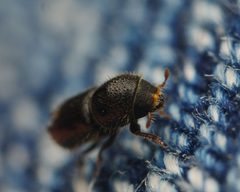
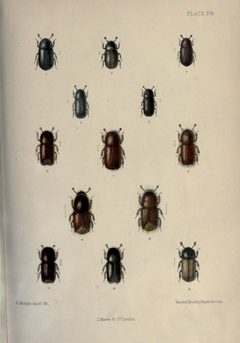
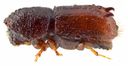
Pityogenes bidentatus is a European bark beetle that colonizes Scots pine (Pinus sylvestris). The exhibits sophisticated olfactory-mediated for location, including attraction to components (grandisol and cis-verbenol) and active avoidance of nonhost volatiles. Its behavioral response to monoterpene odors is context-dependent: avoidance occurs during but not during , likely representing distinct sensory mechanisms for long-range host discrimination versus short-range gallery establishment.
Pronunciation
How to pronounce Pityogenes bidentatus: /ˌpɪtiˈɒdʒɪniːz bɪˈdɛntətəs/
These audio files are automatically generated. While they are not always 100% accurate, they are a good starting point.
Images
Habitat
Mixed conifer and deciduous forests; specifically associated with Scots pine stands
Distribution
Native to Europe; recorded from northern Europe including the Czech Republic; GBIF records indicate presence in Europe, Africa, and North America though native range is European
Host Associations
- Pinus sylvestris - primary Suitable for feeding and
- Picea abies - marginal nonhostSupports marginal laboratory ; avoided in field
- Sorbus aucuparia - nonhostVolatiles reduce attraction
- Quercus robur - nonhostVolatiles reduce attraction
- Frangula alnus - nonhostVolatiles reduce attraction
- Vaccinium myrtillus - nonhostVolatiles reduce attraction
- Rubus idaeus - nonhostVolatiles reduce attraction
- Deschampsia flexuosa - nonhostVolatiles reduce attraction
Behavior
When flying toward , both sexes avoid conifer monoterpene odors at natural release rates; this avoidance is absent when in laboratory assays. Attraction to aggregation pheromone components grandisol and cis-verbenol is significantly reduced by volatiles from nonhost plants including mountain ash, oak, alder buckthorn, blueberry, raspberry, and grass. Electroantennographic responses have been documented to 1-octene-3-ol and β-caryophyllene from nonhost odors.
Sources and further reading
- BugGuide
- GBIF taxonomy match
- iNaturalist taxon
- NCBI Taxonomy
- Catalogue of Life
- Avoidance of nonhost plants by a bark beetle, Pityogenes bidentatus , in a forest of odors
- Bark Beetles,Pityogenes bidentatus, Orienting to Aggregation Pheromone Avoid Conifer Monoterpene Odors When Flying but Not When Walking
- A Population Genetic Model of Evolution of Host-Mate Attraction and Nonhost Repulsion in a Bark BeetlePityogenes bidentatus
- Bursaphelenchus pinophilus Brzeski & Baujard, 1997 (Nematoda: Parasitaphelenchinae) associated with nematangia on Pityogenes bidentatus (Herbst, 1783) (Coleoptera: Scolytinae), from the Czech Republic