
Polydrusus
Germar, 1817
Species Guides
7- Polydrusus americanus(American broad-nosed weevil)
- Polydrusus cervinus(Deer Broad-nosed Weevil)
- Polydrusus formosus(Green Immigrant Leaf Weevil)
- Polydrusus hassayampus
- Polydrusus impressifrons(Pale Green Weevil)
- Polydrusus ochreus
- Polydrusus unnamed
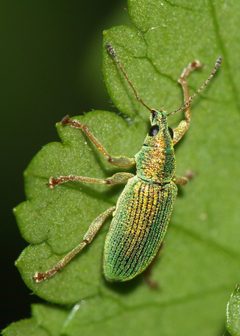
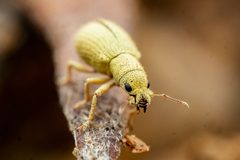
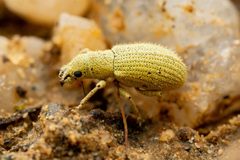
Polydrusus is a of weevils in the Curculionidae, Entiminae, containing dozens of distributed across Europe, North America, and parts of Asia. Several species have been introduced to North America and have become established in northern hardwood forests, where some function as herbivores with documented impacts on tree crops. The genus is taxonomically complex, with multiple subgenera recognized including Conocetus and Orodrusus, and has been subject to recent revisionary work clarifying species boundaries and synonymies. Polydrusus species are frequently confused with the genus Phyllobius due to superficial morphological similarities, though they are not closely related.
Pronunciation
How to pronounce Polydrusus: /ˌpɒlɪˈdruːsəs/
These audio files are automatically generated. While they are not always 100% accurate, they are a good starting point.
Identification
Polydrusus are easily confused with Phyllobius weevils due to superficial similarities, but can be distinguished by subtle morphological characters. Males of nonnative North American species can be separated from females using specific characters described in recent taxonomic literature. Within the subgenus Orodrusus, P. davatchii exhibits strongly reduced hair brushes on tarsal segments. Species-level identification typically requires examination of genitalia and other detailed morphological features; comprehensive keys and figures are available in taxonomic revisions for regional faunas.
Images
Habitat
occur in diverse including natural forest systems, orchards, and agricultural settings. In North America, inhabit northern hardwood forests. In Iran, P. davatchii is associated with pistachio orchards. The introduced P. sparsus has been recorded from riparian and forest edge habitats in northern Spain.
Distribution
Native to the Palearctic, with highest diversity in Europe. Introduced and established in northeastern North America, where seven are recorded from the United States and Canada. Specific regional records include: central and southern Iran (P. davatchii); northern Greece (P. tibialis on peach); first Iberian Peninsula record for P. sparsus from Aragon, Spain; eastern Mediterranean region including Italy, Turkey, Greece, Jordan, and Crete for subgenus Conocetus. Chinese records from Guizhou and Hebei provinces.
Seasonality
of P. impressifrons and P. formosus in Minnesota emerge in late May and remain active until mid-July. P. davatchii is active in early spring in Iranian pistachio orchards.
Diet
herbivory on hardwood trees documented for multiple . P. sericeus feeds on aspen, birch, and maple foliage, with strong preference for birch over aspen and maple regardless of environmental conditions. P. davatchii feeds on pistachio trees. P. tibialis has been recorded infesting peach. P. impressifrons and P. formosus damage buds, foliage, and roots of hardwoods including hazelnut.
Host Associations
- Populus tremuloides - food plantaspen, consumed by P. sericeus but less preferred than birch
- Betula - food plantbirch, strongly preferred for P. sericeus
- Acer - food plantmaple, consumed by P. sericeus
- Pistacia - food plantpistachio, for P. davatchii
- Prunus persica - food plantpeach, for P. tibialis
- Corylus - food planthazelnut, for P. impressifrons and P. formosus
Life Cycle
P. davatchii produces one per year. Detailed information for most is not well documented in available sources.
Behavior
P. sericeus exhibit selection , preferentially feeding and ovipositing on birch compared to other available hosts. Visual abundance surveys indicate P. sericeus is significantly more abundant on birch than aspen in field conditions. P. davatchii adults have not been found on plants other than pistachio within their growing areas, suggesting host fidelity. Ovipositional behavior has been documented for P. sericeus in laboratory conditions.
Ecological Role
Herbivorous members of forest and orchard . in North America may displace native weevil fauna in select areas. P. davatchii functions as a pest in pistachio production systems. Elevated atmospheric CO2 has been shown to reduce female longevity and in P. sericeus, with potential long-term consequences.
Human Relevance
Several are economically significant as pests of tree crops. P. davatchii became an important pest of pistachio orchards in Iran by the early 21st century. P. tibialis has been reported infesting peaches in northern Greece. P. impressifrons and P. formosus present potential threats to the hybrid hazelnut industry in North America through damage to buds, foliage, and roots. in North America are subjects of ecological study regarding climate change responses and competitive impacts on native fauna.
Similar Taxa
- PhyllobiusFrequently confused with Polydrusus due to superficial morphological similarities, but not closely related; requires careful examination for correct identification
More Details
Taxonomic Complexity
The contains multiple subgenera including Conocetus and Orodrusus, with recent revisionary work describing new , proposing synonymies, and transferring species between subgenera. The subgenus Denticonocetus was erected to accommodate P. kahri.
Climate Change Research
P. sericeus has been studied at the Aspen Free Air CO2 Enrichment () site to assess responses to elevated atmospheric CO2 and O3, representing one of few weevil with experimental climate change impact data.
Parthenogenesis
P. davatchii is known only from females, though the specific reproductive mechanism has not been confirmed in available sources.
Sources and further reading
- BugGuide
- Wikipedia
- GBIF taxonomy match
- iNaturalist taxon
- NCBI Taxonomy
- Catalogue of Life
- Presence of Polydrusus (Polydrusus) sparsus Gyllenhal, 1834 in the Iberian Peninsula (Coleoptera: Curculionidae: Entiminae)
- A review of Conocetus Desbrochers des Loges, 1875, subgenus of Polydrusus Germar, 1817 (Coleoptera, Curculionidae, Entiminae)
- Morphological description and observations on the biology of Polydrusus davatchii (Coleoptera: Curculionidae: Entiminae), a pest of pistachio trees in Iran
- Host Breadth and Ovipositional Behavior of AdultPolydrusus sericeusandPhyllobius oblongus(Coleoptera: Curculionidae), Nonindigenous Inhabitants of Northern Hardwood Forests
- Performance of the invasive weevil Polydrusus sericeus is influenced by atmospheric CO 2 and host species
- The Polydrusus weevils (Coleoptera: Curculionidae) of the United States of America and Canada: identification and insights into the ecology of two nonnative species in hazel (Corylus spp.)
- First Report of Polydrusus tibialis Gyllenhal (Coleoptera: Curculionidae) Infesting Peaches in Northern Greece.
- The genome sequence of an Entiminae weevil, Polydrusus pterygomalis Boheman, 1840.