
Polydrusus impressifrons
Gyllenhal, 1834
Pale Green Weevil, Leaf Weevil
Polydrusus impressifrons is a small broad-nosed weevil native to Europe, introduced to North America in the early 20th century. It is on hardwood trees and has been recorded in hybrid hazelnut orchards in Minnesota, where it may damage buds, foliage, and roots. are active from late May to mid-July. The is smaller, lighter, and has a broader than the similar P. formosus.


Pronunciation
How to pronounce Polydrusus impressifrons: //ˌpɒlɪˈdruːsəs ɪmˌprɛsɪˈfrɒnz//
These audio files are automatically generated. While they are not always 100% accurate, they are a good starting point.
Identification
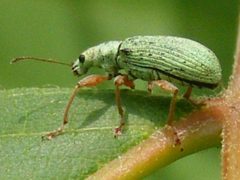
Distinguished from the similar Polydrusus formosus by being smaller, lighter in color, and having a broader . The pale green-blue coloration with linear and punctate patterning is characteristic.
Images
Appearance
are pale green-blue in color with a pattern of lines and dots on the . Body length ranges from 3.8–5.6 mm. The is broader relative to body size compared to .
Habitat
Hardwood environments; recorded in hybrid hazelnut orchards (Betulaceae) in Minnesota.
Distribution
Native to Europe; introduced to North America in the early 20th century. Recorded in the United States and Canada, including Minnesota, New Brunswick, and states in the Pacific Northwest.
Seasonality
emerge in late May and remain active until mid-July.
Diet
; feeds on buds, foliage, and roots of hardwood trees. Associated with hazel (Corylus spp.) and other fruit trees.
Host Associations
- Corylus spp. - feeds onhybrid hazelnut
- hardwoods - feeds onbuds, foliage, and roots
Ecological Role
Nonnative that may be displacing native weevil fauna in select areas of North America.
Human Relevance
Potential pest of the hybrid hazelnut industry; capable of damaging buds, foliage, and roots of orchard trees. Present in lower numbers than P. formosus in surveyed hazelnut orchards.
Similar Taxa
- Polydrusus formosusLarger, darker, with narrower ; both occur on hazelnut and may be confused without close examination.
More Details
Sex ratio
Observed sex ratios in Minnesota were generally 50–60% male.
Subspecies
Two recognized: P. i. danieli (Hoffmann, 1959) and P. i. impressifrons.
Sources and further reading
- BugGuide
- Wikipedia
- GBIF taxonomy match
- iNaturalist taxon
- NCBI Taxonomy
- Meloidae Holdings | Entomology Research Museum
- The Polydrusus weevils (Coleoptera: Curculionidae) of the United States of America and Canada: identification and insights into the ecology of two nonnative species in hazel (Corylus spp.)