
Phyllobius
Germar, 1823
Species Guides
2- Phyllobius intrusus(Arborvitae Weevil)
- Phyllobius oblongus(Brown Leaf Weevil)
Phyllobius is a of broad-nosed weevils (Curculionidae: Entiminae) containing at least 60 described , with many distributed across Europe. are primarily folivorous, feeding on leaves of broadleaved trees and occasionally causing defoliation damage in young woodlands. Larvae develop in soil, feeding on grass roots. Some species have been introduced outside their native ranges and established as nonindigenous in northern hardwood forests.
Pronunciation
How to pronounce Phyllobius: /ˈfɪloʊbiːəs/
These audio files are automatically generated. While they are not always 100% accurate, they are a good starting point.
Identification
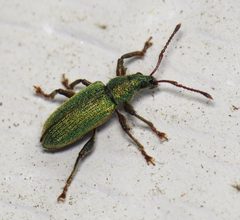
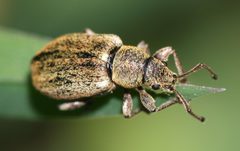
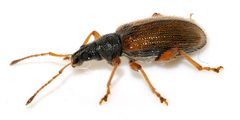
Phyllobius can be distinguished from similar broad-nosed weevils (Polydrusus, Sciaphillus) by examination of rostral and antennal characters, though species-level identification often requires detailed examination of genitalia and elytral scaling patterns. typically exhibit metallic green, blue, or coppery coloration. The is characterized by the structure of the and the insertion of the on the rostrum.
Images
Habitat
inhabit broadleaved woodlands, forest edges, and young plantations. Larval development occurs in soil, particularly in grassy areas adjacent to trees. High densities have been documented in young pine plantations with mixed grassy patches and regenerating birch, where larval food resources (grass roots) and adult host plants occur in close proximity.
Distribution
Native distribution centered in Europe; individual ranges extend from Western Europe to Western Siberia. Phyllobius cylindricollis has been recorded as far east as Altaiskii Krai. Phyllobius oblongus is established as a nonindigenous species in northern hardwood forests of North America.
Seasonality
of Phyllobius pyri emerge in May and feed for approximately 16 days before oviposition. Adult lifespan averages 33 days. hatch occurs after 16–20 days. Larval of P. piri and P. viridicollis overwinter as pupae, with densities of approximately 500 individuals per m² documented in central Sweden.
Diet
feed on leaves of broadleaved trees. Phyllobius pyri has been observed feeding on cherry, birch, oak, and hornbeam; field maple, hawthorn, rowan, lime, and ash are relatively . Phyllobius oblongus is associated with sugar maple. Phyllobius maculicornis feeds on birch (Betula pendula) and has been shown to prefer leaves with elevated condensed tannin concentrations. Larvae feed on grass roots.
Life Cycle
Holometabolous. are deposited in soil. Larvae develop underground, feeding on roots. occurs in soil; emerge in spring. Phyllobius pyri females are reproductively at and require a preoviposition feeding period on foliage.
Behavior
exhibit folivorous feeding , with documented preferences for certain plant chemistries. Phyllobius maculicornis prefers leaves grown under elevated CO₂ conditions with high condensed tannin and phenolic content, despite reduced nitrogen levels. Adults of P. pyri are active in and can be captured in traps.
Ecological Role
function as folivores in broadleaved forest , occasionally reaching densities sufficient to cause defoliation in young farm woodlands. Larvae contribute to soil as root herbivores. by Pygostylus falcatus (Braconidae) and Rondania fasciata (Tachinidae) has been documented at rates of 11–29% in P. pyri .
Human Relevance
Some cause economically significant defoliation in newly established farm woodlands and young plantations. Phyllobius oblongus is recognized as an in North American northern hardwood forests, where it affects sugar maple .
Similar Taxa
- PolydrususSimilar broad-nosed weevil with metallic coloration; distinguished by rostral and antennal characters
- Sciaphillus asperatusCo-occurs with Phyllobius oblongus on sugar maple; broader range and different morphological features distinguish the two
More Details
Population dynamics
Larval production of P. piri in abandoned fields has been quantified at 4.6 ± 1.9 g dry weight per m², with hibernating pupal of approximately 500 individuals per m² sustained over multiple years.
Climate response
Feeding of P. maculicornis is influenced by plant chemistry modified under elevated CO₂ and temperature conditions, though temperature effects alone on feeding performance were not clearly demonstrated.
Sources and further reading
- BugGuide
- Wikipedia
- iNaturalist taxon
- NCBI Taxonomy
- Catalogue of Life
- Production of Larvae of Phyllobius piri L. (Col. Curculionidae) in an Abandoned Field
- First record of Phyllobius cylindricollis Gyllenhal, 1834 (Coleoptera, Curculionidae) from Altaiskii Krai, Western Siberia (Russia)
- Phyllobius oblongus and Sciaphillus asperatus Associated with Sugar Maple Reproduction in Northern Michigan 123
- Host Plant Phenology Affects Performance of an Invasive Weevil,Phyllobius oblongus(Coleoptera: Curculionidae), in a Northern Hardwood Forest
- Host Breadth and Ovipositional Behavior of AdultPolydrusus sericeusandPhyllobius oblongus(Coleoptera: Curculionidae), Nonindigenous Inhabitants of Northern Hardwood Forests
- Adult fecundity, host plant preferences, field activity and parasitism in the leaf weevilPhyllobius pyri(L.) (Coleoptera: Curculionidae)
- Effects of elevated CO 2 and temperature on the leaf chemistry of birch Betula pendula (Roth) and the feeding behaviour of the weevil Phyllobius maculicornis