
Naupactini
Gistel, 1856
broad-nosed weevils
Genus Guides
10- Aramigus
- Artipus(broad-nosed weevils)
- Atrichonotus
- Ericydeus(broad-nosed weevils)
- Glaphyrometopus
- Mesagroicus
- Naupactus(White-fringed Weevils)
- Pactorrhinus
- Phacepholis
Naupactini is a diverse tribe of broad-nosed weevils ( Entiminae) with highest and in South America. Members range from 3.5 to 35 mm and exhibit diverse coloration including iridescent . The tribe is notable for frequent flightlessness and in with sparse vegetation, with parthenogenesis linked to bacterial . Several are agricultural pests, particularly on Fabaceae.
Pronunciation
How to pronounce Naupactini: /naʊˈpæktɪnaɪ/
These audio files are automatically generated. While they are not always 100% accurate, they are a good starting point.
Identification
Broad-nosed weevils with highly variable coloration; iridescent scaling distinguishes many from related entimine groups. Flightlessness and are common in lineages from open , though these are not visible diagnostic traits. Distinguished from Geonemini by tribal characters including genitalic and mouthpart (Artipus was transferred to Geonemini based on such characters).
Images
Appearance
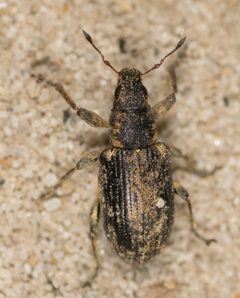
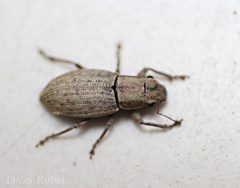
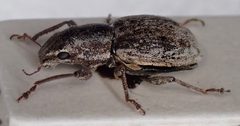
Size ranges from 3.5 to 35 mm in length. Color patterns are highly diverse: many possess colorful iridescent in blue, green, or gold; others have opaque scales or setae; some are subglabrous. Flightlessness occurs frequently in certain .
Habitat
Occurs across diverse Neotropical environments including forests, open vegetation, and areas with sparse vegetation or tree absence. In open with reduced vegetation, flightlessness and are frequently observed.
Distribution
Primarily with highest diversity in South America. Biogeographic analysis identifies 11 generalized tracks corresponding to: Northern Venezuelan, Galápagos Islands, Ecuadorian, Yungas, Cerrado, Caatinga, Puna+Pacific coastal deserts, Chacoan, Atlantic+Parana forests, Monte, and Pampean regions. Distribution spans both north-western and south-eastern South American components separated by the Andes.
Diet
Larvae are ectophytic, living in soil and feeding externally on roots of plants. are but many show preference for Fabaceae; capable of feeding on diverse plant materials.
Host Associations
- Fabaceae - preferred for many primary plant association documented in literature
- Wolbachia pipientis - intracellular endosymbiontinduces ; strain wNau1 most common; horizontal transfer occurs between unrelated
- WO phage - carried by wNau1 strain
Life Cycle
Females lay in batches between adjoining surfaces such as fallen leaves in litter, soil cracks, and crevices in tree trunks or fruit calices; eggs covered with adhesive substance. Larvae live in soil and feed ectophytically on roots. Developmental details beyond larval are not specified in available sources.
Behavior
Flightlessness is frequent in lineages from with sparse vegetation or tree absence. occurs in many , particularly in open habitats; this trait is -dependent on levels.
Ecological Role
Root-feeding larvae impact plant through belowground herbivory. Several function as agricultural pests in native and introduced ranges.
Human Relevance
Several are agricultural pests of major phytosanitary importance in crops, leading to development of using parasitic . Some species have been introduced to new regions through human activities.
Similar Taxa
- GeoneminiArtipus was transferred from Naupactini to Geonemini based on morphological characters; careful examination of tribal characters required for proper assignment
- other Entiminae tribesbroad-nosed weevil tribes share general body form; Naupactini distinguished by combination of South American dominance, -associated , and specific genitalic
More Details
Taxonomic instability
Mimographus, Hoplopactus, and Naupactus are not monophyletic per Lanteri (2017). Genera Mimographopsis and Floresianus require resurrection as extant genera.
Wolbachia threshold hypothesis
expression requires threshold of bacteria; bisexual carry wNau1 strain at sub-threshold loads. with other bacteria may prevent parthenogenesis in some infected individuals.
Reproductive mode geography
Association between open , flightlessness, and suggests environmental drivers of evolution.
Sources and further reading
- BugGuide
- Wikipedia
- iNaturalist taxon
- NCBI Taxonomy
- Catalogue of Life
- Evolutionary biogeography of South American weevils of the tribe Naupactini (Coleoptera: Curculionidae)
- Parthenogenesis in weevils of the tribe Naupactini (Coleoptera, Curculionidae): a Wolbachia -density dependent trait?
- New synonymies, new combinations and lectotype designations for weevils in the tribe Naupactini (Coleoptera: Curculionidae: Entiminae)