
Isochnus sequensi
(Stierlin, 1894)
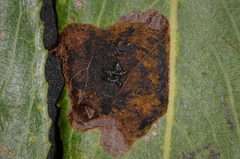
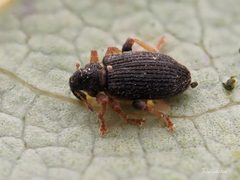
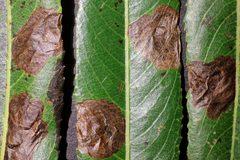
Isochnus sequensi is a -weevil (Curculionidae: Rhamphini) that creates leaf mines on Salix fragilis (crack willow). The has been documented as a for multiple eulophid in northwestern Russia. It belongs to a of small weevils associated with willow and poplar species.
Pronunciation
How to pronounce Isochnus sequensi: /ˈaɪsɒknəs sɛˈkwɛnsi/
These audio files are automatically generated. While they are not always 100% accurate, they are a good starting point.
Identification
As a member of the -weevil tribe Rhamphini, this likely possesses enlarged hind adapted for jumping. Definitive identification requires examination of genitalia and other microscopic features; leaf mines on Salix fragilis in combination with may support identification in its known range.
Images
Habitat
Associated with Salix fragilis (crack willow), where larvae develop within leaf mines. The Saint Petersburg study site indicates of temperate, continental conditions with human-modified landscapes.
Distribution
Recorded from Belgium (multiple occurrences), New Brunswick (Canada), and the environs of Saint Petersburg, Russia. The Russian has been studied in detail; broader Palearctic and Nearctic distribution likely but not confirmed by available sources.
Diet
Larvae feed internally on leaf tissue of Salix fragilis, creating mines. feeding habits not documented in available sources.
Host Associations
- Salix fragilis L. - plantcrack willow; sole documented for leaf mining
- Cirrospilus pictus - Eulophidae: Eulophinae
- Cirrospilus diallus - Eulophidae: Eulophinae
- Minotetrastichus frontalis - Eulophidae: Tetrastichinae
- Chrysocharis nephereus - Eulophidae: Entedoninae
Life Cycle
Larval development occurs within leaf mines on Salix fragilis. emerge from these mines. Specific details on placement, location, voltinism, and stage not documented in available sources.
Behavior
Larvae are leaf miners, feeding between the upper and lower of willow leaves. This concealed feeding strategy provides protection from and desiccation.
Ecological Role
Functions as a herbivore on Salix fragilis. Serves as for at least four of eulophid , contributing to local parasitoid structure.
Similar Taxa
- Other Isochnus speciescongeneric weevils also associated with Salix and Populus; require morphological examination for separation
- Other Rhamphini leaf miners on Salixsimilar leaf mine and use; identification necessary for -level determination
More Details
Parasitoid community
The Saint Petersburg supports a diverse spanning three of Eulophidae, suggesting this weevil may be a significant for chalcid in willow .
Taxonomic note
Described by Stierlin in 1894; the specific epithet 'sequensi' refers to the type locality (Sequen, now Šakiai, Lithuania).