
Triplax
Herbst, 1793
pleasing fungus beetles
Species Guides
15- Triplax alachuae
- Triplax californica
- Triplax cuneata
- Triplax dissimulator(pleasing fungus beetle)
- Triplax errans(Red-winged Triplax)
- Triplax festiva(pleasing fungus beetle)
- Triplax flavicollis(pleasing fungus beetle)
- Triplax frontalis(Black-headed pleasing fungus beetle)
- Triplax frosti(pleasing fungus beetle)
Triplax is a of pleasing fungus beetles in the Erotylidae, containing approximately 50 described distributed across North America, Europe, and East Asia. Members are small beetles (typically 3–6 mm) strongly associated with fungi, particularly mushrooms. Some species are significant pests of cultivated oyster mushrooms. The genus is taxonomically placed in tribe Tritomini within Erotylinae.

Pronunciation
How to pronounce Triplax: /ˈtrɪplaks/
These audio files are automatically generated. While they are not always 100% accurate, they are a good starting point.
Identification
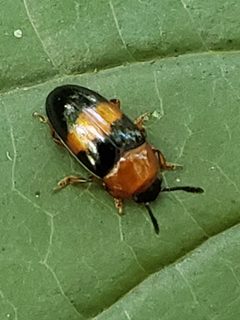
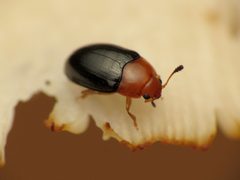
Small, oval to elongate-oval beetles, 3–6 mm in length. Body typically shiny black or dark with contrasting orange, red, or yellow markings on the or pronotum. short with weakly clubbed tips. Distinguished from other Erotylidae by the combination of small size, compact body form, and specific antennal . Some show distinctive color patterns: T. thoracica has an orange underside, while related species may have dusky or black surfaces.
Images
Habitat
Strongly associated with fungal fruiting bodies, particularly mushrooms. Found on decaying wood with fungal growth, on living trees with bracket fungi, and in cultivated mushroom environments. In natural settings, occurs in forests and wooded areas where fungi are present.
Distribution
Widely distributed across temperate regions: North America (eastern half of U.S. and adjacent Canada), Europe, and East Asia (China, Korea, Japan). Specific collection records include Denmark, Norway, Sweden, and Guizhou Province, China.
Seasonality
Active during autumn when fungal fruiting bodies are abundant. observed flying to mushroom clusters and aggregating on fruiting bodies.
Diet
Fungivorous. and larvae feed on fruiting bodies of mushrooms, particularly Pleurotus (oyster mushrooms). T. ainonia is a documented pest of cultivated Pleurotus ostreatus in China.
Host Associations
- Pleurotus ostreatus - food sourceoyster mushroom; cultivated and wild
- Pleurotus - food source of oyster mushrooms; primary for T. thoracica
Life Cycle
Larvae and both feed on fungal fruiting bodies. Specific details of -laying, larval instars, and sites are not well documented for most .
Behavior
aggregate on mushroom fruiting bodies in large numbers. Strong capability allows rapid location of ephemeral fungal resources. Males have been observed forming 'love trains' following females on mushroom surfaces. Some individuals carry phoretic mites (order Mesostigmata) that use the beetles for transport between fungal patches.
Ecological Role
Primary consumer of fungal tissues; contributes to nutrient cycling in forest . Serves as prey for predatory beetles including rove beetles (Staphylinidae) such as Philonthus caeruleipennis and Platydracus maculosus. Acts as transport for phoretic mites.
Human Relevance
T. ainonia is a serious pest of cultivated oyster mushroom production in China, with both and larvae damaging marketable fruit bodies. Other may occasionally infest cultivated mushrooms. Generally harmless to humans; no known venom or defensive compounds.
Similar Taxa
- Other Erotylidae genera (Tritomini)Similar body form and ; distinguished by antennal structure, specific color patterns, and subtle morphological details of the pronotum and .
- Endomychidae (handsome fungus beetles)Also fungivorous and found on mushrooms; typically have different body proportions, more rounded , and distinct antennal club structure.
- Mycetophagidae (hairy fungus beetles)Share fungal ; distinguished by hairy or setose body surface and different antennal .
More Details
Mitochondrial genome
The first complete mitochondrial for the was sequenced for T. ainonia (17,555 , AT-biased), supporting the monophyly of Erotylidae.
Chemoreception
Antennal studies indicate specialized for detecting fungal volatiles, facilitating location of ephemeral mushroom resources.
Sources and further reading
- BugGuide
- Wikipedia
- GBIF taxonomy match
- iNaturalist taxon
- NCBI Taxonomy
- Catalogue of Life
- Bug Eric: Fungus Party-y-y!
- Bug Eric: 2022
- Functional morphology of antennae and sensilla of the fungivore beetle, Triplax ainonia Lewis (Coleoptera: Erotylidae).
- The complete mitochondrial genome of Triplax ainonia Lewis, 1877 (Coleoptera: Erotylidae).