
Triplax thoracica
Say, 1825
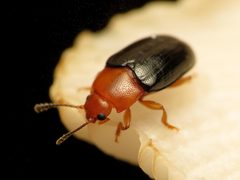
Triplax thoracica is a small pleasing fungus beetle in the Erotylidae, measuring 3–5.6 mm in length. The is strongly associated with oyster mushrooms ( Pleurotus) and has been documented occurring in dense on fruiting bodies. It occurs across the eastern half of the United States and adjacent Canada.
Pronunciation
How to pronounce Triplax thoracica: /ˈtrɪplæks θɔˈræsɪkə/
These audio files are automatically generated. While they are not always 100% accurate, they are a good starting point.
Identification
Distinguished from other Triplax by the orange coloration, though some individuals may show dusky or black bellies. The species' strong association with oyster mushrooms (Pleurotus) provides a clue. At 3–5.6 mm, it is smaller than many other fungus-associated beetles. Definitive identification may require examination of genitalia or other microscopic features.
Images
Appearance
Small , 3–5.6 mm in length. The surface is typically dark with the surface orange; some individuals may have a dusky or black belly instead of orange. As a member of Erotylidae, the body is likely somewhat flattened and oval in outline, though specific morphological details are not well documented in available sources.
Habitat
Strongly associated with fruiting bodies of oyster mushrooms (Pleurotus spp.), typically found at the base of trees. Occurs in forested or wooded areas where fungi are present.
Distribution
Eastern half of the United States and adjacent Canada. Documented from Alberta, Manitoba, and New Brunswick in Canada.
Seasonality
Active during autumn; observed in mid-September in Kansas. Likely associated with the fruiting period of mushrooms.
Diet
Feeds on oyster mushrooms (Pleurotus spp.).
Host Associations
- Pleurotus - feeds onStrongly associated with fruiting bodies, particularly oyster mushrooms
Behavior
Forms dense on mushroom fruiting bodies. fly actively to and from fungi. Males have been observed forming 'love trains' following females on mushroom surfaces. Some individuals carry phoretic mites (order Mesostigmata), which use the beetles for transport to locations where they can feed on insect or other small prey.
Ecological Role
Primary consumer of fungal tissue. Serves as prey for predatory beetles including rove beetles (Staphylinidae) such as Philonthus caeruleipennis and Platydracus maculosus. Acts as transport for phoretic mites.
Human Relevance
Occasionally a nuisance in cultivated oyster mushroom operations. Has no documented economic importance otherwise.
Similar Taxa
- Other Triplax speciesSimilar size and ; distinguished by coloration and possibly genitalia
- Other ErotylidaeShare characteristics; specific identification requires detailed examination
More Details
Associated community
At a Kansas site, T. thoracica was found in a diverse including predatory rove beetles (Philonthus caeruleipennis, Platydracus maculosus), pomace flies (Drosophilidae), and ants (Aphaenogaster tennesseensis). The beetles also carried phoretic mites.