
Platydracus maculosus
(Gravenhorst, 1802)
Brown Rove Beetle
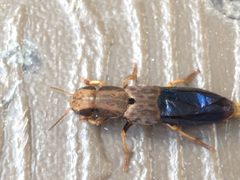
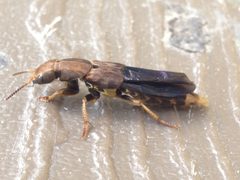
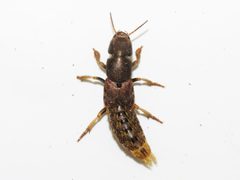
Platydracus maculosus is a large rove beetle in the Staphylinidae, commonly known as the Brown Rove Beetle. It is among the largest members of its family in North America, measuring 22-35 millimeters in length. The is a predatory insect attracted to decomposing organic matter and fungi, where it hunts other insects. It has been documented across eastern North America and is recognized as a significant presence in contexts due to its attraction to carrion.
Pronunciation
How to pronounce Platydracus maculosus: /ˌplætɪˈdrækəs ˌmækjəˈloʊsəs/
These audio files are automatically generated. While they are not always 100% accurate, they are a good starting point.
Identification
Distinguished from other rove beetles by its substantial size (22-35 mm), which dwarfs most other staphylinids. The short exposing the long is characteristic of the Staphylinidae. It can be separated from the similar Philonthus caeruleipennis by its larger size and lack of metallic blue-green coloration on the elytra. The Platydracus includes many of the larger rove beetles in North America, and P. maculosus is among the largest.
Images
Appearance
Large, elongated rove beetle with very short forewings () that leave most of the exposed. Body length ranges from 22-35 millimeters, making it one of the largest North American staphylinids. The elytra are brown with darker markings, and the overall coloration is predominantly brown. Like other rove beetles, it has a flexible abdomen and can move rapidly when disturbed.
Habitat
Found in association with decomposing organic matter, including carrion, rotting fungi, and decaying wood. Has been observed on oyster mushrooms (Pleurotus spp.) and in moist, disturbed . Occurs in both natural and human-modified environments.
Distribution
Eastern North America, with records from Canada (Ontario, Quebec) and the United States (Alabama, Arkansas, Connecticut, Delaware, Florida, Georgia, Iowa, Illinois, Indiana, Kansas, Kentucky, Louisiana, Massachusetts, Maryland, Maine, Michigan, Minnesota, Missouri, Mississippi, North Carolina, Nebraska, New Hampshire, New Jersey, New York, Ohio, Oklahoma, Pennsylvania, Rhode Island, South Carolina, South Dakota, Tennessee, Texas, Virginia, Vermont, Wisconsin, West Virginia).
Diet
Predatory on other insects. Has been observed preying on pleasing fungus beetles (Triplax thoracica) and likely feeds on various insects associated with decomposing matter and fungi.
Behavior
An active that moves quickly through decomposing substrates. When disturbed, can flex the forward in a -like manner and may open its defensively. Capable of . Attracted to concentrations of insects on decomposing matter, where it hunts prey.
Ecological Role
in decomposer , regulating of fungus-feeding and detritivorous insects. Contributes to nutrient cycling through its presence in decomposition . Documented as a forensic due to its attraction to carrion.
Human Relevance
Of interest in as a attracted to human and animal remains. Occasionally encountered in domestic settings when attracted to decomposing organic matter. Not considered a pest; beneficial as a of other insects.
Similar Taxa
- Philonthus caeruleipennisSimilar large rove beetle habit and , but distinguished by metallic blue-green and smaller size (12-15 mm versus 22-35 mm for P. maculosus)
- Tasgius winkleriAnother large rove beetle that was historically confused with Platydracus ; European native expanding in North America, distinguished by subtle morphological characters including setal patterns
More Details
Forensic significance
Documented as a common visitor to scenes of death and decomposition, making it relevant to investigations
Historical taxonomy
The Platydracus has historically included many of the largest rove beetles in North America, though some have been reassigned to other genera such as Tasgius