
Platydracus
Thomson, C. G., 1858
Species Guides
22- Platydracus caliginosus
- Platydracus centralis
- Platydracus cinnamopterus(Cinnamon-winged Rove Beetle)
- Platydracus exulans
- Platydracus femoratus
- Platydracus fossator(Red-spotted Rove Beetle)
- Platydracus immaculatus(Immaculate Rove Beetle)
- Platydracus maculosus(Brown Rove Beetle)
- Platydracus mysticus(Mystic Rove Beetle)
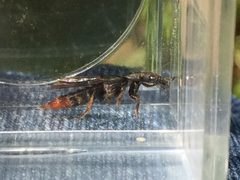
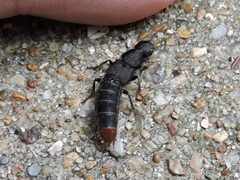
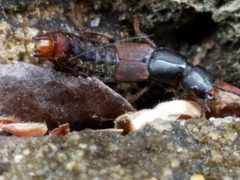
Platydracus is a of large rove beetles in the Staphylinidae, containing more than 280 described worldwide. Species were formerly classified in the genus Staphylinus. The genus includes some of the largest rove beetles, with reaching 22–35 mm in body length. Members are predatory and associated with decaying organic matter including fungi, carrion, and rotting wood.
Pronunciation
How to pronounce Platydracus: //ˈplætɪˌdrækəs//
These audio files are automatically generated. While they are not always 100% accurate, they are a good starting point.
Identification
Distinguished from other large staphylinid by combination of large body size, short , and specific chaetotaxy (arrangement of setae) visible under magnification. Separated from the closely related genus Staphylinus by larval morphological characters including specific combinations of setal patterns and body proportions. may be confused with other large rove beetles such as Tasgius, but Platydracus generally lack the expanded front seen in male Tasgius. Identification to species level requires examination of microscopic characters including genitalia and setal patterns.
Images
Appearance
Large rove beetles with elongated, slender bodies typical of Staphylinidae. Very short forewings () leave most of the exposed. Size ranges from moderately large to among the largest staphylinids; Platydracus maculosus measures 22–35 mm. Coloration varies by , often with dark bodies and contrasting patterns. Some species exhibit metallic blue-green or other iridescent coloration on elytra. Abdomen is flexible and can be curved forward. are thread-like and prominent.
Habitat
Found in moist, decaying organic substrates including rotting wood, leaf litter, and decomposing fungi. In Hainan, China, collected from rainforest, broad-leaved forest, and mixed forest at elevations of 700–1100 m, specifically in decaying logs and leaf litter. The brachycerus group is likely associated with colonies. Some species are and occur in human-disturbed .
Distribution
Worldwide distribution with highest diversity in Asia. Documented from North America (including Vermont, USA), Europe (Denmark, Norway, Sweden), South America (Colombia: Parque Nacional Natural Serranía de Chiribiquete), and across Asia including China (Zhejiang, Anhui, Hunan, Guangxi, Yunnan, Hainan, Fujian, Guangdong, Jiangxi, Taiwan), Myanmar, Vietnam, and Indonesia.
Diet
Predatory on other insects and . Platydracus maculosus has been observed preying on fungus beetles (Triplax thoracica) at mushroom clusters. General feeding habits likely include other soft-bodied insects encountered in decaying organic matter .
Life Cycle
Complete with , larva, pupa, and stages. Mature larvae described for some ; larval includes diagnostic characters distinguishing Platydracus from related . Specific data under natural conditions are poorly documented for most species.
Behavior
are fast-moving and secretive, typically hiding in crevices or under objects during the day. When disturbed, they may curve the forward in a -like posture and some can secrete defensive substances. Attracted to decomposing organic matter where they hunt prey. Some species are attracted to light.
Ecological Role
in decomposer , regulating of other insects in rotting wood, fungi, and carrion. The brachycerus group may have specialized ecological relationships with colonies. Contribute to nutrient cycling through their association with decay processes.
Human Relevance
Occasionally encountered by entomologists and naturalists when investigating decaying wood, fungi, or compost. Some are large and conspicuous enough to attract attention. No significant economic impact documented; likely beneficial as of potential pest insects in decaying organic matter.
Similar Taxa
- TasgiusLarge rove beetles with similar body form; male Tasgius have dilated front not seen in Platydracus
- StaphylinusFormerly included many Platydracus ; distinguished by larval morphological characters and chaetotaxy
- PhilonthusSimilar elongate rove beetle form, but generally smaller and with different ecological associations
More Details
Taxonomic History
now placed in Platydracus were formerly classified in the Staphylinus. The generic status of Platydracus has been confirmed through comparative larval studies.
Species Diversity
Over 280 described worldwide, with ongoing taxonomic work describing new species, particularly from China. Recent studies have described three new species from Hainan Province, China, and three new species in the brachycerus group from mainland China.
Forensic Relevance
Platydracus maculosus has been documented as attracted to scenes of decomposition, indicating potential applications.
Sources and further reading
- BugGuide
- Wikipedia
- GBIF taxonomy match
- iNaturalist taxon
- NCBI Taxonomy
- Catalogue of Life
- Bug Eric: A "New" Beetle in Colorado
- Bug Eric: Fungus Party-y-y!
- The Flies and Beetles That Turn Death Into Dinner
- Bug Eric: May 2015
- Bug Eric: 2022
- rove beetle - Entomology Today
- A taxonomic study of the Platydracus brachycerus group with descriptions of three new species from China (Coleoptera: Staphylinidae, Staphylininae)
- Comparative larval morphology of Platydracus and Staphylinus (Staphylinidae: Staphylinini: Staphylinina) with notes on their biology and redescription of the pupa of Staphylinus
- The genus Platydracus Thomson in Hainan, South China (Coleoptera, Staphylinidae, Staphylininae).