
Tasgius winkleri
(Bernhauer, 1906)
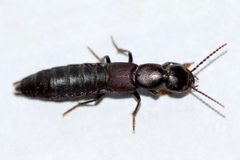
Tasgius winkleri is a rove beetle ( Staphylinidae) native to Europe that has become established in North America. First reported in New York in 1938, it has since spread to both coasts and westward to Illinois and Colorado. This thrives in human-disturbed and is seldom found far from human activity. Males can be distinguished by their dilated front (expanded 'feet'). The species was previously confused with T. melanarius under the name Tasgius globulifer until taxonomic revision in 1987.
Pronunciation
How to pronounce Tasgius winkleri: //ˈtæsk.i.əs ˈwɪŋ.klɛri//
These audio files are automatically generated. While they are not always 100% accurate, they are a good starting point.
Identification
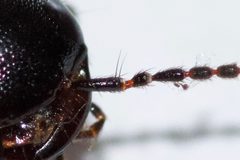
Identification to level typically requires examination of minute characters such as length and placement of setae (hairs). However, T. winkleri has been identified from images by experts familiar with European staphylinid fauna. Males are readily distinguished from females by their expanded front . Distinguished from the similar T. melanarius by subtle morphological characters clarified in 1987 taxonomic revision. Previously confused with T. melanarius under the name Tasgius globulifer.
Images
Appearance
A relatively large rove beetle measuring approximately 10-12 mm in body length. Males possess distinctly dilated front (expanded 'feet'), a sexually dimorphic character. Like other staphylinids, it has short that leave most of the exposed, and the typical elongated, somewhat flattened body form characteristic of rove beetles.
Habitat
; found in human-disturbed . Occurs under stones and boards, in leaf litter, at edges of wetlands, and in moist . Associated with gardens, neighborhood parks, and similar urban or suburban environments. Seldom found far from human habitation.
Distribution
Native to Europe (Austria, Belgium, Croatia, Czech Republic, Germany, Finland, France, Great Britain, Georgia, Greece, Hungary, Italy, Lithuania, Luxembourg, Moldova, Netherlands, Poland, Portugal, Romania, Slovakia, Sweden, Switzerland, United Kingdom, Yugoslavia), Turkey, Armenia, Lebanon, Madeira, and possibly Iran. Introduced and established in North America: first reported in New York (1938), subsequently recorded in New Hampshire, Pennsylvania, Michigan, Illinois, Washington, Oregon, California, Connecticut, Massachusetts, New Jersey, Rhode Island, Virginia; and in Canada (Ontario, British Columbia). Range expanding westward; documented in Colorado by 2015.
Behavior
When disturbed or threatened, may secrete foul substances or odors in self-defense. One observer reported defensive involving lifting the in a -like fashion and opening the . Rapid movement typical of rove beetles.
Ecological Role
of other insects. As with other rove beetles, likely contributes to control of small in its .
Human Relevance
Beneficial ; not destructive. Occasionally encountered indoors. Not considered a pest; no control measures recommended. association with human-disturbed environments.
Similar Taxa
- Tasgius melanariusPreviously confused under the name Tasgius globulifer; distinguished by subtle morphological characters including setal patterns
- Platydracus speciesSimilar large size and general appearance; T. winkleri distinguished by specific characters and male dilated
More Details
Taxonomic History
Before 1987, this was known as Tasgius globulifer, which included both T. winkleri and T. melanarius. The splitting of this resulted from recognition of overlooked character differences by alert taxonomists.
Range Expansion
Alfred Newton noted in 2015 that T. winkleri appeared on both east and west coasts of North America about 90 years prior (~1925), had spread westward as far as Illinois, but was not previously known from anywhere near Colorado, indicating active range expansion.