
Harmonia dimidiata
(Fabricius, 1781)
Greater Asian Lady Beetle
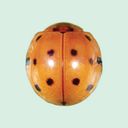
Harmonia dimidiata is a medium to large ladybird beetle (7.4–10 mm) native to southern Asia with introduced in North America. display reddish-yellow with black markings in a thirteen-spot pattern. The is a voracious with documented prey including Rhopalosiphum maidis, Aphis gossypii, Myzus persicae, and Aphis pomi. Temperature strongly influences its development, , and predatory capacity, with optimal performance at 24°C. Males produce yellow reflex blood containing harmonine as both chemical defense and during courtship.
Pronunciation
How to pronounce Harmonia dimidiata: /hɑrˈmoʊniə dɪmɪˈdiːɑtə/
These audio files are automatically generated. While they are not always 100% accurate, they are a good starting point.
Images
Habitat
Hill zones, terai zones, and old alluvial zones; recorded from open forests, agricultural fields, orchards (guava, mango, apple), tea gardens, and roadside vegetation. Elevation range 15–2200 m. Associated with oak, pine, banyan, jackfruit, rose, and various crop plants.
Distribution
Native to southern Asia: India (West Bengal, Kashmir to Assam, Himalayas), Pakistan, Bhutan, Nepal, China, Taiwan, Japan, Vietnam. Introduced to North America (conterminous United States) and far Eastern Russia. In Pakistan reported from Malakand, Swat, Murree, Peshawar, Islamabad, and Rawalakot. In West Bengal specifically recorded from Northern Hill Zone, Teesta-Terai Alluvial Zone, Old Alluvial Zone, and New Alluvial Zone; absent from Red and Laterite Zone and Coastal Saline Zone.
Diet
; feeds on aphids. Documented prey: Rhopalosiphum maidis on maize, Aphis gossypii on guava, Myzus persicae, Aphis pomi on apple, Schizaphis graminum, Aphis fabae, Acyrthosiphon pisum, Lipaphis erysimi, and Ceravaphis quercus on oak.
Life Cycle
Multivoltine. to : 19–43 days depending on temperature (43 days at 16°C, 22 days at 25°C, 19 days at 32°C). Four larval instars before . Egg incubation: 3–9 days. Larval duration: 11–23 days. Pupal duration: 4–9 days. One takes 22 days at 25°C or 35 days at 20°C. Maximum 657 eggs per female at 24°C; no egg production at 32°C.
Behavior
Highly voracious at all life stages; fourth instar larvae consume more aphids than the other three larval instars combined. Rapid response to prey availability. Male courtship involves secretion of yellow reflex blood from tibio-femoral joints of hind-legs; this blood contains the alkaloid harmonine and functions as both chemical defense and edible . Amount of reflex blood offered decreases with each subsequent mating. Mating duration is prolonged and initially increases before decreasing with subsequent matings.
Ecological Role
Significant of aphids in agroecosystems; considered an important biocontrol agent against economically important crop pests. Potential for commercial biocontrol operations, particularly in programs.
Human Relevance
Valued as agent for management in agricultural systems including maize, guava, apple, and other crops. Laboratory mass rearing protocols have been developed for commercial application.
Sources and further reading
- BugGuide
- Wikipedia
- GBIF taxonomy match
- iNaturalist taxon
- NCBI Taxonomy
- Pyromorpha dimidiata | Beetles In The Bush
- Mating behaviour of the predaceous ladybird, Harmonia dimidiata
- Occurrence, distribution and description of Harmonia dimidiata (Fabricius), a predacious Coccinellid from West Bengal, India
- Effect of Temperature on the Biology and Predatory Potential, of Harmonia Dimidiata (Fab.) (Coleoptera: Coccinellidae) Feeding on Myzus Persicae (Sulzer) (Hemiptera: Aphididae) Aphid
- Studies on the Biology and Predatory Potential of <i>Harmonia dimidiata</i>, a Major Predator of <i>Aphis pomi</i> De Geer on Apple Host in India